I was hired at a job the very same day Google released their first Panda update[0]. This was the update that nuked all content farmers from search results. It was complete chaos, I sat in an empty cubicle, not knowing if I should stay or leave while the manager cursed and paced. Our ad revenue went from millions to zero, overnight. Unfortunately, they figured out a trick to game google. Which I guess meant I remained employed.
You could make the tackiest, most commercial and derivative musical, but it's still not content because it's just one.
You could make the most eloquent, poetic and inventive podcast in the world, but so long as you are still doing weekly releases (with ads, plus an ad free patreon, of course) it is content.
The tragedy is that we want artists to have reliable income, but the business models, incentives and consumption habits that come with the reliable output to provide that reliable income lead us to the ugliness that people blame on "content".
I don't think a content creator would naturally describe themselves as a content creator. The word is useful for contexts where you need to generalize over all the different types, but that's not useful when speaking about yourself. So a writer says "I'm a writer", not "I'm a content creator." But writing this paragraph, I needed a word to generalize.
P.S. The closest alternative word might be artist, but it's not quite right--some writers are artists and some aren't.
--
I could not resist playing this game of words...
And this isn't to say that "content creation" is any less valid than "creating art". There are plenty of "content creators" who know exactly what they are making at the end of the day (a product) and don't hide that fact or try to dress it up under the pretense of being anything more.
You could make a plausible conspiracy theory that this was why so much capital was invested to develop generative AI: Maybe the holy grail of tech CEOs wasn't AGI, it was a web full of content without those annoying content creators...
The alternative is "art" but that comes with a lot of other baggage that often sounds unintentionally pretentious, especially if you aren't actually creating paintings/sculptures/traditional/contemporary studio art. The word creative used to serve a similar purpose, but nowadays I think it sounds both blasé and pretentious.
Yes, content does come with an expectation that you're creating things for an commercial audience; however, I think content is tied to media, and not merely any sort of created object. And so by extension you are participating in the global media sphere by making content, and not just painting for your own enjoyment.
It’s also worth pointing out that while Michelangelo did think of himself as an artist and a sculptor and painter, those professions were basically tradesmen at the time. The concept of high art, in the purely non-economic way we think of today, didn’t come for centuries after his life.
I wish somebody could motivate me to publish them anyway.
The first section did a great job of grabbing my attention. It feels like these days, all creative works are lumped together as "content", anything not brand-new and bleeding-edge is labelled "legacy" (I see this more on HN than anywhere), and everything is distilled down to "engagement" and "conversions".
I hate business buzzword-jargon, the corporate in-group lingo, and I've also always disliked this use of the word "content". It's too generic - we might as well be calling it "stuff".
As a child, I used to notice that there were some other kids who, upon hearing a word that was new to them, would immediately start using it incessantly, replacing the (sometimes richer) choice of words they'd thus far been brought up to use. Very often wrongly, by slightly misunderstanding the meaning, the context, or the word itself, and never checking first. It was clear how the choice of words used, or even the meaning of words, could subtly change within a small group. As I grew older I realised these people appeared to be in the majority, and that it showed how, via various methods of trying to sound clever or in-group signalling, changes in speech patterns spread out across the larger population.
Anyway that's my view, now I'll go back to yelling at clouds.
That’s not what it means. It means that the vendor and you are a good fit for each other. The hard part in almost all these things is that two parties would both benefit if they had common knowledge but they don’t have common knowledge. The guy who puts the two together is useful. That’s who you describe as “sending great leads”.
It’s not clear to me why this style of manufactured grievance writing is popular. The world is full of Pareto wins.
There are top-shelf authors that insist on writing everything in cursive, in legal pads (God help the poor schlubs that have to transcribe it, though). They insist that they can’t be creative, otherwise. There are musicians (like Rhiannon Giddens), that always perform barefoot.
Most of the Great Masters could work in many mediums, and they chose specific media, to do specific works, because they knew that the medium would “push back,” and inform the work.
Michelangelo was quoted as saying something like he “saw the statue in the stone,” and that was why selecting the rock was as important as any other part of the process.
Many folks take great pains, to do their work in specific contexts, as that affects their creativity.
Creativity isn’t something that is easy to commoditize.
I don't particularly like the term "content creator". It feels too blunt and sterile to be particularly useful. But it does seem to be generally useful in how wide-reachingly descriptive it is.
I'm not trying to argue that art is sacred and we have to hold it up over everything else, but I am joking that there is still an implicit boundary where we don't use "content" to refer to things that we respect highly.
I think a lot of people that talk about "art" vs. "content" are talking about art vs. business, but I'm more arguing about big vs. small and aggregation vs. individuality.
It makes sense for YouTube and Twitter and Facebook to refer to everything on the Internet as "content" because there's so much variety and those platforms are trying to capture all of it. But I just realized it's silly for me, an individual author to refer to my work as "content" when I could just as easily say "book" or "blog posts."
> I feel that all the terms mentioned are useful in specific contexts. Web traffic brings visitors to your resource. If they read your blog, they become readers. If they use your products, they become users. When someone buys something from you, they become a customer.
I'll respectfully disagree. I think those terms make sense if you're talking in general terms, but if you're an individual person talking about your work, they're generic catchall terms with better alternatives.
Like, in concrete terms, let's say I publish funny cartoons on my website and sell prints of those cartoons. It doesn't make sense for me to say "web traffic brings visitors to my resource." What traffic? What resource? It would be more meaningful to say, "Visitors find my website through Google search."
Customer is a much nicer term. Words do matter.
I don't really have anything against the existence of the catchall term "content." Like, I don't expect the CEO of YouTube to say, "music, short film, art, comedy, journalism, ..., creators" every time he talks about YouTube users. It makes sense from their perspective to bucket everything into "content."
The thing I found interesting was just that the language had crossed over to people where it doesn't make sense to bucket everything. If I'm a blogger, I can just say "blogger" and it's more meaningful than "content creator" but I think the people running small businesses or doing creative work have needlessly adopted the big bucket terminology of "content."
Who gets kicked out?
> But I did notice an immediate change, especially with words like “traffic.” Traffic makes me feel like I’m just throwing out flypaper and measuring whatever sticks. When I describe website visitors as “readers,” it reminds me that these are real people who have literally billions of other things they could be reading that day, but they’re choosing to spend some of their limited time with me.
I'm having trouble understanding where we disagree. It seems like you're arguing that she's correct because it was helpful for the mutual acquaintance to refer me to this vendor, which I agree it is.
My point is that the term "lead" implies that she's thinking about making the sale rather than serving me as her client. Do we disagree about the connotation of the word "lead?"
As a more extreme example, if you went to a doctor for an illness and they said, "Wow, I'm going to make so much money treating you," I imagine you'd find it off-putting even if the doctor would only earn the money because they're doing a useful thing by treating your illness.
Being a musician has nothing to do with the output of working with wood, and likewise, my prowess on gouges, chisels, and saws is irrespective of my ability to write an interesting chord progression. Using a catch-all term to amalgamate the output of multiple specializations I think detracts from the results being, well... special.
Just my .02c
> I just realized it's silly for me, an individual author to refer to my work as "content" when I could just as easily say "book" or "blog posts."
Which, I believe, was the intention.
Sometimes when I'm thinking about a blog post, I fall in love with a joke I want to use, but then it constrains how I think about the topic. I still like the David example, but I'm too close to the post to have a balanced perspective, just having finished it today.
The first time I saw Michelangelo’s David in person, I wept. Never in my life have I witnessed a more beautiful piece of content.

I wasn’t the only one who felt that way. Museum patrons all around me were looking up from their phones to admire David as well. Despite it being legacy content, David was so scrollstoppingly captivating that it generated stronger engagement than TikTok and Instagram combined, despite those platforms offering fresher, more personally relevant content.
My awe only grew when I noticed the museum gift shop converting 60% of its traffic, numbers that would make any content creator salivate.
If you read the first few paragraphs of this post and found yourself nodding in agreement, I regret to inform you that you’re a LinkedIn spambot.
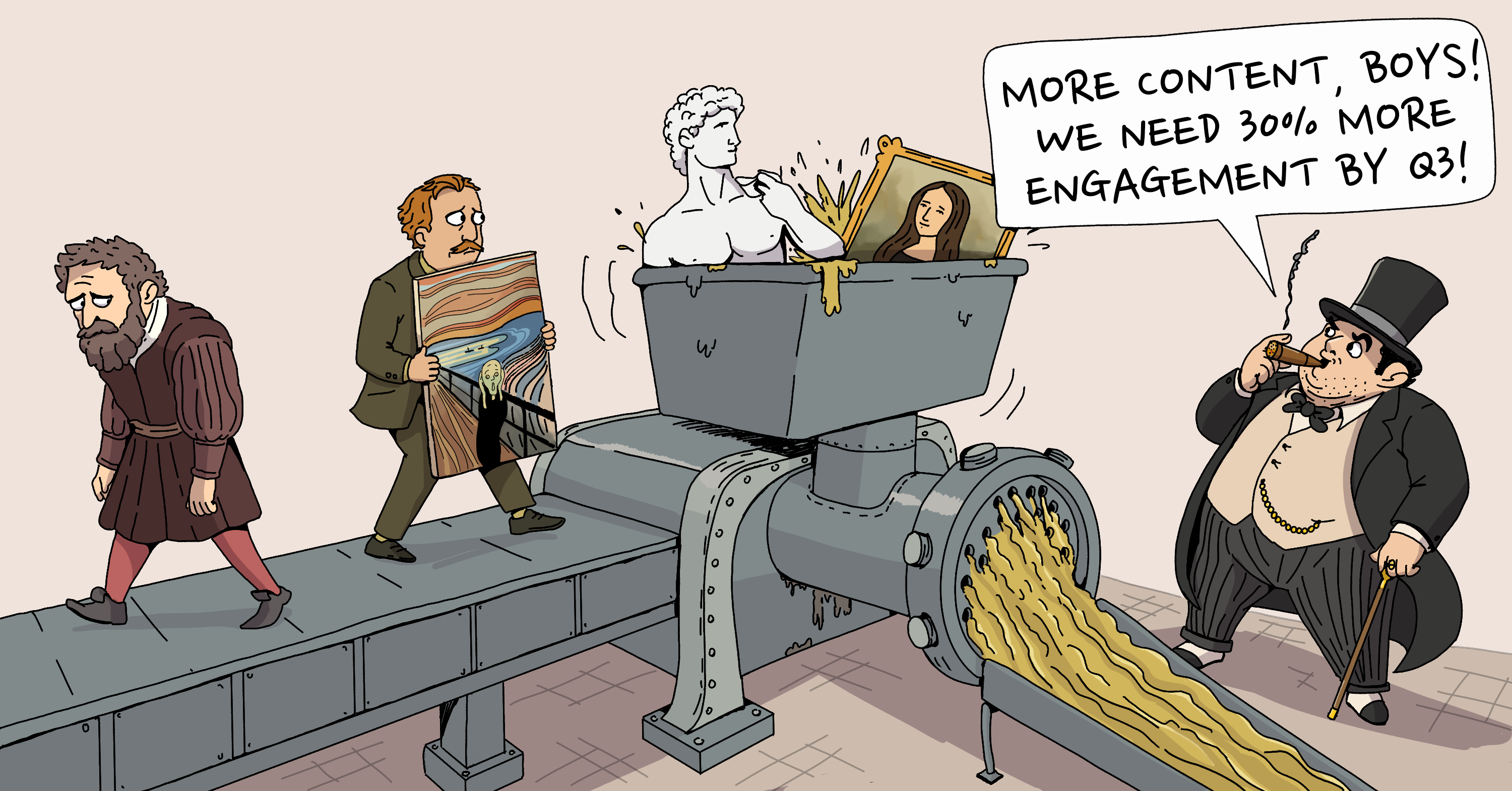
We’re not quite at the point where we call Michelangelo a “content creator,” but we’re getting closer every year.
The term “content” started when business owners needed a term to describe every kind of creative work they’d enthusiastically commercialize. 30 years ago, while still chairman of Microsoft, Bill Gates wrote an influential essay called “Content is King,” that correctly predicted the degree to which the Internet would commoditize creative work (with Gates’ help):
Content is where I expect much of the real money will be made on the Internet, just as it was in broadcasting.
[…]
When it comes to an interactive network such as the Internet, the definition of ‘content’ becomes very wide.
—Bill Gates, “Content is King,” 1996
The term “content” stuck. Over the last few decades, the business school folks have been so successful at influencing language that “content” has become the catchall sludge term to encompass everything from blog posts to songs to Netflix films. It’s now common to hear authors, comedians, and filmmakers refer to themselves as “content creators.”
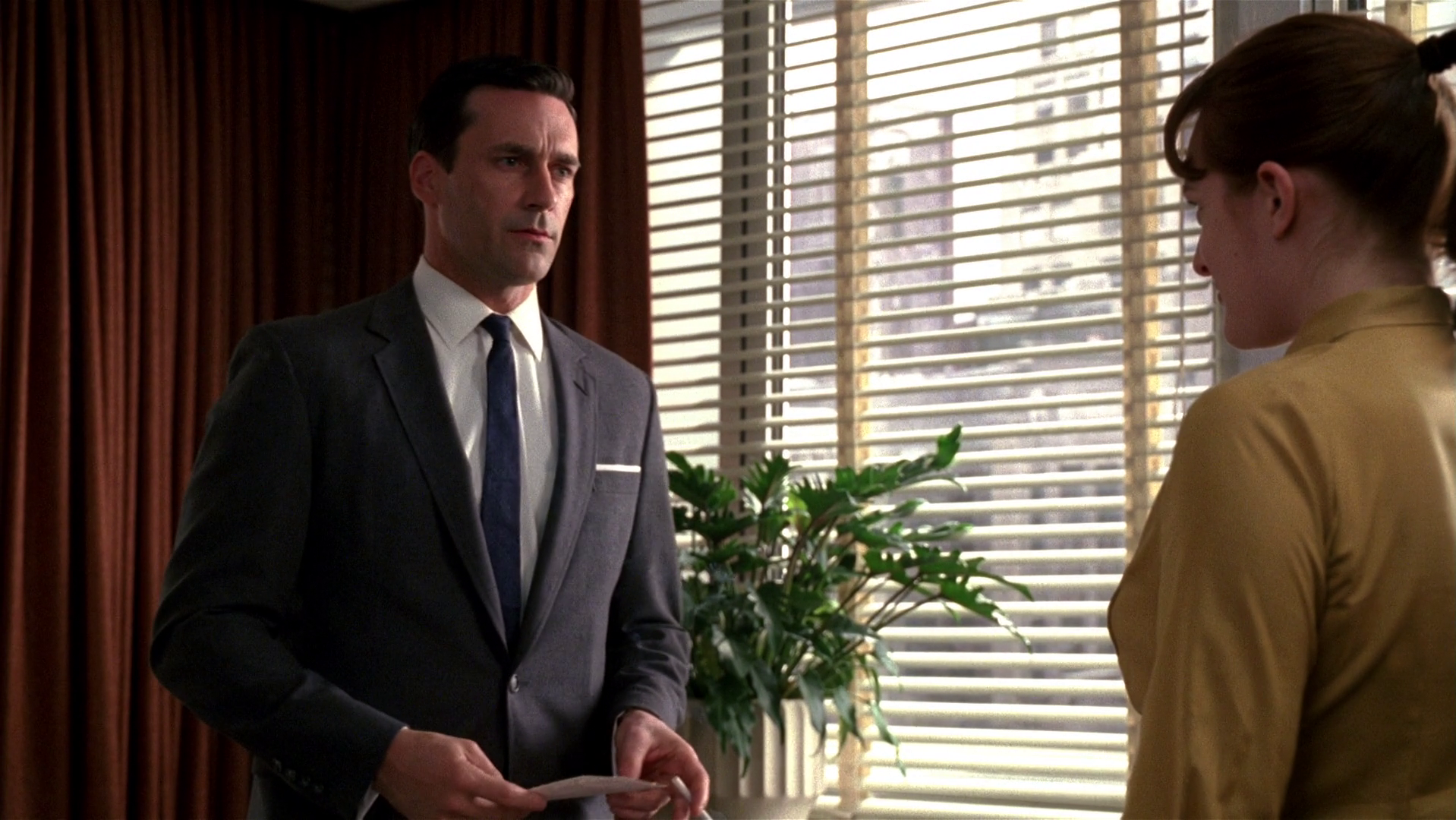
Peggy: Sex sells.
Don: Says who?
Just so you know, the people who talk that way think that monkeys can do this. They take all this monkey crap and stick it in a briefcase, completely unaware that their success depends on something more than their shoeshine.
[…]
They can’t do what we do. And they hate us for it.
—Mad Men, “For Those Who Think Young”
In 2018, I quit my job to start my own company. A lot of my business ideas involved writing, so I described them as “content businesses.” It always felt odd to me, but that was how everyone else described businesses like mine, so I just went with it.
A few years later, I went to an indie business conference where most attendees ran single-person companies — the bigshots had a dozen or so employees. Despite this, everyone talked about their work in corp-speak, business school terms. How are you capturing value? How can you expand distribution? How are you increasing lifetime value? That is, what are you doing to extract more money from each customer throughout their lifetime?
The overload of business jargon basically rebooted my brain. Do I sound like these people? Why was I calling my work “content?” When did I start saying “distribution channel?” What does that even mean?
My favorite thing about being an indie business owner is that you can do it however you want. After the conference, I started thinking more critically about how I described my work. When I found myself using a corp-speak term, I questioned whether there was another word that felt more natural and communicated the same thing.
When I talked about my personal blog, I just called it a blog. There was never a situation where “content” would have conveyed a richer meaning. My website visitors aren’t “traffic”; they’re readers. They don’t “generate engagement”; they send me comments or questions. When I started writing my book, I never called it an “info product.” It’s a book, and I’m its author.
At first, I wasn’t sure if avoiding business school terms would make a difference. Was I just word policing my own mind?
But I did notice an immediate change, especially with words like “traffic.” Traffic makes me feel like I’m just throwing out flypaper and measuring whatever sticks. When I describe website visitors as “readers,” it reminds me that these are real people who have literally billions of other things they could be reading that day, but they’re choosing to spend some of their limited time with me.
I’m a bit unique in that I write a lot about the behind-the-scenes side of my business, and a lot of my paying customers read those posts. Would they enjoy me referring to them as “traffic?” Or scheming to pump them for more “lifetime value?”
Once, when I was interviewing vendors for my last company, I told the sales rep that a mutual acquaintance had recommended I reach out to her. She said, “Oh, yeah, he always sends me great leads.” I think she meant it as a compliment, but she might as well have said, “Oh, yeah, he’s so good at spotting gullible marks.”
I’m not telling anyone what words they can use to describe their own work. If you genuinely see yourself as a content creator, go out and create that content.
My modest suggestion is that you think about whether you chose your terms or if they were chosen for you. Maybe you’ll find that you’re not a content creator but rather a blogger, comedian, or artist.
“More Content” illustration by Piotr Letachowicz. Photo of Michelangelo’s David by Brian Banford