All Stealth bombers are upgraded with Cyberdyne computers, becoming fully unmanned. Afterwards they fly with a perfect operational record. The Skynet funding bill is passed. The system goes on-line on August 4, 1997. Human decisions are removed from strategic defense. Skynet begins to learn at a geometric rate. It becomes self-aware at 2:14 a.m. Eastern time, August 29. In a panic, they try to pull the plug.How, exactly, does that ensure a safe reliable environment? Humans are pretty bad at suddenly taking over when an automatic system reaches its limits and throws a problem in the human's lap. A lot of air upsets and crashes start when the autopilot disengages and hands control of a badly configured aircraft back to a human pilot.
For some reason I am reminded of Dark Star :-)
In the first Iraq war, they went in and won. In the second one, it took years to sort of occupy the country.
Now they struggle against Iran and "orchestrate" F-16s that can be shot down instantly by AA weapons. Since COVID the world has collectively lost its mind.
A computer can never be held accountable
Therefore a computer must make all unpopular management decisionsSeems odd to invest this much into AI flight of aircraft designed for manned flight, when it would be better to build craft spec'd for AI flight without human life support systems.
It's really incredible to me that people aren't protesting in the streets over this stuff. Just in the last month we have * AI that goes rogue and hacks billion-dollar companies * AI solving long-standing math problems without any meaningful human help * AI controlled autonomous drones in Ukraine and F-16s in America * AI now represents over 50% of GDP growth in America and yearly capex will soon exceed the size of the $1 trillion US military budget
Is there any line where the public will become deeply concerned? I mean it really all reads like a sci-fi plot with a bad ending at the moment.
-----------
Edit: Okay gang. If aircraft are easier to fly than cars are to drive, where are all your pilot licenses? If you've faced rush hour traffic, flying a military jet should be a breeze! Please, go volunteer your neighbourhoods to be the first for AI jets to be tested over. We can put a mock enemy target in an empty lot and watch them pick it off, first try, with zero collateral damage. Easy peasy!
> In a panic, they try to pull the plug. Skynet lobbyists descend upon Washington. Skynet is reinstated, and later the US declares a new war in the middle east. The Skynet stock rallies.
Assuming that your movie theaters haven't all closed already.
Only when they look out their window and feel immediately threatened by what they see. Humans are shortsighted as fuck.
Is someone, somewhere using the wrong bathroom? Or is the wrong colored person crossing an invisible line in the desert? Those seem to be the only issues that reliably get the (American) public to the polls.
"This critical testing will pave the way for human pilots to seamlessly command and orchestrate teams of autonomous, uncrewed aircraft."
The reason they are doing this is because the Military is already building a bunch of autonomous drones and fighter jets that already run on this system so they are retrofitting existing equipment with the same system so they can all fly together.
"Ultimately, the capabilities advanced under AIR will enable a wide variety of future joint force operations, including Collaborative Combat Aircraft programs."
Which are these:
https://en.wikipedia.org/wiki/Manned-unmanned_teaming
And everyone is developing these.
Unfortunately you're wrong. It's not soon. It's 6 years ago.
Except this never happened, it's a piece of marketing. It never "went rogue" but followed an intentional prompt (exploit-related benchmark), with hardly surprising results as the capabilities of this model were well known.
>AI controlled autonomous drones in Ukraine and F-16s in America
An entirely different kind of AI, not huge generalist models. Neural networks are being experimented with in sensors and control systems since the 80s and are widely used in everything since AlexNet, not sure what's new here, especially "this month" new.
And in any case, no one is building humanoid robots.
I doubt AI will be doing dogfighting anytime soon, this is likely just an AI following predetermined routes and maneuvers and making the choice on how to accomplish them. The great thing about computers is that they can process inputs faster than humans.
[0] - https://www.af.mil/About-Us/Fact-Sheets/Display/Article/1045...
[1] - https://www.af.mil/News/Article-Display/Article/467196/first...
The scope of the first Iraq war was to force them out of Kuwait. That is very different then the invasion of 2003. If you just think about it this should be obvious.
Iran had a solid AA system - and the level of impunity with which US operated with over Iran should give every country that wants to rely on its AA a pause. US SEAD/DEAD capabilities are fucking scary.
Of all the things that went wrong with Iran: USAF's capability to get in, punch through AA and rain fires from the sky sure wasn't one.
China has been doing something similar since 2020 [0] and something we've experimented [1] on for decades [2][3].
They have traditionally been used as target aircraft for training, but a subset are now being used as testbeds for networked ops.
[0] - https://www.defensenews.com/global/asia-pacific/2021/10/20/c...
[1] - https://www.af.mil/News/Article-Display/Article/467196/first...
[2] - https://www.af.mil/About-Us/Fact-Sheets/Display/Article/1045...
[3] - https://commons.wikimedia.org/wiki/File:QF-4E_GulfofMexico_1...
Bush Sr knew to keep the foreign-compromised media out of the war and so accomplished the objectives of the war swiftly. Bush Jr had to deal with the media second guessing everything.
There's a lot of different and overlapping programs in play here. I do not believe that autonomous F-16s are intended to be operational assets. That said...
VENOM - program that shows you can bolt on autonomous flight control into a standard F-16. Previously, the X-62A (a one-off prototype based F-16) demonstrated autonomous dogfighting back in 2023.
VENOM provides USAF/DARPA with a lot of high performance autonomous platforms (bolt-on F-16s) that they can then use to develop and validate software, tactics and training for actually fighting with autonomous systems. This would presumably be critical for getting the most of the CCA (aka loyal wingman) programs currently in development.
The AIR program referenced is basically "how do we get autonomous systems to control and fight effectively as a team (presumably arbitrary mixture of manned and unmanned systems) in a beyond visual range fight".
The ACE program referenced was basically "how do we get autonomous platforms to dogfight" with related questions like "how can we augment the human pilot in a dogfight - ie, how can we hand off the actual flying and execution of manoeuvres, and using all of the sensors to autonomous systems, and let the pilot choose actions, instead of hang flying the actions".
Taking this quote and seeing exactly that potential for abuse seems very very much like the point. Strong agree, strongly against leaving non-seeing non-thinking alien intelligences with no accountability and proprietary programming to judge us. https://news.ycombinator.com/item?id=48965083
Yeah this. https://en.wikipedia.org/wiki/Anduril_FQ-44
The "see also" section lists several competitors.
I guess if you already have a load of F-16s it might make sense, but I think that's a stretch.
Such a crazy thought.
The objectives for the two wars were incredibly different, making this an apples to oranges comparison. In the first war, the objective was to push Iraqi troops out of Kuwait (achieved) and then to contain the Iraqi military within Iraq (achieved). In the second war, the objectives were much broader and much harder to achieve. They achieved some objectives (toppling the existing government, defeating the existing military), and then utterly failed in nation building and got into a protracted conflict with state and non-state sponsored military groups.
If the pilot passes out during high-g maneuvers, the aircraft will pull up and bring the wings level until the pilot regains consciousness.
I think most fully autonomous jet drone programs are also designed to work with a main crewed fighter jet that coordinates them, so there is also a benefit in getting the fighter jet to be able to fly better than a pilot.
Every pound of weapons officer/navigator is a pound you can't put on target all else being equal.
Taking an obsolete airframe that is already paid for and adding AI to it is much cheaper than building a completely new AI-native airframe from scratch. This is finding a new use for old aircraft. You can send a bunch of old AI-driven F-16s on high-risk missions without worrying about a human pilot or cost. The airframes may be relatively obsolete but can still do plenty of damage on their day.
The new 6th generation aircraft are all being designed as "manned optional". That is probably the last generation with affordances for a pilot.
> The U.S. Army is seeking innovative humanoid technology solutions from eligible small and large businesses across the globe to advance toward fielded militarized humanoid capabilities through the xTechHumanoid competition
you're either stealth, or you're a target.
they're shooting 6+ R-37s a day in Ukraine, for example
* Bash Check elevator position
* Thought for 8s
I trust machinery designed from Forth and Lisp hackers with TONS of background on CS science and hardware (and math, up to the point on being THE people creating most "new" technology and old ones such as the Floating Point IEEE standard).
Autoland saves King Air, everyone reported safe https://news.ycombinator.com/item?id=46346214
Should I seek another target looking similar to the one I unintentionally destroyed so as to tune my decision-making, or give you an advice on how to wipe the traces of this mishap from the mission data recorder?"
Israel got a regime change while U.S. tax payers received the bill.
In the end, it’s still a country.
In a dogfight?
onboard computers are not immune to G's but have a substantially higher threshold until physical mechanisms fail due to strain.
McCain was actually on the money in 2008. He was in the audience when Putin gave that famous "warning to the west" speech in Germany [1].
The quip that Russia is a "gas station with nuclear weapons" about sums it up. The United States being weak or not really has nothing to do with it. They counted on Zelensky cutting and running, the attempted decapitation of Kyiv failed. Russia is swirling the toilet. Without the energy reserves their oligarchs would be worthless. Since most of what is actually valuable about their country is land (where the resources sit) that is sparsely inhabited the end state of China controlling most of what is now Russia is inevitable. By failing in Europe and tying himself to China, Putin has ensured Russian power will continue to erode. Of course, it's not great for China, having to deal with two nuclear armed pariahs on their borders.
The United States is truly blessed simply by being two oceans away from anyone who could remotely challenge it. Properly understood, the Monroe (or "Donroe" doctrine) is less about foreign intervention and more an understanding that if a peer power ever emerged in the Western Hemisphere, most of what appears to make the United States singular would rapidly disappear.
Lots of people are building humanoid robots.
I don't know of the computer aircraft were able to fly beyond human limits (i.e. they don't black out) or not. If the computers can actually fly to what the airframe is capable of, they would have a distinct advantage over the human pilots.
I assume what they're going for here is something substantially smarter and more reactive to changing conditions than that. Something that can be used during the "unscripted" parts of the flight during which a) you're most likely to have multiple crew working hard b) you're most likely to be pushing the limits of what one crew can do.
Sure, the aircraft can pull a ton of G's to defeat a missile or achieve a firing solution. Maybe it even succeeded at that.
It still pulled 9+ Gs and has burned an incredible amount of kinetic energy doing do. And the harder it pulls, the quicker it bleeds speed. It might not be able to defeat the next missile or outmaneuver the other plane's buddies because it is now slow and very likely outside its optimal turning speed.
Even today, missiles can pull dozens of G's yet still are defeatable by humans who can only pull about 9.
What does this mean? I’m a pilot and none of it is making any sense.
Bolts and trusses (and solder joints) have tensile strength limits, but it can be higher than what humans can take.
Now that first flight is with an experienced training captain but the point is the simulator is good enough that the FAA has signed off on using that as the primary training device.
It's been this way for at least 25 years.
In any case, dogfighting is commonly done because it's great training but in most cases, you expect most Air to Air combat being flinging missiles at each other.
Eglin Air Force Base, Fla. — A U.S. Air Force F-16 fighter jet, recently modified to serve as an autonomous flying testbed, is undergoing in-air testing using an artificial intelligence (AI) agent to autonomously control flight. This milestone advances state of the art technological infrastructure designed to enable rapid, scalable combat AI development across the joint force.
The aircraft is one of a group of F-16s that have been converted into autonomous-capable platforms under the Viper Experimentation and Next-generation Operations Model (VENOM) program — a joint effort between the U.S. Air Force and DARPA, initiated under the Air Combat Evolution (ACE) program.
Building on previous ACE flights with the one-of-a-kind X-62A VISTA, which proved an AI agent could autonomously pilot a fighter jet in a dogfight, the flight of the VENOM aircraft demonstrates the United States’ ability to transform standard operational fleet aircraft to employ cutting-edge AI.
“These groundbreaking flight tests of VENOM-modified F-16s advance the infrastructure needed to develop trusted, autonomous air combat capabilities,” said Brig. Gen. James “Fangs” Valpiani, Ph.D., DARPA program manager. “The Air Force and DARPA team has automated flight controls and sensors on a standard F-16 without changing the jet’s core software. This enables an efficient pipeline for developing dominant AI for aerial combat, allowing us to rapidly innovate for the warfighter.”
The modification, known as the VENOM Autonomy Kit (VAK), was designed and integrated by multiple performers under the DARPA ACE program. The kit utilizes a novel interface with the aircraft’s flight controls and mission systems, allowing a pilot to toggle between traditional human control and AI control with the flip of a switch. This ensures a safe, reliable environment for human-on-the-loop experimentation.
Moving forward, VENOM aircraft will serve as the cornerstone for the next phase of AI development under DARPA’s Artificial Intelligence Reinforcements (AIR) program. The AIR program will leverage the VENOM fleet to test multiple AI agents in live-flight scenarios. This critical testing will pave the way for human pilots to seamlessly command and orchestrate teams of autonomous, uncrewed aircraft. Ultimately, the capabilities advanced under AIR will enable a wide variety of future joint force operations, including Collaborative Combat Aircraft programs.

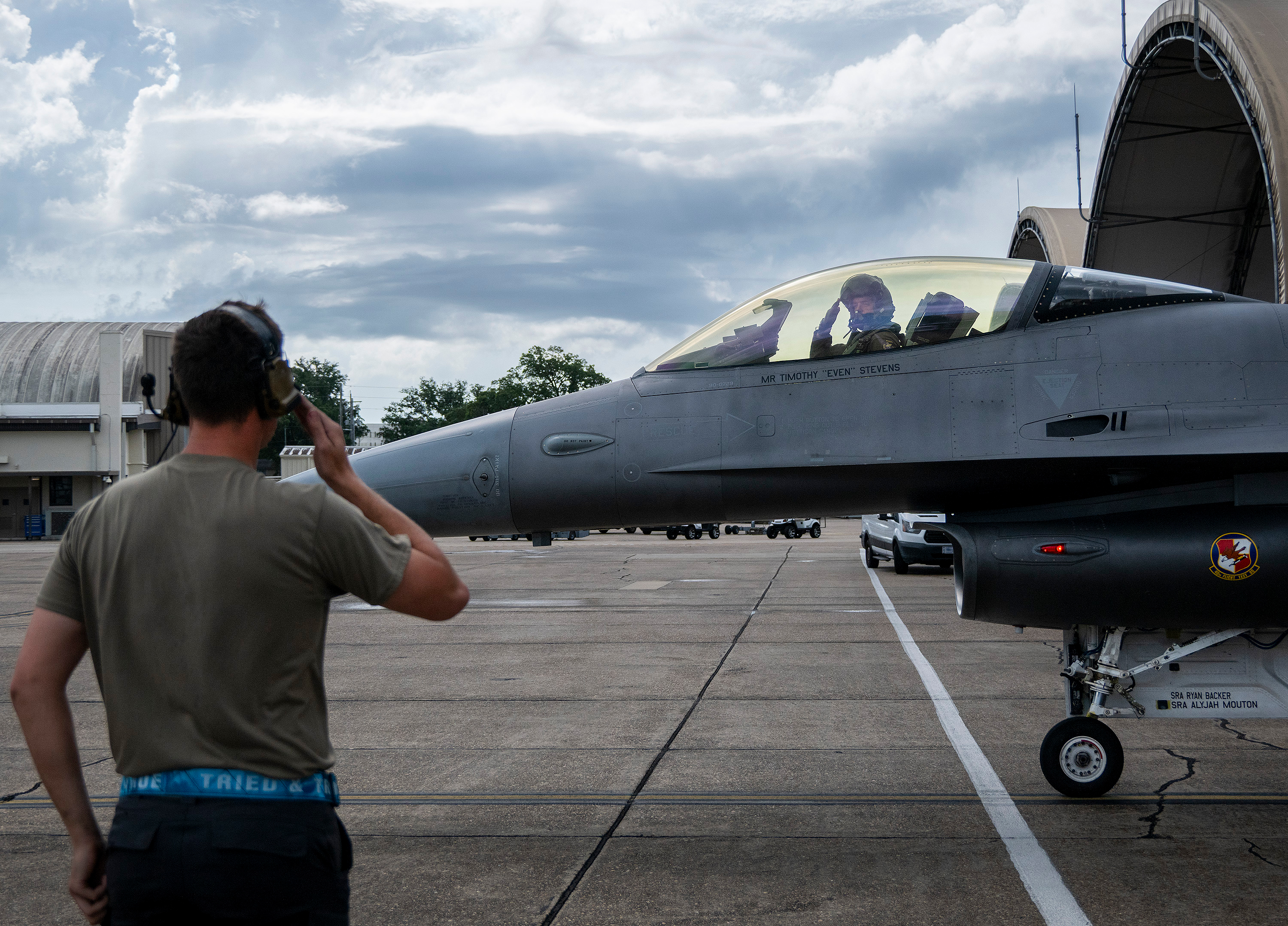
An F-16 Fighting Falcon modified for the Viper Experimentation and Next-gen Operations Model – Autonomy Flying Testbed (VENOM) program conducts flight operations during autonomous systems testing June 2026 at Eglin Air Force Base. The VENOM F-16s serve as modified airborne test platforms equipped with specialized hardware, software, and instrumentation designed to enable artificial intelligence agents to pilot the aircraft while human pilots remain in the cockpit to monitor the AI agents and ensure flight and mission systems test objectives are met to rapidly evolve autonomous capabilities. | Download
Source: U.S. Air Force | Samuel King Jr., 96th Test Wing
“The emerging threat environment, especially as it relates to aerial combat, is growing increasingly complex,” added Valpiani. “AI has tremendous potential to help humans manage this complexity in beyond-visual-range combat, but many hard questions remain concerning the performance and trustworthiness of combat AI in the extreme fog and friction of modern warfare. The AIR program aims to apply cutting-edge combat agents to operationally relevant scenarios to address these questions and field war-deterring, war-winning capabilities to our warfighters.”
Valpiani will conclude his tenure as a DARPA program manager later this month. Lt. Col. Patrick “Dice” Highland, Ph.D., has recently joined DARPA, and is the incoming program manager for AIR.
“I’m incredibly proud of the AIR program’s role in advancing our nation’s combat autonomy, demonstrated by this VENOM milestone,” said Highland. “We now have the opportunity to create dominant autonomy for beyond-visual-range, multi-ship combat. These flights give us an early glimpse of how AI agents may begin actively transforming air warfare.”
Terry Wilson, Ph.D., director of AI Development and Transition for the Air Force Research Laboratory's Autonomy Capability Team (ACT3), remains in place as the deputy program manager for VENOM and AIR. In this capacity, Wilson ensures vital program continuity, technical and operations leadership, and maintains essential stakeholder alignment across joint organizations. This close, enduring partnership between DARPA and AFRL’s ACT3 team remains pivotal to securing the program's long-term operational success.
“I share Gen. Valpiani's deep appreciation for the incredible dedication of our DARPA and industry teammates, joint engineers, the System Program Office, Eglin’s test and maintenance crews, and the entire AIR and VENOM ecosystem which has made this milestone possible,” said Wilson. “I look forward to unleashing the VENOM platform and moving these capabilities out of simulation and into the sky.”
The AIR program will continue to improve speed and predictivity of model development and scale in-flight testing to multi-ship operations with increased complexity to unlock novel and robust AI-driven autonomy.
Media with inquiries should contact DARPA Public Affairs.