I agree with this but for a different reason than what the author gives.
When you write in a notebook you can see where what you are writing is within the notebook (e.g. ~1/3 of the way through, etc). That seems like a small thing but I think it really helps with anchoring the memory when writing, as well as with referencing it later. And of course you can also add all sorts of tabs and page markers to help even more.
The same is true when reading a book.
Once I settled on this method, other writing setups felt unsatisfying. Maybe others will enjoy this setup as much as I do :)
To this day, if I'm trying to learn something new, I will sometimes "type" on an invisible keyboard if I don't have a pen/paper or a smartphone I can write down specifics on. It doesn't work as well for things like memorizing phone numbers or like support ticket ID numbers, but I've found it helps me ingest knowledge even if it doesn't help as much with raw information the way writing by hand does.
Now all of that said, I have also found, like Neal Stephenson, that a high quality, low friction pen on notebook paper tends to feel the best and produce the least cramping. To this day, when I absolutely need to take handwritten notes, I use a Sharpie Rollerball 0.5 black pen with a small notebook, primarily for D&D (and other TTRPG) prep-work, so that I can recall specifics off the top of my head better while improvising.
I went back to school at 25, and that moment made me realize why school felt strangely more difficult, and then I remembered that we wrote down everything back then.
I completely agree! Perhaps it's simply for one reason: slowness.
Writing by hand slows down and the brain "breathes", calms down, and the waves of thought flow at their proper pace.
We aren't made to rush always: by slowing down, our brain also has time to better process thoughts and information, one at a time, and each one is given the "time it deserves."
Our brain works best when it's relaxed and has time to make all its connections.
Thinking is, first and foremost, an exercise in slowness.
(ps: I'm also left-handed, I wonder if this also affects the functioning of the brain...).
It also allows you to make more mistakes, which can lead to surprising directions.
And the team who makes the most mistakes usually *wins*!
See also:
The Hand - How Its Use Shapes the Brain, Language, and Human Culture By Frank R. Wilson
Drawing on the Right Side of The Brain by Betty Edwards
Wooden: A Lifetime of Observations and Reflections On and Off the Court by John Wood
You Matter More Than You Think by Karen O’Brien with illustrations by Tone Bjordam
I’m sure, as the author says, it’s not as good as the real deal of writing with an actual pen, but I need it to be digital text eventually and don’t want to waste a lot of paper. I have found that I’m more creative and enjoy writing more.
So I have this massive stack of notes that I glimpse at before shredding or whatever. Nothing of permanent value, nothing that I look at even 24 hours after it is written. But the sheer volume of the writing like that I do surprises me ever time I clean it out. It's like a novella sized stack of paper with server names, sketchy diagrams, peoples names, dates, commit hashes, debug messages. Lots and lots of lists. Things underlined, circled, stars, strike through, arrows, etc.
It is such an ingrained habit that its almost a compulsion, like someone is tying my hand behind my back if I don't have access. It is like my brain needs reassurance that some detail I just noticed won't be lost, at least it will be on the paper if I need it in the next 5 minutes. Like an extension of my short-term memory.
I have also kept a journal for 20+ years, mostly on paper. I often use a fountain pen (Lamy 2000) and notebooks with high-quality paper, but I am not super picky about it. I've used the cheapest school notebooks to the finest Japanese boutique papers. I'm a fan of the Pilot G2 and pens that have a similar feel. I'll also journal in Google Docs, Apple notes, or text docs in VS Code.
It is hard for me to disentangle the supposed benefits from the sheer weight of habit. It is just something I do, part of who I am.
Well since I've never written with a fountain pen, and the type of paper I write on with the fountain pen matters, I'm probably better off picking up the habit with an ipad or the like.
From the source paper:
> Existing literature indicates that connectivity patterns in these brain areas and at such frequencies are crucial for memory formation and for encoding new information and, therefore, are beneficial for learning
I would also be interested in whether the parts lighting up are actually contributing to learning the task at hand. The 2024 paper quoted above didn't mention a test for comprehension. The prior Stanford experiment also reasoned that writing helped with comprehension because students were forced to summarize.
I'd like to see an experiment that forces both groups, typing and writing, to summarize while their brains are scanned. I'd also like to see results from tests for comprehension for each group. I feel like that would make a stronger case for whether the benefit from writing is actually worth it.
I’m also opposed to getting too precious about writing tools. So many people have drawers full of fancy notebooks with something on the first few pages and the rest empty. Get something and use it. Don’t matter if it’s a dollar-store spiral notebook or a fancy Leuchturm 1917 notebook, just as long as you use it. Same with the writing utensil. Pencil? Ballpoint pen? Whatever. I find these days I prefer to write using a cheap mechanical pencil (the kind they sell in bags of 20 at the supermarket), but I’ll use whatever.
I used to be really precious about these things. I only used college-ruled 9½×6 150-page spiral bound notebooks and wrote in 0.4mm fine-point felt tip pen. Did all my first drafts by hand. It ended up being an excuse to not finish stuff. I do most of my first drafts typing now, because it lets me get s⸻ done (although I still take notes by hand because that helps me remember what I took notes on better).
I don’t buy the cursive thing, mostly because I write slower in cursive than in print (although I have a handful of ligatures and abbreviations I use to speed up some things).
Didn't know he is a lefty too! Fountain pens + lefty is a tough combo; we had to use fountain pens in the 1st grade and my wrist was always stained on the side. Agree with the rollerball angle, Pilot V5 is my go to now...
Not only does it make consumption a lot more engaging, it makes a revisit of that book extremely rewarding.
Don’t get caught up trying to figure out the right notation or highlighter color for a line. Just mark them up and later it’ll make sense.
Edit: I think the broader point that some of you may be missing is that I’m not prescribing a particular form of notetaking. I’m saying that reading is made more rewarding with active engagement. How you best engage is up to you.
I totally buy that this is the case for him. I wonder how much is just what he's used to vs what's actually better. I feel like I write so slow compared to how fast I type that I struggle to put the words together on the paper. I can spurt out something with a keyboard 10x as fast, and then re-review and re-organize and all that.
Sometimes I'll skip whole letters in a word without thinking and need to go back fill it in. Sometimes my baselines will drift as I write a sentence despite the paper _being lined_. Cursive is nearly impossible for me without extraordinary effort, despite me thinking it beautiful and wishing to improve my abilities there.
Dysgraphia for me makes it difficult to write for extended periods of time, and results in very poor handwriting. In fact, the reason I first got a computer as a little kid was so that I could type school assignments, and this was in elementary school in the 90s when everything was still handwritten where I grew up. I even typed my math homework with awkward notation in College (my professors hated me).
All of that said, I still find that I agree with the sentiment of this post, and I do keep notebook. It's laborious for me to write, but I still find that the intentionality and forethought that it demands produces (think about it, you're committing something immutable in the real world with ink and paper) something we're losing: deeper introspection. I know this might sound silly or pretentious like hipsters and vinyl records, but I think there's something in physical writing worth keeping despite its inconveniences.
For example, if I asked you to code FizzBuzz while riding a unicycle, I'm pretty sure you would show more brain activity than if you were just sitting at a desk. This does not mean it's an efficient way to program, nor that coding on a unicycle is better for learning.
I know lots of people do say they learn better when handwriting, just like some people say they learn better while going for a walk. This does not translate into a universal theory of learning.
That may be true, but it's not like you can't just re-acclimate to the experience of writing on an iPad. Most people don't handwrite much, period, so if they start handwriting again they're going to have to have an adjustment period either way.
I personally would think that the the benefits of digital writing (searchability, portability, infinite canvas, handwriting cleanup, digitization) would outweigh his friction quibbles. I personally don't find it to be tiring to write on an iPad, even without a screen protector (which some people use to increase friction). Also, e-paper devices tend to have more friction-y feedback, but he doesn't address this at all when dismissing all "gadgets" outright.
About a decade ago I went back to writing with fountain pens after a nearly two decade hiatus. Oh, the joy!
But very sad he has no (real) tips on dealing with hand fatigue - other than to write in cursive. I always had hand fatigue for writing long stretches of prose - even back in my school days. A few years ago, I simply had to change how I grip the pen to reduce the pain, but I still can't write many pages without significant pain and the need for breaks. I can't imagine writing a whole novel that way.
Also, I wish he told us how he gets that handwritten stuff into digital form. Does he just mail handwritten stuff to the publishers?
In the past, I'd write twice: Once by hand, and then I'd type up anything worth saving to get it in digital form. A royal pain!
Then with Whisper and LLMs, life got a lot better. I would simply read what I'd handwritten, and get an LLM to clean it up. I only occasionally needed to fix it up after that.
Now LLMs are so good at it that I simply take a picture and send it to the LLM for transcribing.
I don't care how much people hate AI - for me it has quite literally reduced physical pain in my life.
It wasn't until I got a nice notebook from Leuchtturm 1917, though, that the ensemble came together and I started looking for excuses to get my kit out and write things down. Since then, I've moved onto notebooks from de Kempen, but the point stands
The only problem I have is doing it comfortably. My desk is cluttered with a keyboard, laptop, and monitor. There’s barely any room to write with proper posture, and shuffling things around every time just isn’t practical
The author dismisses all pencils because he has to press down hard to use them, but I don't press down any more than I would with a fountain pen.
Being able to erase is also a bonus. Not to mention the ASMR sound!
Most of which includes the author's favorite mental task, food, or exercise.
- whose gonna tell it to em?
- dont worry, the long term studies are going to pick this up big time 5 years from now
1. I don’t believe iPad doesn’t offer the same benefits of writing with pen on paper. I mean iPad writing can be made to be almost as realistic as pen on paper with good accessories. It can be slow, doesn’t waste papers, you can edit, color code it, annotate in a way that’s backed up. I definitely like writing on paper, but I don’t see too much of a difference with iPad.
2. I absolutely love using Pilot V5 RT pens, and haven’t found something that is as smooth and satisfying when put on paper. What are your favorite pens? Are they available on JetPens for trying? Thanks!
I like to handwrite, but my right hand gets tired very fast, especially as I got older. I write almost a shorthand style, and it is hard to read, but I value speed of writing things down versus the neatness or readability afterward. The author recommends fountain pen or gel rollerball pen, which I have both tried.
Does anyone have any other advice for preventing fatigue? I've also tried to learn to use my left hand, so I can switch hand when my hand gets tired. But even after months (or years?) of trying, I could never get it to write, or atleast to my satisfaction.
I like sketching and outlining with pencil and paper, but my handwritten notes are often illegible and disorganized. I know it's partly process and my poor penmanship, but digital surfaces compensate for this with built-in organization, searchability, and easier integration into projects and knowledge bases.
I watched a video recently from someone, from memory the creator behind the youtube channel vsauce. Very briefly, he lost some notes to water. His words, thoughts and ideas vanished. His solution was switching to pencil.
I found the interview https://www.youtube.com/watch?v=SfY2JACiDGU
I'm addicted to people talking about pens and pencils. Adam Savage also has done a few videos on his favourite mechanical pencil.
Apparently Stephenson loves fountain pens and reluctantly gel pens. In general, those are water based inks and will wash away with water. There are one or two fountain pen inks designed to be more permanent and won't wash away with water.
Just something to keep in mind if you're currently writing or want to start.
I just needed to re-read the better notes 1 or 2 times and I could already recall the information, even at distance of time.
I see this style of informational writing all over the place now.
Switched to a 36 key ergo split with a tweaked alpha-thumb layout (R is on my left thumb, Space is on the right, base layout is Hands Down Vibranium V). Started learning Pitman shorthand (again) then switched to Noory Simplex and stuck with it. Became fascinated with Zaner's Method of cursive where the writing is done entirely through arm movement and using the rhythm of the muscle movement instead of by conscious control over the pen position. At the moment I can write at about 100wpm on a keyboard, 70wpm in shorthand, and 26wpm longhand.
I believe that the improved ability to learn comes from the need to focus on a concept for longer while writing and not on the motion of the writing itself. My ability to retain is better in cursive than in shorthand and I don't notice a significant difference in retention between keyboard and shorthand.
I think what happens in these types of threads is that the people who like handwritten notes, perhaps even obsessively so, all pour in. But that population of handwriting fans isn't necessarily representative of the population overall.
Don’t be involuntarily incapable like your peers, kids. If your school didn’t teach you cursive, teach yourself ASAP. Not calligraphy, not oblique italic roundhand, just pick a cursive and do an entire drill book end to end and make sure to take hand breaks whenever it hurts for 5min.
>pressure
the gel pen I use can write under its own weight, so it's surely less pressure than any pencil would require, unless it's particularly soft and hefty?
I'm dealing all day with developers incapable of thinking about anything else than "queries", "classes", "structs" and "early returns are bad". Semantics, ontologies, interfaces, abstraction boundaries, problem decomposition: ain't got no time for that.
We got structs to initialize, copy constructors to worry about and header definitions in bloody C++ to deal with! Oh look, you forgot to use Yoda-speak in your conditional, also you initialized two variables instead of one in this completely transient, temporary piece of code that is only run once every two months. Let's talk about this all morning! Because code hygiene is so extraordinarily important. You should definitely worry about each and every line of code. I hear it's "good for the brain".
Ultimately went back to my moleskine that fits in my back pants pocket and I don't have to worry about battery life.
Perhaps the biggest reason why my experiment failed was that I found it difficult to look back at digital written notes beyond a week. There is no physical flip...
Equally important though, I didn't retain information quite as well when writing against a screen. I can't explain it. I wanted the system to work, but it didn't. Maybe I tried to write too verbose, more carefully than I would a paper page... hoping my more careful writing would be captured by OCR better. I don't know but it was different. Intended focus matters.
Less effort = more retention to me. Digital writing, at least at that time, was more effort to me it seems
While you may be convinced writing on a screen or tablet is objectively superior to doing things the "old way" there is literature on the topic indicating otherwise you might want to consider - that being said, everyone is different in their preferences and anatomy. I for one can't stand to write on a plastic/glass surface with a stylus, the ergonomics feel wrong and my retention for journaling is significantly worse.
Versus a fountain pen, a liquid-ink rollerball pen has the advantage of being insensitive to orientation (which may be difficult to control if you tire easily) and it is also much more unlikely to dry up when unused.
I do not write so much by hand as to become tired, so for myself I prefer a Japanese fountain pen with a nib that allows variable-width lines, for less boring letter forms, but if the criterion for choosing is the maximum possible comfort then I recommend a liquid-ink rollerball pen, and I have experimented with all kinds of writing implements known to mankind.
Except for using the most comfortable writing tool, there is nothing else to do besides changing the style in which you write, to simplify the hand movements.
Perhaps you should alternate between 2 different styles of handwriting, because they might stress different hand muscles.
I have no idea what style of handwriting you use, but I am not convinced that the kinds of "cursive" handwriting that were taught in many schools are really the least tiring, despite their emphasis on minimizing the number of times when the pen is raised from the paper. Many years ago I have abandoned the kind of writing that I was taught as a child and I have switched to one of the variants of the so-called "Italic" handwriting, which are now promoted in many places and which are a revival of the Aldine letters from the Italy of the 16th century, which have also been the base from which the so-called "Italic" style of the printed typefaces (fonts) had been developed. Such a handwriting has improved readability, but how fast and comfortable it is felt, can vary a lot between people. It works for me, but that does not mean that it would also be the best for others. There are books and on-line tutorials about this.
Perhaps you should just write slower, to avoid fatigue.
I write a daily journal - in this calm relaxed mode, I write linearly (on dotted paper).
When I'm in a business meeting, or taking notes where time is fleeting (a speech / seminar), I use bubble notes - which is effective for quickly getting the thoughts down, and connecting them.
Give it a try!
Positive: - I can send PDFs of my notes out within a minute to any email - a lot less to carry around, I just make sure to keep it with me, nearly all the time - organizing notes retrospectively is a big leap forward from paper - I can just select lines of text I wrote and move them around, even shrink them a little (to fit an extra line of text or two on the same page)
So far I haven't gotten used to actually extracting the notes with the Kindle application on my PC, it's always going over Amazon's servers whenever I click "share" to export my notes...
How do you go about having AI conversations with your notes?
(I've noticed this with students I support. In the UK the public exams known as GCSEs and GCEs are written papers, and some adult students who need to take them have similar fatigue problems).
Edit: another poster has mentioned grip
"Cross out stuff you disagree with" actually makes me sick.
It also seems useless for understanding and retention, since highlighting is almost always misleading and margin notes are almost always empty. If you want to write notes, get a notebook, which gives you space to write real thoughts down. I use a trapper-keeper.
A tiny glimpse into a stranger's thinking as they processed the same pages I just did.
Thoughts they may never have shared anywhere else, that may not have made sense to anyone anywhere else. A secret code only for people who just read the last few pages. Shockingly intimate.
It's so frustrating to be so pregnant with an idea, to open ones iPad, and to find out the battery is low, Procreate isn't working, the Notes app is confusing to navigate, oh no you're writing but your palm has slid on the screen, etc.
I've spent a lot of time searching for a digital alternative, but IMO we're at least a decade away from digital handwriting being even close to on-par with paper, even ignoring friction and feel.
I also spent a good amount of time in academia (math & physics), wrote everything by hand (dozens of pages per day), and I, too, suffered from serious hand fatigue & RSI for years, even when using a fountain pen. My recommendations:
- Use as light and as thick a fountain pen as possible. Also, very thin & hard pen tips may be nice but in my experience they make it harder to write.
- Work on your posture (if you don't do that already). Work out your neck and your back in particular to compensate for sitting all day every day. A stiff neck (even if you don't feel that it is stiff) can seriously impact the nerves in your arms & hands and, thus, muscle tension & recovery.
I actually like using pencils, with a thick lead because I tend to have a pretty heavy hand when writing and I will continually break a thin lead.
> Brain electrical activity was recorded in 36 university students as they were handwriting visually presented words using a digital pen and typewriting the words on a keyboard
kinda funny.
It's also not clear from this study that there is actually any benefit to "more brain activity". Of course doing more complex motor tasks requires more brain activity but nobody guarantees that this helps with remembering things.
I have a Lamy 2000 (well, more than one...) that I adore for writing anything with any actual length. But I still scatter those G2s around.
https://www.scotthyoung.com/blog/2017/10/02/how-ben-franklin...
EDIT: maybe the term I was looking for is: copywork?
For example, for taking math notes it's easier for me to write by hand rather than take notes in my laptop (because writing LaTeX takes time). If I spend more time on my notes in my laptop, would that improve retention?
Pilot friction pens - the four color versions. I find multicolored notes great and they are erasable.
Muji spine notebooks - hit the perfect balance between cheap and nice to write on. For me, a moleskin becomes “too nice to waste on this meeting” - the spine version lays flat and it is easy to rip out a paper if someone needs a sheet or you are really unhappy to keep some scribbles around.
It scores bonus point for cardboard cover making it easy to write on the outside
Added bonus points for no spills, blobs or airplane worries.
As for disorganization, that's kind of the nature of early notes. There are ways to kind of organize them. One technique I use is writing them on notecards or notecard-sized paper, which I can later shuffle and organize.
This is actually the biggest reason I own a Remarkable 2/Kindle Scribe, let's me "destroy" the book while also not having to worry about losing my notes.
Whatever the process it is, long as his books may be, it works.
When I hand write, I am generally forced to either slow down and repeat what I am listening/watching (if an option), or actually think about what is being said, and choose the important parts to write down, or rephrase it in a more efficient-to-write way.
I am taking a course right now and I find repeatedly that I understand the concepts from taking down the notes (many aha moments), and then I remember. I rarely if ever actually look at the notes I take - they are objectively inferior as a product compared to the official course notes or the textbook.
Maybe typing would be efficient for learning if I was bad it - could be an interesting hypothesis to test.
If you can replicate that mental engagement while typing, you'd probably get similar results.
This makes a lot of sense to me in light of what we know about how learning happens. I have never seen any research on brain activity though, and my tutor didn't cite any.
There were times in college where I blanked on important information during an exam, but was able to recall it by visualizing the physical sheets I had written my notes on. I aced several infamously difficult classes like OChem and OChem 2 using that technique.
I’ve never found it possible to do that with typed notes.
If lots of people said they code better while riding a unicycle, I'm not sure I'd just dismiss it off hand.
Sometimes I get benefit taking notes on a computer, e.g. I read Wittgenstein with notes in org-mode, took lots of notes about software/CS directly in the comments of the program implementing the ideas, etc etc.
Maybe typing isn't ideal, but it's the better of the 2 options for me.
It actually wears down over time which may sound like a bug/trying to get you to buy more but I have to say that it really does feel like using a pen. There is just enough drag to give you the sense of moving without it feeling like drawing on glass (like an iPad).
A lot of people reading this may say "But I'm a SWE, not an artist. Why would I ever need this?" My response is that if you ever used a whiteboard and now you work remotely, you would be surprised how much faster meetings can go when you can quickly draw out a data flow. I'm a DevOps/SRE and I've also used it during outages to explain to management or other teams "ok, here is how it's supposed to work and here is what's broken"
If you get one, I highly recommend the Medium [0]. The Small is very portable but feels a bit cramped and the Large is too big for someone who isn't using it all the time. The Medium is just big enough to be comfortable but easy to put aside when you are using the keyboard.
MAny a times, the books I read don't have enough place to scribble so I keep a A5 half folded as a bookmark and write notes on that with page numbers. Once the book is over, I read through the points and try to reconstruct.
I use a mechanical pencil myself since I like the teeth and my handwriting is better when I use it. Also, ability to erase (not for cleanliness but more to avoid wastage of space) is useful.
I think it’s important to have that friction between the stylus and the screen. And if you have that, I am pretty happy with notes on either my iPad or paper.
To be fair, your notebook probably won’t get light like that, but pencils are pretty archival.
different strokes. if you want to ensure you don't get sick from a line being crossed out, buy new.
"Paper Website" seems appealing, but I haven't tried it yet: https://paperwebsite.com/
These were fun to find in college bookstores every semester. Not a fan of "highlight it all" but the occasional enlightened soul with a scientific bent.
It's also that I'll often not have my entire notepad on the desk, I might not have room, might only have the top corner on it, or just quickly jotting something down. An ipad, that's too precarious and unstable, no a notepad, it just works.
I often have like an inch of the notepad hanging off of my desk, when my arm is across it, the notepad just flexes and it's fine, if I do that to an ipad, it's cutting into my arm.
It's not just the ipad, I've also tried a remarkable and a kindle scribe and they all suffer from the same issue. Notepads are just more flexible, both literally and figuratively.
I use Fine-Medium nibs (some fine nibs are too fine, and some medium nibs are too thick).
Amusingly, I've discovered recently that my handwriting is much worse with thick pens. I write better with pens slightly on the thin side (but not too thin). Of course, that doesn't mean it's better for my wrist!
My first was the Pilot Metropolitan. Still a solid pen I recommend.
My next favorite was/is a PenBBS - perhaps the 309 - I don't have it on me at the moment. I replaced the nib with a Goulet nib, and somehow made it extremely smooth. I've not been able to make any other Goulet nib that smooth - somehow got lucky.
These days I'm heavily using a Platinum Plaisir which is also surprisingly smooth (no modifications).
Every time I've paid more than $50 for a pen, it hasn't been worth it. I can't get the ink in my Opus 88 pen to flow consistently. I'm sick of it.
I'm partial to Faber Castell nibs, but the pen I bought had a grip that I didn't like, and I don't want to spend the money to try their other pens.
Since you can change all of this on computers (or it happens automatically), you don't have to give it thought before writing it down.
I am thinking of switching to a supernote which allows me to write on a paperlike surface, but mainly because it is free from distractions and notifications on an ipad.
i mainly like the idea of a blank canvas and writing and rearranging thoughts on that canvas - which pen and paper do not allow.
That critique doesn't apply to Remarkables or Kindle Scribes though.
This doesn't really refute the theory—maybe touch typing is worse—but it doesn't match my logical intuition at all.
I love my Kobo. I highlight stuff with it. But for anything really important, I then go to my computer, go through each highlight, and make notes in my org file.
(I probably should automate it - I know tools exist to extract all that metadata from the Kobo).
But not for the reasons you're stating. It was just more like "unreadable". There would've been essentially a post-it note on every single page. Or I'd highlight like half the page.
It's a bit like bookmarks in browser for me. I started out trying it. Neatly categorizing things in a hierarchy. It just doesn't scale. And I see people like your parent, with elaborate systems of bookmarks and they navigate the hierarchy, failing to find what they need, often giving up on it in the moment, saying they'll "find it later". Dude, guess what we're in a call together right now discussing a topic, either you find it now or never!
On the other hand, I don't bookmark anything at all any longer. But I'd die if I lost my history ;)
As in, I somehow remember the terms to write to find what I need and the browser finds it in the location bar history (made up of actual browser history and bookmarks if I had any of course) but it also applies recency/number of times I used it (I never bothered to look at which of these they actually apply). But I just know all I need to type is `n` and hit enter and based on how often I come here, that's gonna get me to hackernews!
Similarly at work, I remember phrases, parts of ticket summaries or even just the current epic everyone's talking about and I type in the number/summary parts and find what I need.
I could probably spend hours "organizing my bookmarks" (i.e. post-it notes and annotations) but I don't. Never needed it, never made sense, never worked. But it does need to be digital. I'd die if I had to be a 50 years ago librarian!
---
On the actual article though: writing by hand definitely is awesome in general. Learning other languages in school we had to learn the vocabulary by writing translations of terms into books. Often I could tell you that "this is the third word on the second page" but not the actual translation :)
Do most left-handers learn to hold their pen/pencil like that? If not I imagine it would be quite a transition to adapt to as all the motions are rotated - the portion of the stroke previously done by moving fingers in and out would instead be done by moving side to side, and vice-versa.
Edit: Or from trying it, I guess you could just write as normal and end up with everything italic/slanted.
i still feel writing something down helps with memory formation, in part because i remember the act of writing it down. cocktail napkins and whiteboards way better than ipads also
i remain obsessed with Pilot v5 rolling ball extra fine; i would say Pilot g2s are for proles but the outcome if you leave it in the dryer is far less severe
I've pretty much given up on handwriting, it's embarrassing to either try to write, or have someone else write stuff for me. I ask my wife to fill stuff out for me all the time, but people probably think that's weird when they see it.
If you chiseled some formula or something into stone you’re unlikely to forget it any time soon. I wonder if forcing yourself to ruminate over something a bit longer than it takes to type it, in a way that can actually hold your attention or repeatedly bring it back to the topic, doesn’t indeed help.
I saw another video about someone's favourite pen and he gave the reason as check fraud. Apparently the uniball 207 is pigment based ink and doesn't wash away in acetone.
I just searched then on youtube for acetone pen check fraud and it looks like there's a 13 year old video about it, and a million copycats. Either copycats are lazy, or the 207 is still $2 13 years later.
He wasn't saying "buy a fancy pen, it's better for your brain".
The positioning is "every time people hear that I write on paper, they come up with all these reasons why it won't work for them (crap/smudges/etc). These are the things I do so that's not a problem for me"
Fountain pen + fancy paper sounds like I am tied to a desk again. Stephenson is probably doing way more intense sit down grind out some pages type writing sessions though.
https://www.themarginalian.org/
Highest possible recommendation for its thoughtful, intelligent, entirely human, poetic writing about various interconnected topics. Maria Popova is a treasure.
Turning that off, or using automatic airplane mode (eg in shortcuts set a schedule to turn on airplane mode daily)
I'm sure if you drove the unicycle through a trough of paint and then used it to make words you'd have a similar experience.
This is nowhere near the same as doing to completely unrelated activities at the same time.
Try to "dot i-s" in a long word and see for yourself. It's just awkward. So people compensate by using thicker strokes that hide that "floating" effect.
I'm studying Chinese, and writing the characters is pretty much the only way to learn them. So far, the only device that semi-worked for me was a reMarkable 2 tablet. But its software is too shitty to be useful.
So I just switched to paper completely.
Wish I had a definitive answer. I do know from personal experience that when I'm touch typing notes while reading a book or listening to a lecture, my thoughts drift fairly often. (I'm a fairly fast touch typist though, 140+ wpm.) I'm also more likely to be thinking, "damn, that's a lot of notes!" rather than about the material, lol. Whereas while handwriting, I'm heavily engaged with the material, to the point where I lose sight of the fact that I'm in the middle of taking notes.
Oh and because it's so easy to make quick edits while typing, I find it hard to resist the impulse to correct a typo or add an extra word here and there, which further distracts me from the material.
Also, I can touch type for long stretches without the slightest mental fatigue, but I need a tiny mental break after 30-60 seconds of handwritten note taking.
When I return the book to the library etc., I take all my record cards out and put them in a little perspex index box.
Sometimes I use the record cards to then start some more detailed notes in a notebook; sometimes the record cards refer to a page in my notebooks where I've attempted a derivation etc.
Give his earlier works a try and you may find he used to be able to write well (ie. he used to actually edit his work), before he stopped caring and just wrote 1000 pages of unfiltered garbage.
I teach an adult Bible study class, and I use Logos for all of my notes and highlights. Your question touches on one of my specific concerns, because they use a proprietary format for their datasets. The best solution I have is that I export the notes and format them in Markdown, and I distribute them to the class via one of my blogs. Obviously, I can't include verbatim copies or quotes from the sources I use, but it's better than leaving the notes inside a platform that could (potentially) disappear in 20 years.
I cite all sources used in the footnotes of every session, so at the very least, it should be possible (theoretically) to obtain the source material in printed form and find the exact page number (Logos stores page number metadata in the digital copies). It's probably not ideal, but it's the best thing I've come up with so far that doesn't require a lot of duplication of effort.
Point being: as this feature works perfectly fine in Airplane Mode, you don't need an internet connection to use your Remarkable.
Not that I'm that price sensitive, it is kind of nice: Sarasa ($2+ each, if you can find it), G2 (~1.25 each), Cristal ($0.10-$0.25 each)
Another way of saying it is discussing a book with some people will be really rewarding. But others you will rather prefer not to. This is just an instance of a more generalizable rule: people develop preferences regarding who they want to spend their time with.
I would even say that "crossing out lines you disagree with" is vandalism because a book can always be read by others and come to a different conclusion and debate in their mind from there.
Why treat books as disposable mind scaffolds when they can be used again by others productively and even preserved for later generations? If you found a book to be at least somewhat useful to write notes on, then why would others not also find it useful?
Margin notes are fine though as long as they do not make the main contents of the book unreadable like "crossing out lines".
Books are treasures. The second book is an enormously valuable source of wisdom. I am glad nobody vandalized that wisdom with marginalia and highlighting.
I think it's a combination of a ritual and some sort of somewhat-more-elevated engagement (or wishing thereof) with the material. Somewhere between meditative ritual and attention aid. I doubt it helped much, if at all - except for Stabilo; they were the true winners.
The part about choosing paper is about fountain pens being blotchy where better quality paper helps.
You can write with anything and on anything, but just like how it is much more enjoyable to type on a fancy mechanical keyboard it is more enjoyable to write with fancy fountain pen. Although I prefer gel pens since they are just easier to have a bunch around.
I genuinely do not understand how people find it helps them to handwrite notes in a lecture. If I type on my laptop, I can do that "mindlessly", which is beneficial because then I have enough of my brain free that I can also understand what the lecturer is saying. Ask a question if I have one, etc.
If I'm hand-writing notes in a notebook, I can't do any of that. I'm so focused on trying to get the stuff down that it's using a lot of my brain that I'd really rather be using to actually think more deeply about what is being said.
I'm genuinely so baffled by people who find that hand-writing notes helps them understand the material better. I used to assume they were terrible typists, but I don't think it's that.
But for example, with your comment, you say that when typing notes, you can transcribe word-for-word without knowing or thinking. But... why not just actually pay attention? Isn't that the whole point? Why do you need slower handwriting to force you to actually pay attention? That's what confuses me so much. I pay attention by default. Writing notes by hand takes away from my attention, because I have to give attention to that.
If you want to take notes during lectures, you need to learn how to summarize in your own words. You need to write the stuff down so you can remember what was in the lecture. Something you can summarize the whole sentence with one word. Notes are for you, not for other people to read.
Because I am known to write using a fountain pen on paper, a number of people have pointed me to this post and its underlying research. I won’t rehash what is said in those sources, but the gist of it is that when you write things down by hand you’re recruiting more of your brain, which is a good thing.
I’m not an expert on how the brain works, but I can say that, when writing by hand, one is continually solving a series of small problems having to do with the spacing of words, how letters are connected, the crossing of the letter t (sometimes more than one in the same word) and the dotting of the letters i and j, and how to accomplish all of those things through coordinated movements not just of the fingers but of the whole arm. All of that has to be integrated in real time with whatever is happening on a more abstract level in the brain’s processing of ideas and imagery.
Concurrently I have been following discourse on Reddit and other sources about how widespread use of AI has forced educators to return to the long-abandoned practice of having their students take exams in person by writing things out longhand in blue books. This has created new challenges for students who never really learned how to write by hand, and for teachers who can’t make sense of their students’ terrible handwriting.
About twenty-five years ago I stopped composing at the keyboard and switched over to fountain pen on paper. Since then I have written many thousands of pages that way. The manuscript of The Baroque Cycle was a stack of handwritten pages 42 inches high, which for a time was on display at the Museum of Science Fiction in Seattle. With the exception of The Rise and Fall of D.O.D.O., which I co-wrote with Nicole Galland by emailing Word files back and forth, every book I’ve written since then has been composed with fountain pen on paper.
Every so often, when I’m signing books at a book tour appearance, someone will come up to me and say something like “you must have writer’s cramp!” or “is your hand sore yet?” I never have the time to provide a full answer. If I did, however, my answer would be that never, at any time during a quarter of a century during which I have spent a substantial fraction of each working day writing by hand, have I experienced even the faintest traces of so-called “writer’s cramp” or any other such hobgoblins.
Yet I can remember getting a sore hand when I was a kid writing out assignments in school. Many people probably remember such experiences and assume, reasonably enough, that it’s a natural consequence of writing by hand for any length of time. This is not the case.
Here are some fairly simple dos and don’ts for people who want to reap the benefits of writing by hand.
It’s pretty obvious that you’re going to get tired faster if your muscles have to exert more force. Writing with a pencil requires significantly more force than writing with a good pen. Old-school ballpoints with thick ink are no better. You can see visual evidence of this if you flip over a sheet of paper on which you’ve been writing with a pencil or an old ballpoint. The paper will bear a visible imprint where it was pressed down by the writing instrument. Often that will continue down into the stack of paper beneath. That’s because you had to push hard. This doesn’t happen with a fountain pen. If the nib is working properly you need to exert very little force. The nib is basically skating on the little lake of ink that it has just laid down.
Pains me to say it, but rollerball gel pens are about as good as fountain pens on this front.
It might then seem reasonable to think that writing with a stylus on an iPad or similar would be best, since no force is needed and friction is minimized. I don’t think this is true. A small amount of friction is actually desirable. You don’t want the tip of the writing instrument to skid out of control. Your brain and your little hand muscles are relying on a little bit of friction. Since I’m writing this during the World Cup, I’ll make a soccer analogy. Soccer players have spent many hours dribbling balls across playing fields, and they’ve internalized the physics—they know about how far the ball is going to travel when they kick it a certain way, and how often they need to give it another kick to keep it moving. If you put them on a giant, frictionless air hockey table, all of that knowledge would become useless. Every touch on the ball would send it out of control. Dribbling the ball down the field would become more tiring because they’d have to be making continual efforts to control the ball’s movement. Relying on a little bit of friction reduces the amount of mental and physical effort.
The combination of fountain pens and paper embodies a balance that has been worked out over a long span of time by people who write a lot. This phenomenon is called “tooth” by aficionados. Removing friction by using a hard stylus on glass will actually make the process more tiring.
Too much friction, and too little friction, are both more tiring than just a little bit of friction, and that’s the balance that is reflected in the fountain pen/paper technology.
Rresults vary when you use various pens on various kinds of paper. Generally I get the worst results on cheap printer paper, because it wicks ink out of the nib too fast, and so creates fat, blurry lines. Often I have the same problem with yellow legal pads. But almost any paper in a blank notebook, or higher-grade printer paper with at least 25% cotton content, works fine. I’ve learned over time that some of my fountain pens work better with certain kinds of paper than others, so I match them up without having to think about it too hard.
Here’s a 300 dpi scan of tests I did with three different pens on various types of paper. You might have to zoom in to see much difference.
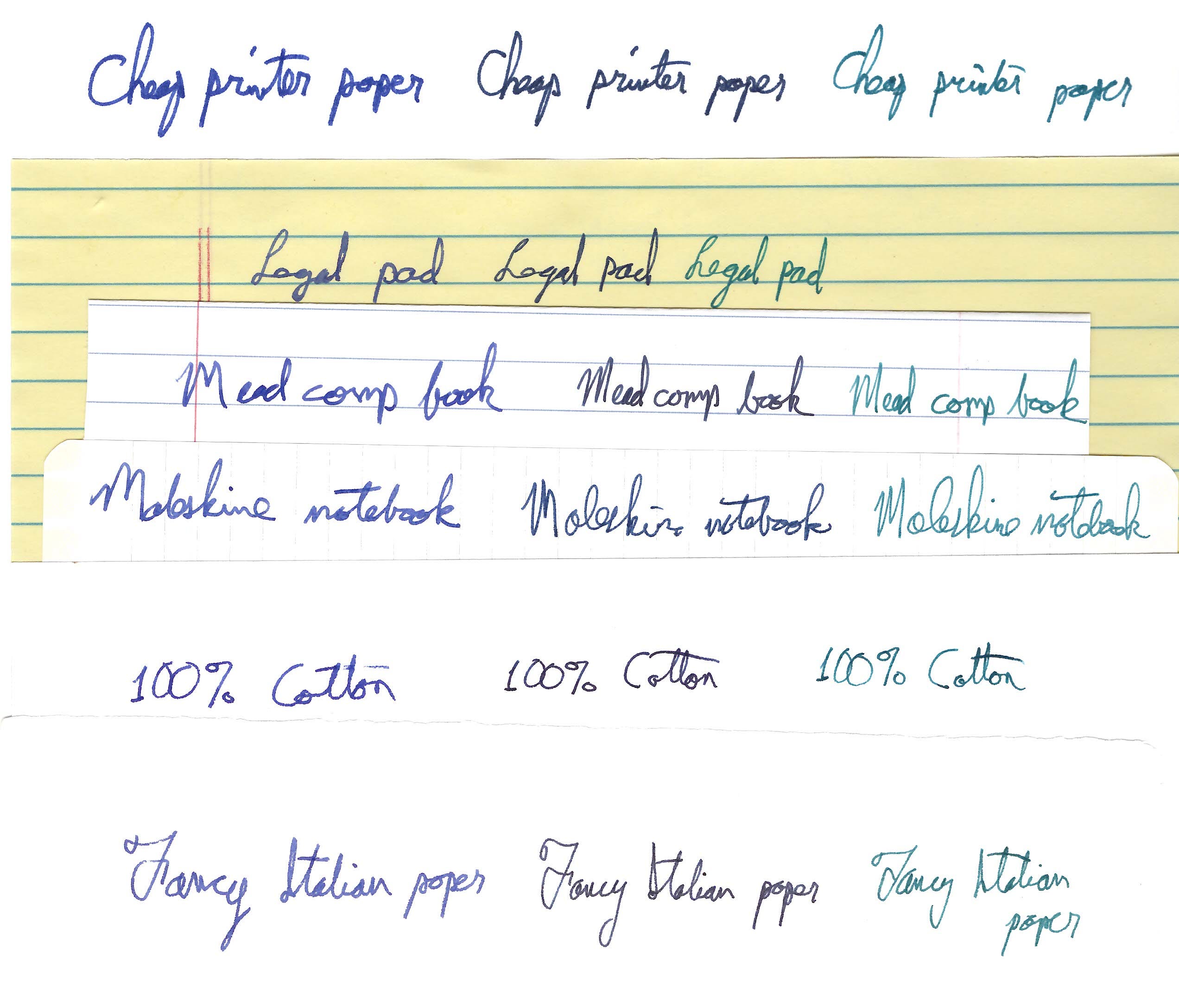
The pen on the left is a Jorg Hysek with a wide nib, and you can see that the cheap printer paper soaked up a lot of ink and left a thicker, fuzzier line. The legal pad wasn’t much better. Everything else basically worked. The 100% cotton paper is from a box I purchased a long time ago - it was marketed for printing resumes, back in the days when people printed resumes. It is the toothiest of all these papers and felt noticeably scratchier. I guess it goes without saying that fancy Italian paper is the best, but the comp book and moleskine work perfectly well with just about any pen.
(For those scoring at home, the middle pen is a Diplomat Aero and the one on the right is a Monteverde Invincia)
If the paper is thin, writing on one side can bleed through to the other, so the results can be slightly harder to read if you write on both sides. Which leads me to:
The ecosystem isn’t going to collapse if you use more paper. It’s cheap. Focus on what’s important here: your brain and your time. Write on one side. Trying to cram more words into a sheet will take you out of your natural and comfortable writing style and make you tired. Just buy a shitload of paper or notebooks or whatever it is you want to use, and use it.
There’s a reason cursive was invented. Don’t even think about not using it. It is far less tiring than printing one letter at a time. I learned cursive as a child. Then I went for many years without using it much, and forgot some of it. Later I re-learned it by sitting in my kid’s elementary school classroom during a parent-teacher conference and examining the forms printed on a long strip above the chalkboard (I still remembered how to do the lower-case letters, but I had forgotten some of the capitals).
Legibility was more important back in the day when written documents had to be read by other people. Hence the need for exacting penmanship, taught in schools to long-suffering children. This is probably the source of a lot of angst around writer’s cramp and ink disasters. Today, if you’re writing things down with ink on paper, you’re probably writing just for yourself, or perhaps for family members who can learn to recognize your handwriting.
To judge from the way people talk, a lot of them have memories of fountain pen disasters where ink got all over the place for some reason. Or perhaps it’s just generational trauma, handed down in an oral tradition. If the pen is working correctly, ink can only come out of it so fast. A couple of rare exceptions:
If the pen’s ink reservoir is partly empty, so that it contains an air bubble, and if it’s positioned nib down, then, when you go up in an airplane, the bubble will expand as the ambient pressure drops, forcing ink out the nib. Once I figured that out, I got in the habit of making sure my pens were positioned nib up when taking off in an airplane. If I have time I’ll also refill the pen before departure, to minimize the size of the air bubble.
Sometimes if a pen gets dirty, or if the nib is somehow damaged, the ink will stop coming out and you can restart it by giving it a little shake. If you do it just right, the ink flow restarts without incident, but if you overdo it, a few drops of ink might shoot out onto the page and become blots. This scenario happens a few times of year for me, only with one pen that has this problem. I blot it with a piece of scrap paper and move on.
Just have notebooks lying around, or on your person. Write grocery lists, doodles, notes on meetings, to-do lists, or stray ideas. Journal. Copy out good lines from books. Anything that has your mental focus will have a more enduring presence in your brain if you write it down.
I am left handed. I have never had any trouble with my hand smearing the ink. Yet every conversation I have about fountain pens leads to someone claiming that it can never work for them because they are left handed. I have no idea what they’re talking about. When I was a child, writing at length with pencil, the side of my hand sometimes became gray from graphite picked up as my hand rubbed across the page. And sometimes I have got ink on my hand when using a ballpoint pen that left an ink glob on the paper. But with fountain pens it’s easy to find a pen/paper combination such that the ink soaks into the paper and dries quickly enough that it doesn’t smudge when you’re writing the next line. Here’s a simple demonstration of drying time and how it works with two pens: first a fountain pen and then a Pilot G-2 gel pen.
Obviously the Pilot gel pen ink dries faster, and so that might be a better choice for people who are really worried about smudging.
Most modern pens allow you to choose between using preloaded plastic ink cartridges and a plunger that enables you to draw ink up out of a bottle by hand. I use both. Start with the ink cartridges, especially if you travel. There’s no need to complicate matters by messing around with bottles. Since I do a lot of work from one location, I have a corner of a tabletop set up there with ink bottles and a folded-up paper towel for wiping off the nib after it’s filled (I have been using the same paper towel for about twenty years). In theory this works better in the long term because it allows you to flush the nib by forcing ink in and out of it a couple of times whenever you refill. In practice I see no difference at all - pens that I refill with cartridges don’t get clogged.
Even if everything works perfectly you’ll end up with the occasional ink-smudged finger. It will wash off quickly - the ink is water-soluble. Until then, consider it a mark of distinction.
If you’re new to this I think it makes most sense to start by considering what kind of paper is going to work best in your life. Are you writing looseleaf, or in notebooks? Legal pads? Blue books? Remember, it’s okay to use lots of paper, so pick something that isn’t too precious and that is easy to replenish. I use a lot of moleskine notebooks and Mead comp books, which I can buy in bulk online. For composing fiction I use fancy looseleaf paper.
If you have access to a store where they sell fountain pens, take some of that paper there and see what works best. If you’re working with cheaper, thinner paper, start with finer nibs and work up to fatter ones until you start to see bleed-through.
Buy cheaper pens until you know what you like. I doubt there’s much of a difference between cheaper and more expensive fountain pens in terms of their actual performance. What you’re paying for, in an expensive pen, is fancy materials and styling. For example, if you look at the Pilot Vanishing Point line of pens - an ingenious fountain pen that you can click, like an old-fashioned ballpoint, to retract the nib inside the barrel - fancier versions cost five times as much as the base model.
In all honesty, the Pilot G-2 gel pens are going to give you 80% of what you could expect from a fountain pen for minimal cost.
On the other hand, a ten-pack of Pilot G-2 gel pens goes for about twenty bucks. For the same amount you can buy a simple but completely serviceable fountain pen that will last longer than you will.
No posts
Mostly they're just nice for being fairly rugged and reliable in a way most nicer pens just aren't, for carrying loads of ink, and for being ubiquitous. They're far from perfect. They're just... Good Enough™. And that's good enough!
Here's my own more detailed article, though it's not saying much more on this.
https://www.linkedin.com/pulse/handwriting-better-than-typin...
And it's good for your brain to read the whole article, not just the title:
"Don’t use a gadget"
if you cross out words in a book you borrowed, that is vandalism. if you cross out words in a book you own, by definition, that is not vandalism.
it would be uncool to mark up a textbook you planned to resell at the end of the semester, but it still would not be vandalism assuming you bought the textbook.
This acts as a note keeper, bookmark and sort of time capsule for me. When I finish a book, i’ll always leave it in there. I don’t know why… but I just like the idea of random people (and my kids!) finding these random photos and notes in my books long after i’m gone! The photo in the book also links it to that period of my life.
I found a strange polaroid in a 2nd hand book when I was a little kid, then some years back I used a photo of my own as a bookmark, the memory bubbled back up, and here I am now. Wife and I kept saying we don’t print enough hard copies of photos, so this helps fix that a little bit as well - you could say I now print too many!
> There would've been essentially a post-it note on every single page. Or I'd highlight like half the page.
That just means you are not good at highlighting. Which is likely why your teachers wanted you to practice it.
If you highlight half the page, I totally understand why it never worked for you and you did not get it.
I'd like to slow down and just listen but the reality is I won't.
But for writing in English and many other languages, it seems like this doesn't present a huge challenge. I am particularly interested in (but have not yet tried) the handwriting cleanup feature. This seems like a nice middle ground between full digitization and leaving chicken scratch as-is.
I have been delighted by the writing I've seen in books, especially if it's a copy of a friend or family member, as you feel you are connecting to another reader years later, and the item is no longer identically mass-produced. But maybe it depends on the taste of the person writing in the book.
I admit I don’t mark up my books but I feel tempted to try
for someone so concerned about knowledge, you don't seem to be too worried about continually using this word incorrectly.
But I get where you're coming from as well. I guess it just really depends on the context of who/what/why when it comes to reading.
And not that it matters, but "cross out" doesn't imply "destroy beyond recognition." A simple strike-through is sufficient to keep the text legible (so you remember what it is you disagree with).
You can buy unmarked used books. Just check. (And if you're buying online the state of the book is expected to be in the description.)
(I do wonder if the people here who hate it are picturing students who blindly highlight pages, and the people who like it are remembering the times they've seen a few pencilled sentences in margins of an old book)
> and it's a shallow way of taking notes to begin with
Are we really going to speak down to how someone uses a bunch of paper bound together? That's how they wanted to use it, which is cool, it's just not how you like it.
Very often when I write in margins it's to question or argue against what's written (e.g. "really? what about ...", or "no, contradicts ...") which, to me, seems in line with the dialectic process Socrates promoted. Multiple sides, truth-seeking.
Sure, having a spacious notebook on the side is even better. But it's the same goal, isn't it? Engage more deeply with a text and encourage questioning as you read it, while it's still fresh.
The idea isn't to merely take down a record of what was said, but rather to integrate the concepts into your own understanding: What associations can be made with existing knowledge, can you demonstrate to yourself your understanding of an abstract by contriving examples of it, can you explain it to your grandma, do you have a clear model of its scope/boundaries/limits and of where it fits into its domain, do you know the why as well as the what, etc.
The part where we have to condense what we're hearing into something concise enough that we can keep up is a feature. For that reason I wouldn't really recommend transcribing the lecture and then making notes out of it later, either (ideally we should be reviewing and organizing the notes into a more structured / fleshed-out / pared-down (as needed) form later anyway, so it would just seem to add an extra step). I don't know what everyone's courses are like, though, so maybe that approach could be useful or necessary for someone.
(And of course the takeaway here is that, assuming my understanding of it is well-grounded, and provided there isn't truly something inherent to handwriting that makes it cognitively advantageous, typing should have the potential to be just as workable a medium.)
Amazon's used prices are usually set by booksellers that base their prices on stuff like this for some books... When you get to like old cheap paperback romances though, or that .01 plus shipping, you might or might not.
I would be pissed if I expected a clean, un-scribbled-on book I wanted and it was represented as such, but got that.
The unfortunate part is that you can't then unhighlight a passage.
Here is my github repo with scans of the marginalia from Edison: https://github.com/RRWagner/Making-Good-in-Business-Babson-E...
It is very frustrating the number of people who say "it's their property, they can do whatever they want" and similar comments, all of which are missing the point. Yes. It is legal to write on your own property. I know thay. It's my opinion that they're doing something that is guaranteed to harm overall human knowledge: whoever purchases/inherits/digitzes the book has to deal with it. And it almost certainly harms their own understanding of the book.
Also it seems like you can buy the George Rey one for $54 new here https://www.wiley.com/en-us/shop/general-philosophy/contempo...
unless you also don't believe in paperbacks.
And the other is on amazon _new_ here: https://www.amazon.com/dp/0198244649?lv=shuf&channelId=500&p...
I have never learned how to do something substantially difficult (math, foreign language, any science, or memorizing a substantial amount of content for a humanities course) without handwriting it. I remember in 8th grade latin, I copied down conjugation charts onto a chalkboard over and over until I had them memorized.
I cannot do university level mathematics without writing it down by hand.
My typing is much better than my penmanship, but it doesn't tend to make topics stick in my brain in the same way that handwriting them does.
And it's not like there was some sort of actual objective or teaching. Who knows, maybe I would've "gotten it" :shrug:
I found a used book that was given to someone when he graduated top of his class in the early 1900s. There was an inscription from the principal of his college, signed and with a seal from the college. I stood there gazing at it and couldn't help imagining how he finished reading it, left it here and there in his house and finally, after his time, in the attic of the ancestral home. It was later discovered by his daughter or granddaughter and then when they were cleaning up, sold to a second hand book seller rather than just destroyed.
Contrast that to a PDF which is just as crisp and clean as it was when it was created (and which could, become a format for which we don't have a reader anymore).
I found the exact opposite. My math and physics lecturers were expecting us to write what they wrote on the blackboards or overhead projectors down. So they had prepared the lectures this way, they wrote at a decent speed so you had time, and you could think about the steps as you transposed it to the notebook.
I found many small mistakes the lecturer had made this way, forgotten a sign or forgotten a factor, as I would follow along the whole time and go "wait, how did he get this from that".
I wrote it all down, but I seldom had to study them afterwards. I would often just gloss over and I would recall it all.
This was in stark contrast to other and later classes where the university administration had pushed hard for slideshow-based lectures. There the slides moved so fast I didn't have time to take proper notes, or I had to sacrifice listening to the lecturer. I ended up stop taking notes and just listen, but the memory of that wasn't as good as the handwritten notes, not by a long shot.
Even if we take for granted that it was principled, it almost certainly wasn't pointed at marginalia. The argument (that Plato put in his mouth, through written text, no less) is that writing that substitutes for internal recollection can't answer back. It's an argument against outsourcing a thought to fixed text. A margin note is the opposite: it's the reader talking back to the text.
You have a personal preference about buying unmarked books, and you retreat to a Grand Unifying Socratic Theory whenever someone challenges it.
> it almost certainly harms their own understanding of the book
What? For all people who ever mark up a book in the margins or highlight passages? How could you possibly know that?
> they're doing something that is guaranteed to harm overall human knowledge
Also what? Human knowledge is necessarily a collaborative effort. Reading a text with another person's notes alongside it is just another way to engage with it. I'll maybe grant you highlighting since it's been shown to not help with retention all that much.
We have a deeper understanding of some of the most famous thinkers in history because we have books that they marked up to help us understand how they engaged with specific texts. This is invaluable for "overall human knowledge."
Herman Melville marked up his copies of Shakespeare's works and that shaped how scholars read Moby-Dick. Did he "harm overall human knowledge" by doing that?
A book with notes is a guarantee that the book didn't spend its life sitting on a bookshelf not being read. If people are reading it is a net positive for overall human knowledge.
Lastly, your usage of Socratic teachings is a hollow appeal to authority. Socrates is dead and a modest library in an elementary school would surely have brought him to tears had he known how far we've come as a species, much less the remainder of books currently available.
if it doesn't clarify in the description, ask or don't buy.
If by that you meant to suggest that for formal study, some kind of self-review process combined with cold written practice/rehearsal sustained under interleaved spacing, then that is likely the gold standard for comprehension and memorization. But most people don't even know that, either.
But the main premise is we should not assume all book reading is for rigorous self study. Margin notes can be useful for other purposes than direct understanding/retention (I admittedly don't know the psychology evidence for it but many academics routinely write margin notes here and there on (poorly written/edited) papers for purposes of idea generation, scientific criticism, etc. Presumably the Edison example mentioned above would have been more like that.).
Plato argues, in a book, in the voice of his mentor Socrates, that books will destroy knowledge. And the reason is precisely to do with the thing that Socrates is famous for, his Socratic Method of asking his students (or rival politicians or anyone) questions about what they claimed to know, engaging them in a real discussion where we come to things that we agree about and then build that agreed knowledge-base incrementally. For Socrates, a book could never provide that experience; you cannot ask the book a question.
My guess is cheapest versions of each are the problem
Like, handwriting doesn't do a thing for me. It doesn't help me learn at all.
I can't help but wonder if there's some advantage that I'm missing?
But on the other hand, I don't seem to have any problems paying attention or learning. So I'm still just so confused as to how it helps. Like, is my brain already doing the things that some other people need handwriting for? Or is it not, but handwriting doesn't do those things either?
I think I'm extra-baffled because I can't even imagine how it could help. Like, I can't think of any analogy to anything else that would help me understand. I already understand the things and listen to and see, I don't have any issues with concentration or anything... so what does the handwriting add?
I see a lot of people say that it forces you to think more deeply about the material, but I'm kind of always on "maximum thinking mode" already.
It also coincides with the Taoist philosophy (and actually somewhat Buddhist) of learning through actions and not speech. The most famous (if I recall the story correctly) of the Buddha teaching his disciples by smiling and twirling around a flower.
Kind of fascinating that these faraway places kind of arrived at the same ideas. Independently or not I think nobody would know but it does not matter.
Do you write when you do math? Math and handwriting are so intertwined in my experience, I can't imagine doing math past high school without at least jotting some parts of the process down.
Not all books, of course. If you're reading a self help book or some technical one, scribble away at your heart's content.