If you work in or around the film industry, there is a decent chance you have used the work of The Numbers this month, whether you realise it or not.
Its hand-researched data is the highest quality, tracking box office grosses, budgets, home video and streaming across more than 78,000 films and 236,000 people. It gets north of eight million visitors a year, and is treated as THE definitive authority by journalists, academics, filmmakers, prediction markets, and even Guinness World Records.
And it was this GOAT status which caused the catastrophic events of March this year.
On the 5th March 2026, TheNumbers.com website vanished.
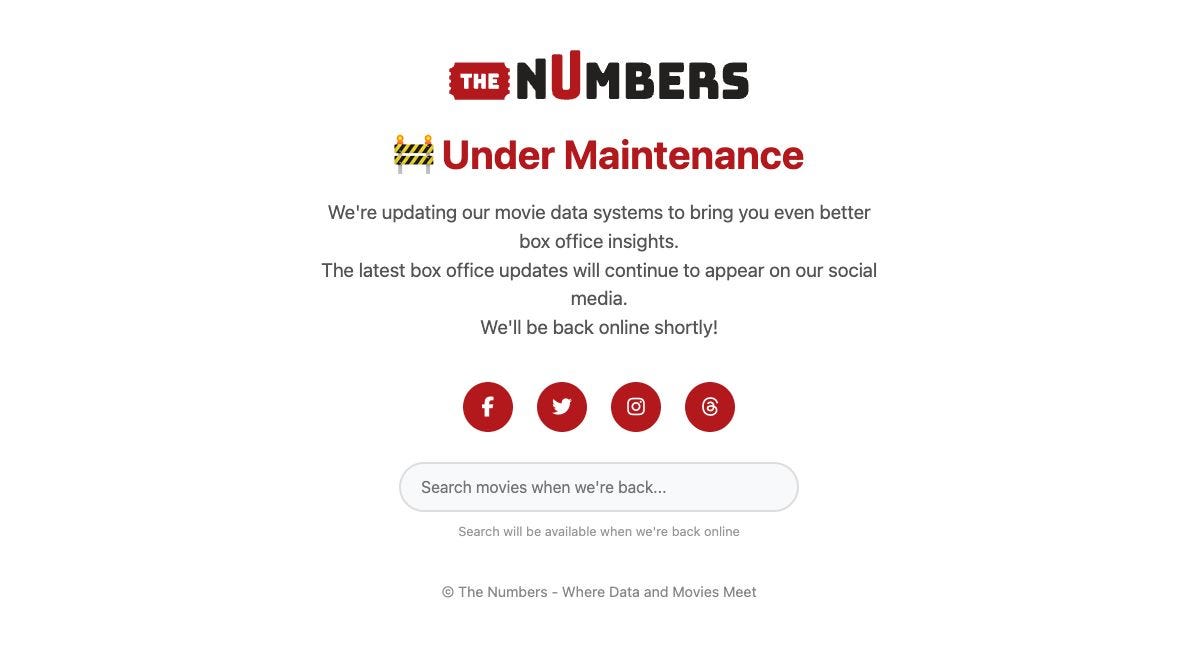
The site was down for over a week, without explanation. A week later, it resurfaced at a fraction of its former size. Gone were the historical charts, the individual movie pages, and even the much-loved Report Builder.
With only a generic “we’re rebuilding, please bear with us” message to go on, the internet responded as it always does - with confusion, anger, and conspiracy theories.
One Reddit theory even suggested it was a deliberate rug pull designed to cripple the free site to push people towards paid products.
Three months on, I spoke at length with Bruce Nash, founder and CEO of The Numbers, about what happened. He describes quite an unpleasant and eventful experience:
We got a lot of angry emails from people who are like, 'Where's this page that you used to have and you don't have anymore?'
Within his tale are a number of things that should worry anyone who runs, relies on, or simply appreciates the internet.
On Friday 17 October 1997, mathematician and former IBM software developer Bruce Nash launched a Geocities site that tracked 300 films.
Bruce described the launch in a 20th anniversary essay (which now survives only in the Internet Archive, for reasons that will become clear):
I hit a button in an Access database, uploaded some HTML pages to Geocities, and made a brief announcement on the Hollywood Stock Exchange message boards to let people know that I was starting to analyze box office for films to help them pick MovieStocks to trade on HSX.
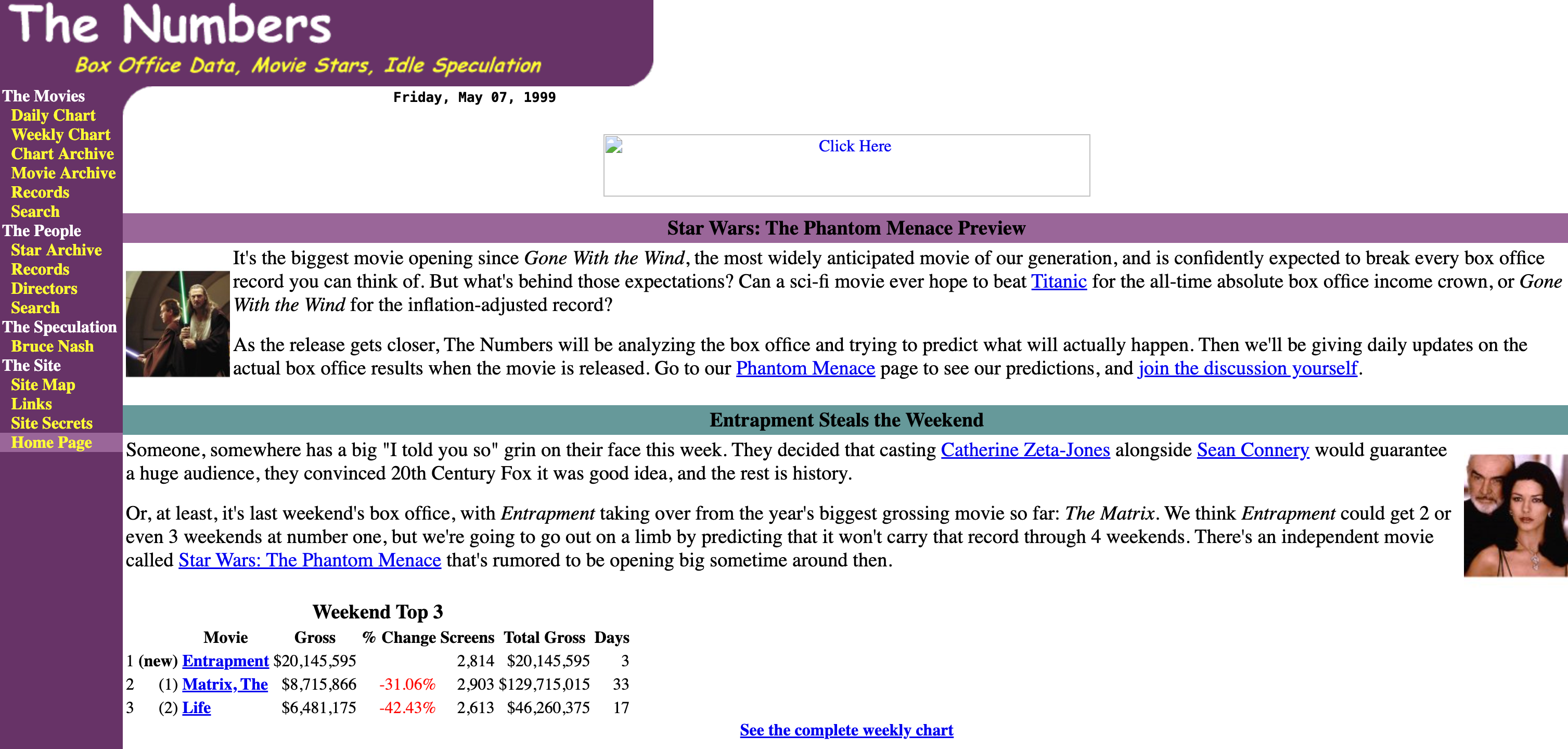
From those humble beginnings, Bruce and the team he built around the site turned The Numbers into the film industry's most reliable financial source.
At the start of 2026, the database tracked 78,396 movies, 178,375 theatrical release records, and 236,176 people.
During its lifetime, the challenges The Numbers has faced have changed immensely. For its first quarter century or so, the traffic was manageable and mostly polite. As Bruce puts it:
Pre-AI, we got human traffic, mostly well-behaved search engine crawlers, and a few people crawling the site for personal projects. If someone got too greedy, we could spot them and block them.
Over the past couple of years, website owners the world over have seen their web traffic change. What was initially only people browsing gave way to an ever-increasing number of bots. By 2024, automated traffic had surpassed human traffic, and just last month, Cloudflare announced that bots had reached 57.5% of web page requests.
The Numbers felt this shift in two distinct waves. The first started around 2024:
We saw a big increase in crawls as AI training joined the search engine crawlers. The AI crawlers are generally less well-behaved than the search engines, which increased the management tasks for us to keep the site running smoothly.
And the second wave was stronger and more damaging:
Around December 2025, we saw another big spike in traffic which I attribute to agentic AI: a combination of AI agents that scrape sites in response to prompts, and people being able to write agents that scrape sites.
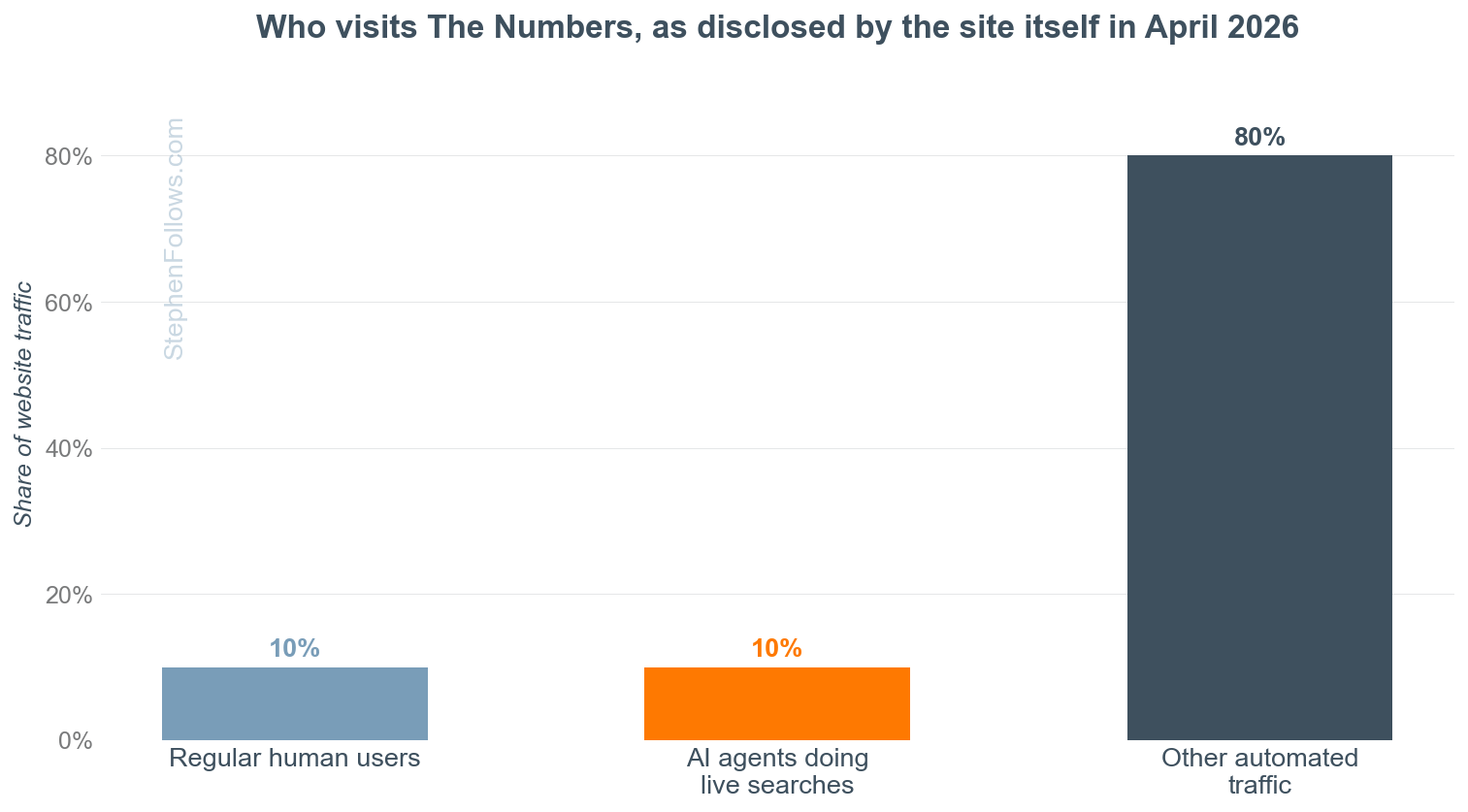
Like every data-rich site, by early 2026 The Numbers was being hammered hard by AI bots scraping its pages over and over at an industrial scale. Bruce says that only 10% of their traffic is from humans browsing the site, with the rest coming from AI bots and automated traffic.
This put enormous strain on the site, but Bruce and his team were able to take measures to mitigate the worst of it. One of the cleverest was talking to the robots in their own language:
There’s stuff on the site which is designed for an LLM to read, so that it can tell somebody ‘here’s how you licence the data’ rather than ‘here’s how you scrape the website’. It’s had a huge effect. We’re now getting probably ten times the volume of licensing enquiries.
But mitigation is not the same as escape. From December through early March, the team struggled to keep the site alive under the load. Bruce estimates that:
Around 90% of our time was spent keeping the existing site running while we spent our spare moments working on a new and improved system.
The problem was compounded by the site’s age: thirty years old, with approximately 160,000 source files serving around 2 million pages.
Then, in the early hours of Thursday 5 March, the servers collapsed.
The team scrambled to understand what had happened, initially assuming it was the sheer weight of AI traffic. It seems AI was to blame... but possibly not only in the way they first thought.
Buried in the flood of agentic traffic, the site’s logs showed something more pointed than scraping. As Bruce describes it:
Some of these used the site using legitimate URLs, others were looking for back doors, most likely so they could get to the data before it appeared on the site, or to manipulate the data presented to users.
On the advice of a friend who works in cybersecurity, the old server stayed off. For good. Restoring the backups and nursing the thirty-year-old site back online would have meant defending 160,000 legacy files against attackers who had spent months probing them.
The team rushed up a skeleton version of the website on new infrastructure, which could at least keep delivering the latest box office figures while they took stock of what had happened and what to do next. It went live on Friday 13 March.
At first glance, The Numbers may not seem like an obvious target. It doesn’t collect credit card information, and there is no juicy customer data to flip on the dark web. It is a small, independent company that publishes how much money movies make.
How could someone expect to make money purely from having private access to their site?
In case you haven’t guessed it yet, it’s linked to prediction markets.
Polymarket runs weekly markets on opening weekends, and names The Numbers as the ultimate source of truth:
The ‘Daily Box Office Performance’ figures found on the ‘Box Office’ tab on this movie’s The Numbers page will be used to resolve this market once the values for the 3-day opening weekend are final.
The sums on any single weekend market are modest by financial-market standards, typically in the tens to hundreds of thousands of dollars, with a couple of million dollars across live box office markets at any given time.
If you could see The Numbers data before everyone else, every single week, you would have a significant edge over all the other traders - learning the answers slightly ahead of publication would allow you to front-run the trades.
In a situation like this, it is hard to know for certain what happened. We know that the logs showed months of automated probing and scraping of the site, but what finally brought the site down, and who did it, remains an open question.
But the theory that someone used AI to develop an advantage in a prediction market is entirely plausible. The Numbers experience shows us that:
We now live in a world where a movie statistics website is worth hacking because prediction markets empower anyone to turn almost any data into money.
Hacking websites is now something anyone can do with a cheap AI subscription.
The web, as we have it, is incredibly fragile in the face of large-scale swarms of agentic AI bots.
In November 2025, Anthropic (the AI lab behind Claude) published a report on what it called the first documented AI-orchestrated cyber espionage campaign. A state-sponsored group had used its coding tool to attack roughly 30 organisations, with the AI performing 80% to 90% of the work and humans stepping in at only 4 to 6 decision points per campaign.
Anthropic’s own conclusion was:
The barriers to performing sophisticated cyberattacks have dropped substantially, and we predict that they’ll continue to do so.
In an earlier threat report, Anthropic were even clearer:
Criminals with few technical skills are using AI to conduct complex operations, such as developing ransomware, that would previously have required years of training.
Meanwhile, an autonomous AI penetration tester called XBOW reached number one on HackerOne’s US leaderboard, the ranking of the people (formerly all people) who find security holes in real companies for bounties, submitting nearly 1,060 vulnerabilities along the way.
Getting access to a thirty-year-old website with 160,000 legacy files is exactly the kind of known-flaw surface that AI tools have made cheap to probe. The expertise barrier that once protected small sites from all but the most determined attackers has largely evaporated.
Bruce and his team were relatively lucky. Despite having their entire site knocked out overnight, they were able to keep going. The Numbers has always been free to use, and the site hasn’t relied heavily on advertising for the past few years, so the outage didn’t destroy an income stream they depended on.
Their core business is tied to selling bulk data through the OpusData service, producing comp analysis reports for filmmakers and investors, and publishing the Business Report - all of which were unaffected by the public site going down.
But they do need to build an entirely new website, from scratch, to host those 78,396 movies, 178,375 release records and 236,176 people. Restoring the site from a backup wasn’t an option, as Bruce points out:
It was really clear that we couldn’t just put that server up again, because it would inevitably be brought down again, possibly within minutes.
That is why the site came back bare-bones in mid-March, and why features are returning gradually rather than all at once.
Right now, the team is having to reconsider what a public website even means in 2026. Bruce’s analysis is that The Numbers used to serve two audiences (human beings and search engines) and now serves roughly six: humans, search engines, LLM training runs, prompt-based AI traffic, agentic AI, and prediction market punters. Each has different needs and a different traffic profile. As he puts it:
We’ve gone from a world where running a web site meant focusing on three things (content, ads, and SEO) to about eight to ten different factors that go into every design decision.
The goal, he says, is to support all six audiences, with new OpusData services and online features for Business Report subscribers, and, importantly, to help regular human users of the site regain the data it has always provided, some of it in new and improved form.
Pretty bad, tbh. Enough that site owners such as Bruce have to question the value of something that will take so much time and money to build and defend.
Cloudflare, which protects a huge share of the world’s websites, publishes data on how many pages each AI platform crawls for every one visitor it sends back to the websites it crawled.
Google crawls about five pages for every visitor it sends you. OpenAI crawls over 1,000. Anthropic crawls over 38,000 pages for every single visitor it refers.
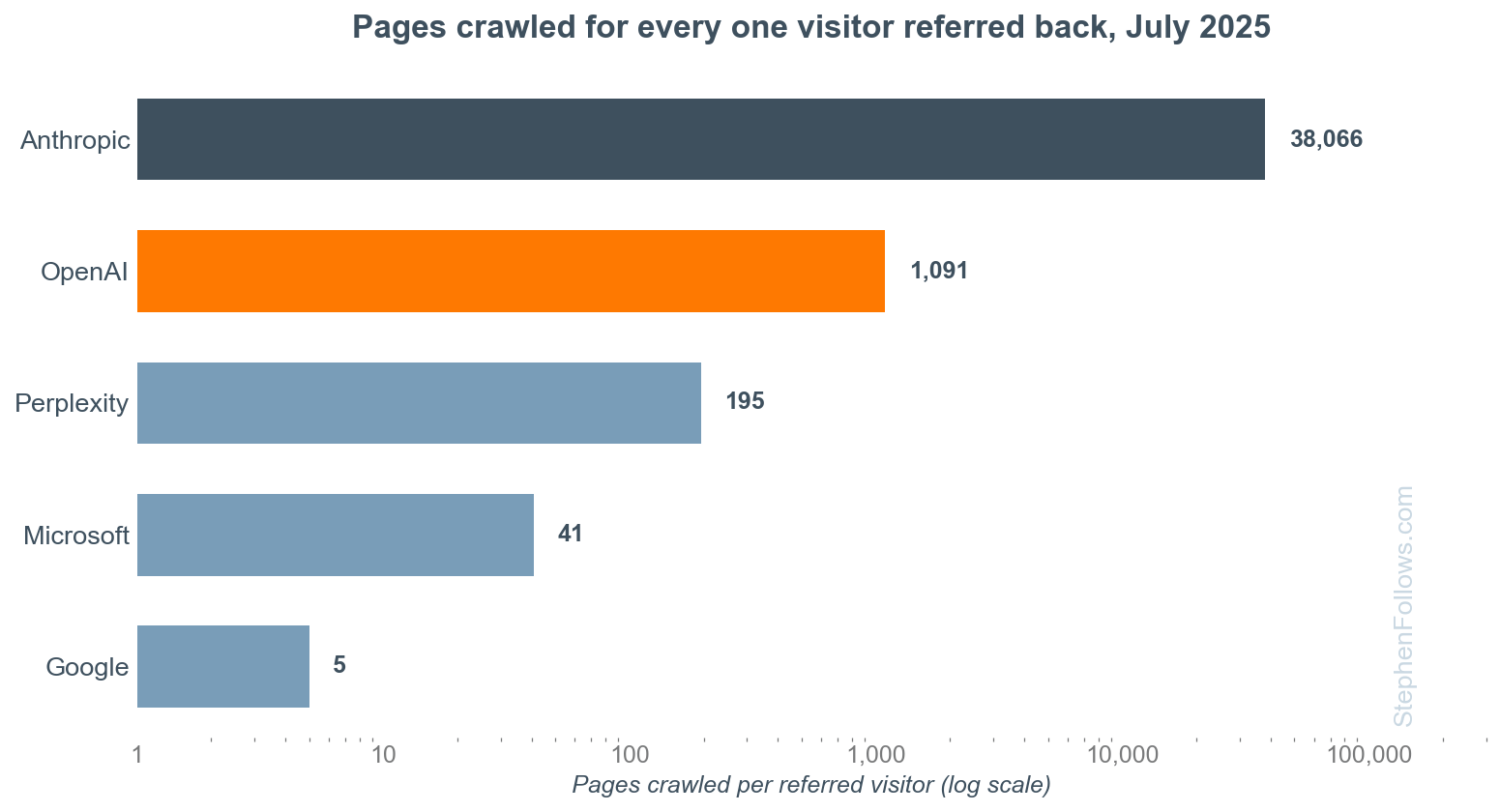
Note that the scale is logarithmic, i.e. each step along the bottom is ten times bigger than the last, because otherwise the differences are quite literally too large for me to include on one chart.
For the history of the internet to date, the principle of the open web was that, in return for letting the search engine robots read your site, they would send you readers. But now, that trade no longer applies. The number of robots has exploded, and they no longer send anyone back.
When this firehose is aimed at a small site, it can inflate the bandwidth bill and possibly even take down an entire site. Sites which can relate to Bruce’s experience include:
Read the Docs, a non-profit that hosts documentation for open-source software, who watched a single crawler download 73 terabytes of zipped HTML in one month, costing it over $5,000 in bandwidth.
iFixit, the repair-guide database, logged a million hits from Anthropic’s crawler in a single day.
Triplegangers, a seven-person company selling 3D scans, was knocked offline during business hours by OpenAI’s bot, in what its CEO described as “basically a DDoS attack”. The founder of code-hosting service SourceHut reported spending “anywhere from 20-100% of my time in any given week” fighting AI crawlers, with “dozens of brief outages per week”.
The editor of Linux news site LWN described crawler traffic from “literally millions of IP addresses” and concluded: “it is a distributed denial-of-service attack”.
When the GNOME open-source project measured its traffic, roughly 97% turned out to be bots.
A university library banned 16,000 IP addresses in 48 hours to keep its catalogue online.
The Wikimedia Foundation, which runs Wikipedia, reported in April 2025 that bots account for about 35% of its pageviews but at least 65% of its most expensive traffic, because crawlers bulk-read obscure pages that human readers rarely touch.
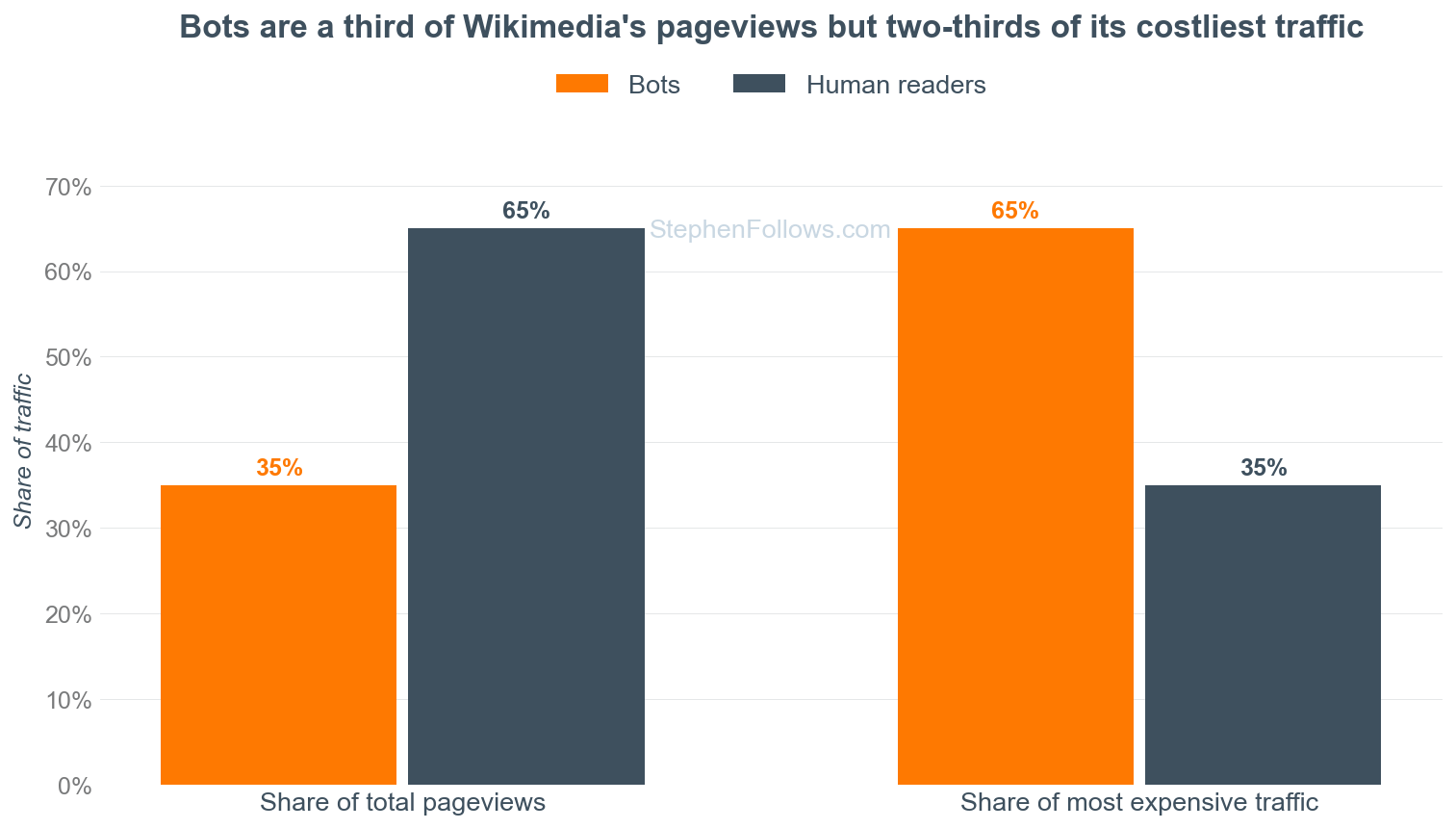
Six months later came the other half of the squeeze, when Wikipedia’s human pageviews fell roughly 8% year on year, as people increasingly get Wikipedia’s knowledge from AI summaries without ever visiting Wikipedia. The machines are taking both the content and the readers at an industrial scale, too.
AI tools are some of the most powerful and destructive things humans have ever created. And they are being effectively tested by the public in real time in the real world. When the Manhattan Project was trying to work out the power of their atomic tech, they did not do so by sending everyone the specs each morning and seeing which houses blew up.
The world we have built thus far is so incredibly ill-prepared for the power and scale of the AI models we all have access to.
I don’t wish for this to sound like a one-sided anti-AI fear campaign. There is a lot to like about AI and what it can do for the human race. But we do need to consider the world we’re currently stepping into.
What breaks first are the things built for the old internet. The open web was built on assumptions such as that visitors are mostly human, that traffic roughly tracks readership, and that the cost of serving your site is related to the value you get from serving it. Every one of those assumptions is now out of date.
A year ago, Cloudflare launched pay-per-crawl, letting sites charge AI crawlers per page. Last week, it went further, announcing a pay-per-use model in which publishers get paid when their content actually appears in an AI answer, and declaring that, from 15 September, its customers’ ad-supported pages will block unpaid “mixed-use” crawlers by default.
Whether any of this works depends on whether the AI companies play along rather than route around it. But as Bruce put it to me, somebody has to try.
Let’s look beyond the specifics for a moment and consider what happened here.
A beloved, useful, free website, run carefully by a competent, honest person for nearly thirty years, was crushed between two features of the new AI economy.
Unsustainable machine traffic hammered it from above, and in all likelihood a financially motivated intruder, operating in a world where breaking into websites has never been easier, took it down.
Bruce’s business and livelihood survived only because the website was not the whole business.
Others have not been so fortunate. Just last week, ZEGO, a German textile firm that had been in business for 37 years, filed for insolvency after a single cyberattack in March shut down its production for six weeks. Unlike The Numbers, they had no other business to fall back on.
The web is full of independent archives, hobby databases, local news sites, forums, reference works. Decades of accumulated human effort, running on old code, maintained by small teams or single individuals, quietly holding up far more of our shared knowledge than anyone acknowledges.
The Numbers is coming back, better built than before. I would encourage you to keep using it, keep supporting it, and, if you are one of the many people who emailed Bruce in fury about a missing page, perhaps send a kinder one now you know why it was missing.