[0]https://www.kmbc.com/article/lithium-ion-batteries-catch-fir...
[1]https://www.kmbc.com/article/panasonic-plant-de-soto-evacuat...
The flavour you want is polymer, single ion conducting solid state with an ion transport activation energy below 10kJ/mol at room temperature and no phase transitions from -40C to 80C.
That is the holy grail of SS batteries.
I am surprised they didn't point out the literal "killer app" - military drones. Energy density is king for any airborne power source. And dendrite growth during charge/discharge cycling isn't as big a deal for that application (how many times would you need to charge a disposable weapon?)
Ambri was working on large scale batteries which seemed like a pretty good idea (looks like they ran out of money): https://en.wikipedia.org/wiki/Ambri_Inc.
The problem is primarily that batteries are storing a lot of energy, which can be released when things go wrong. The electrolytes (technically, the solvents) typically don't ignite under 750°F or so, which makes them less flammable than a lot of other common materials, and far less of a concern than, say, the lithium metal.
The energy density scatter plot is physically correct but misleading and everyone makes this mistake.
From an engineering point of view you have to use work delivered at the end of the drive train not fuel raw energy content.
When you do that lithium ion batteries compare more favorably to liquid fuels. That’s because the conversion path is more than 90% efficient. For ICE engines you’re starting with only 20-40% Carnot efficiency (depending on how good and in good shape the engine is) and then losing in the transmission and then losing more because ICE cars have more other gears and moving parts. Power to wheel is pretty terrible. Most of the energy from gasoline heats the air around the car.
This is also why you get outrageous sounding but accurate things like: an EV charged on 100% coal fired electricity emits less carbon than a typical gasoline car. The fact that coal is literal pure carbon fuel is made up for by the high thermal efficiency of a giant supercritical steam turbine vs a small piston engine. Coal burns real hot too (steeper thermal gradient). So more of the energy from coal ends up doing actual work vs heating the air. (Well directly heating the air I mean.)
is LiFePo4 immune to dendrite shorts? Or do they happen just don't burn?
Well that's fine for terrestrial use but aerospace needs that range to be expanded a little in both directions, otherwise it won't be much of a holy grail if it won't cover the needs of one of the largest growing industries.
And it's still improving at about 5% per year.
The Watt-hours per kilogram of good Lithium Ion batteries is around 250-280 Wh/Kg; for Lithium Iron Phosphate it's about 180 Wh/kg, and for Sodium-Ion about 170 Wh/Kg.
The raw energy in gasoline is about 12,300 Wh/Kg but automobile internal combustion engines get only about 20-30% efficiency yielding about 2500-3600 Wh/Kg. For aviation piston engines it is a bit better at 25-30$ so 3000-3600 Wh/kg.
So, the batteries, instead of being 10-12X the weight of the gasoline for the same net driving/flying range, could weigh about the same as the gasoline. So, a typical car with maybe a 16 gallon tank and 30 miles per gallon fills up with 128 pounds (58 kg) of gasoline to get 480 miles of range. The Li-Ion battery for that range would weigh something like 1300 Lbs (590 kg). That is a substantial additional weight for a car that could be 2800-3800 Lbs in ICE configuration, so 35-45% added weight (a bit less because of savings on the ICE engine, etc). This requires everything else to also be heavier, from the structural frame, the suspension system, and even the wheels and tires (which is also unsprung weight, further impairing performance).
With a 130Lb/60kg battery instead, and saving the weight of the ICE engine and fuel system, the overall car design could go much more lightweight, regaining a lot of performance and range, all while gaining the huge torque of electric motors.
In aviation, a battery systems of that weight would enable all-electric aviation to go from small performance niches to the default for general aviation.
So yes, it would be a HUGE benefit to achieve 10X energy density batteries, and we do have reference points for people to imagine it.
A good place to start would be a BMS on individual cells that monitors them for general degradation, unexpected discharge, unexpected temperature changes, and can remove a failing cell from the array.
Speaking of nuclear, getting tons of the material that powers mars rovers and putting them in every home would generate enough power for decades... At the cost of being able to build a nuclear bomb in a garage.
- WW2 proximity fuzes that had batteries where the electrolyte was in a vial that got smashed by the G-forces of being shot out of a cannon providing power to the radio inside for the 10 seconds it needs to get to the incoming aircraft
- Hearing aid Zinc-Air batteries, that are extremely energy dense because you only have to actually manufacture the anode, the cathode is the entire atmosphere of the Earth
- Missile batteries, which are often Lithium-silicon/Iron Disulfide batteries that borrow some thermal energy from the rocket motor to get a molten salt electrolyte
An 18650 battery weighs ~50g and stores ~10 watt-hours. 10 watt-hours is 8,604 calories, enough to heat 50g of water by 172 C or 310 F. The battery would not even burn without a liquid electrolyte to ignite.
The liquid electrolyte is the thing that releases most energy when the battery burns, more than the anode and cathode. Some also have a very low self ignition temperature.
So the main risk here would be the likelyhood of short circuiting under different failure scenarios.
Is that the electrical discharge, then the lithium going off, then the electrolytes?
The most common lithium battery failure mode is that you have a hole in the plastic separator between the +/- sheets inside the battery, which shorts and causes a hotspot that eventually starts a fire. Dendrites cause the short by growing across the gap. In normal batteries it is caused by a manufacturing defect. The outcome is pretty similar.
Also, EVs use regenerative braking. That should help a little bit.
EVs should be built with 100 - 150 mile range. All families with 2 cars can immediately switch one of their cars to a daily driver EV and the other vehicle is a minivan. There are lots and lots of people for whom an EV works perfectly well and if they need to go longer, US has a robust rental car industry. What would help is to let people charge anywhere they park. All workplaces should offer free charging, and companies can negotiate to get paid for charging their employees cars. The price of electricity goes negative because of lack of demand, and this is something that they can offer to the grid, demand as a service.
A 1 GWh grid scale battery takes up about 4 hectares at the moment. The UKs total energy use is about 2,000GWh a day.
It would need to use 240,000 hectares to store all energy requirements (eletric, transport, heating etc) for a whole month. Even in extreme cold conditions it would last a couple of weeks.
That would be about 1% of land use.
For example, no need to build natural gas infrastructure to every home. Use induction stoves (or electric coil -- already 67% of homes). Heat pump water heater instead of gas. And heat pump for HVAC.
If all energy bills are consolidated as electricity (instead of gas, natural gas and electricity), most people would install solar on their rooftops, buy EVs, and save ~$1000/month on energy bills.
I think you're underselling it, even. A typical like-for-like modern EV is only marginally heavier than the ICE equivalent. If we were able to drop the weight of the battery by a thousand pounds, cars would be lighter than they have been in decades while retaining all the modern safety and convenience features we've come to expect. And if density improved along with weight, we could make EVs with the same form factor as today but with over a thousand miles of range. Not that we need that, but it is just as a tiny example of how mind boggling the game change would be.
As it is I've only recently internalized the notion that the most powerful electric tools are battery powered (what can I say, I grew up when rechargeable batteries were NiCad and they basically sucked). And it will just get better and better as time goes on.
Theres a handfull of Tier 1 BMS chips that support it already. though, half of them are meant for traction/EV packs instead of BESS.
Electric long distance container ships.
Useful portable laser, coil- and rail- guns.
Even longer range drones.
We could go for performance, trading off some battery for four inboard motors (fully sprung weight) with half-shafts and CV joints, steel space-frame chassis and carbon fiber body — it could put many supercars to shame.
Going for range, same light-weighting, but less powerful motors and adding more battery, the range could get silly long at something like 1000 miles for 100kg of battery.
For the kind of long range options another poster mentioned, with 100 kg for 1000 miles, a few 10-kilo swappable battery packs could make it easy to trade luggage space for range, or bring them to a charge station only occasionally, but not lug them around for most in-town trips.
No question, we could go wild!
I live in western Pennsylvania and have both natural gas and electric service, a roof and 1/3 acre of land to utilize. I would love to get rid of at least one of my utility bills and I’m becoming more interested in decoupling from the electric grid than natural gas service. I dream of a future where competition comes to monopoly utilities by way of direct competition with each other as there is a not so far off future where I can utilize solar, batteries and a natural gas fuel cell to cut ties with my Electric Utility. If that kind of competition can exist then the game is on for those utilities to start fighting for customers.
If energy is cheaper than the price of water you can pull water out of thin air (dehumidifiers).
If energy is cheaper you can grow food in areas you normally couldn't.
When you can transport anything for cheap you can move food to areas that are vulnerable to food insecurity.
If you can store energy at large scale you can nearly eliminate grid failures, savings lives in the summer and winter.
Costs for transporting food would go down significantly, imagine groceries being 10-15% cheaper.
Assuming airlines have competitive pressure you could expect plane flight costs to drop 20-30% improving everyone's mobility.
No, I actually work in aerospace and know EXACTLY what the fuck I'm speaking of. Do you build satellites? Looking at your history - no you do not. I do. In fact, I'm responsible FOR THE POWER SYSTEMS (that's battery and solar AND any RTG should we ever go that route.)
Sit down.
Another option is natural gas peaker plant on a ship/barge. Have a fleet of these around that can dock at any port and supply electrictity. A peaker powership is essentially a mobile, marine-class version of an onshore peaking power plant.
What would be best long term if we have a few hundred - few thousand nuclear ships/subs that can go anywhere and supply power.
It can be the sharing economy for clean power at scale.
But it IS crucial for removing bottlenecks & replace fossil fuels.
This isn't true at all for natural gas. Burning it for heat in the home is much more efficient than burning it in a plant, converting it to electricity, transferring that electricity, then turning that electricity into heat.
If you know more than others do, that's great! But please contribute by sharing some of what you know, so the rest of us can learn, rather than putting others down.
As a society relying on solar, I'd want to have more of a buffer than one that relies on hydro.
https://advanced.onlinelibrary.wiley.com/doi/10.1002/aenm.20...
https://www.sciencedirect.com/science/article/abs/pii/S20954...
Heat pumps are significantly more efficient than 100%. They can get to 500% efficiency. So no, it's definitely not more efficient to burn gas in a home. (To say nothing of the safety of running gas lines to every house.)
What it does do is slowly polymerize, becoming useless as an ICE fuel in time, typically in a year or two. This is why backup generators should run on propane, which has no degradation mechanism.
TNT.....: 4 kJ/gram and 7 MJ/liter
Gasoline: 43 kJ/gram and 33 MJ/literEnergy density of gasoline is approximately 44 to 45 megajoules per kilogram.
Energy density of TNT is approximately 4.184 megajoules per kilogram.
A battery technology that’s getting a lot of attention is solid-state batteries, lithium-ion batteries that replace the liquid electrolyte with a solid material. Chinese battery manufacturer CATL alone had more than 1,000 people devoted to solid-state battery research as of 2024, and battery manufacturers like BYD, LG, and Samsung are also working on the technology. US and European startups making solid-state batteries have collectively raised over $4 billion as of 2025.
Solid-state batteries have several potential advantages over the lithium-ion batteries with liquid electrolyte we use now. For one, replacing the liquid electrolyte with a solid should allow for lighter batteries, requiring less mass per unit of energy delivered. And because the liquid electrolyte currently used in batteries is flammable, replacing it with a solid could make batteries safer and less susceptible to fire.
I wanted to better understand why, exactly, solid-state batteries have these advantages compared to conventional lithium-ion batteries, and how they fit into the broader arc of lithium battery improvements.
Batteries supply energy by way of chemical reactions. And chemical reactions, regardless of the chemicals involved, all release or absorb energy using the same mechanism: an electron or electrons move from one potential energy well to another. In a chemical reaction that gives off energy (an exothermic reaction), electrons move from a higher potential well to a lower potential well, giving off energy in the process.
“Potential well” is fairly abstract, so I find it useful to consider an analogy with gravity. Say a ball is in a shallow groove at the top of a tall hill, and there’s another shallow groove at the bottom. The ball is being tugged downward by gravity, which gives it potential energy, a function of how much mass the ball has and how high it is above the bottom of the hill. By itself, the ball at the top of the hill won’t move, but if you give it a little push to nudge it out of its groove, it will roll downhill, releasing its potential energy in the process. This potential energy is converted to kinetic energy (the velocity of the ball), which in turn converts to thermal energy from friction, slowing the ball down until it stops in the lower groove.
Chemical reactions work in a somewhat similar way. But instead of gravity, the potential energy comes from electromagnetism: the positively charged nuclei tugging on the negatively charged electrons. In an exothermic reaction, atoms start in some particular “groove,” their electrons in some particular arrangement. But if you give the atoms a little kick (say, by heating them up so their collisions become more energetic), you can knock them out of their groove, letting them “roll downhill” into a lower-energy configuration, converting their electric potential energy in the process. Some of that potential energy (half, in fact) will go to increasing the electrons’ velocities; the rest will be released as vibration (heat), or as a photon.
So, for instance, say you start with one methane molecule (one carbon and four hydrogens, CH4) and two oxygen molecules (each with two oxygen atoms, O2). These molecules start with their electrons in a particular configuration, the oxygen atoms bonded with each other and the hydrogen atoms bonded with the carbon. At room temperature, O2 and CH4 largely won’t react with each other: each is sitting in its own potential well that takes energy to climb out of. But give them a kick by adding heat, and they can “fall downhill,” going through a series of reactions and ending up in a lower-energy configuration — the hydrogen and carbon atoms each bond with oxygen, forming H2O and CO2. The resulting electron configurations are in lower potential energy wells, with much of the difference being released as heat.
Lithium-ion batteries work by using, unsurprisingly, chemical reactions with lithium. When a lithium-ion battery discharges, lithium ions and their electrons “fall downhill,” moving from one configuration at the anode (inserted between sheets of graphite, known as “intercalation”) into a different, lower-energy configuration at the cathode (intercalated in another material, such as lithium iron phosphate, LiFePO4). The battery is structured to capture energy from this reaction. Lithium ions can pass from the anode into the electrolyte, but electrons can’t: they must go around, through a metallic conductor that connects the anode and the cathode. This flow of electrons is the electrical current that batteries generate. (When a battery is charging, the reverse happens: a voltage placed on the conductor forces electrons back uphill into the anode, with lithium ions flowing back through the electrolyte to keep the charge balanced.)1
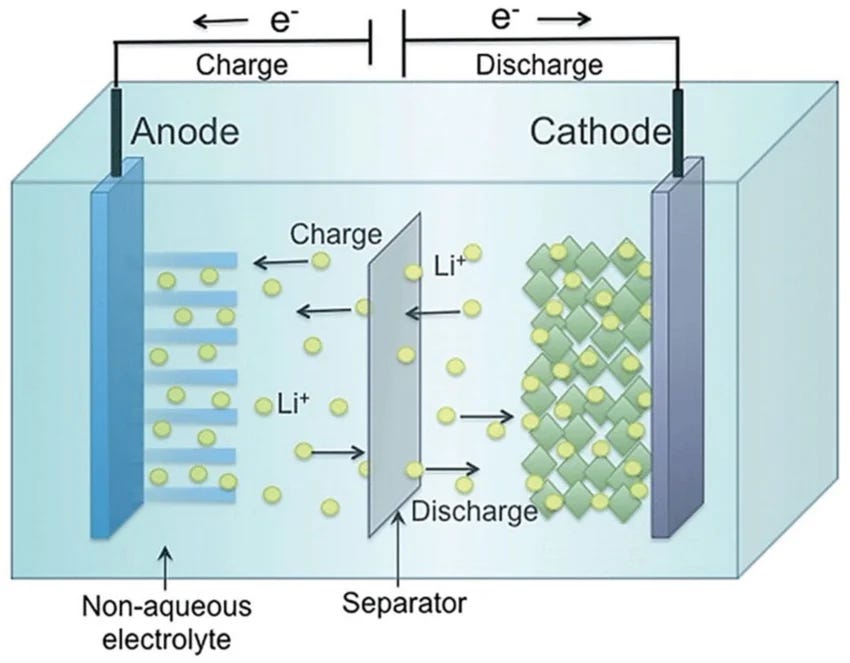
Lithium ion battery diagram, via link.
Lithium is a favored choice for a battery because an electron leaving lithium has farther to fall than an electron leaving any other metal when coupled with the appropriate reactant. Lithium is also a very light atom (an atomic mass of around 7), which, combined with the large “drop,” means that lithium reactions yield a high amount of energy. Per unit mass, lithium reactions release roughly as much energy as burning gasoline.
But if this is true, why are lithium-ion batteries so much less energy dense than gasoline?
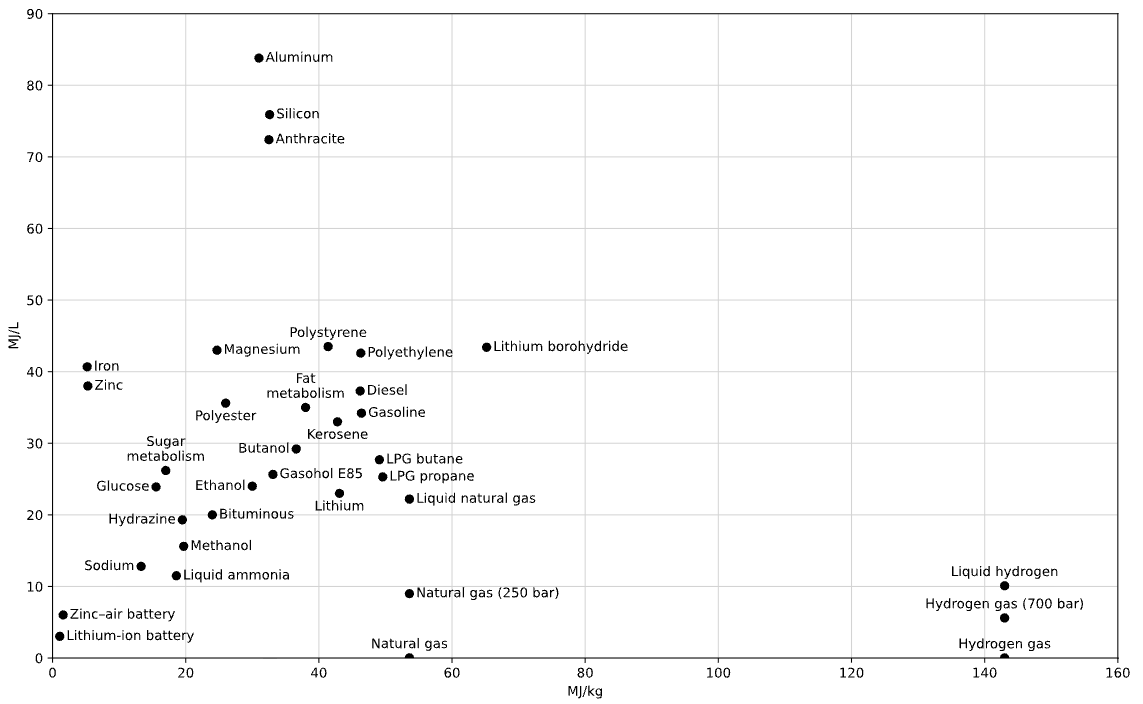
Energy densities of various batteries and fuels, via Wikipedia.
One big reason is the oxidizer. The chemical reactions we rely on for energy typically require some downhill destination for electrons to end up at, which is known as an oxidizer. When burning gasoline, the oxidizer is oxygen in the surrounding air: inside a gasoline engine, fuel and air are mixed together and then ignited, triggering the chemical reaction — an explosion — that powers the engine. Gasoline-powered cars, in other words, don’t need to carry their oxidizer with them, because there’s always one available in the surroundings.
Lithium-ion batteries, on the other hand, aren’t so fortunate. They need to carry their electron destination with them, in the form of the cathode. This adds a lot of extra mass compared to what a gasoline-powered car needs to carry. If a car needed to carry its own oxidizer with it, it would need about 3.5 kilograms of oxygen for every 1 kilogram of gasoline.
More generally, it just requires a lot of material scaffolding to structure the lithium reaction in a way that lets you extract energy from it in the form of electric current. At the anode, each lithium ion requires an additional six atoms of carbon, forming graphite sheets that the lithium ions can nestle into. A similar intercalation structure is required at the cathode. On top of this is the extra mass for the electrolyte, the separator, the current collectors, and so on. As of 2019, every gram of reacting lithium in a battery required about 70 grams of supporting material (though this number has probably fallen somewhat since then).
Without this material scaffolding, the reaction can still take place, but in a non-useful way. If something creates a direct path between the cathode and the anode, the reaction will run nearly instantly, creating a lot of heat and triggering other chemical reactions that will destroy the battery, but no useful electric current. Modern battery design, in fact, takes a lot of effort to prevent these runaway reactions from taking place.
The benefit of all this material scaffolding, of course, is that you can use the same chemicals for the reaction over and over again. The intercalating electrodes on modern lithium-ion batteries in particular are very good at this; because the electrode structure is maintained when the battery charges/discharges, lithium-ion batteries can be used for very large numbers of cycles while maintaining most of their capacity. When you burn gasoline, on the other hand, you’re discharging the products of the reaction continuously (which, of course, is the whole reason we want to switch away from fossil fuels in the first place, to stop the discharged CO2 from building up in the atmosphere). You could, theoretically, dispose of the lithium-ion battery’s scaffolding by having some sort of lithium-based internal combustion engine, but this would work terribly and be outrageously expensive to run (though some people are interested in using oxygen in the air as a battery oxidizer with lithium-air batteries).
The major potential benefit of solid-state batteries is a substantial reduction in this material scaffolding.
A pernicious issue with current lithium-ion batteries is dendrites. As we’ve noted, at the anode, lithium ions are nestled between sheets of graphite. But the anode holds the lithium ions very loosely, only slightly better than metallic lithium does. This is useful, because ions can easily migrate into the electrolyte, thus letting the battery work, but it’s a double-edged sword: under the right conditions, the lithium ions that are supposed to enter the anode during charging might instead acquire an electron at the surface of the anode, forming tree-shaped structures of metallic lithium called dendrites, instead of nestling between the sheets of graphite. If a dendrite pierces the separator between the anode and the cathode, it creates a direct path between the two, letting that runaway reaction that batteries are designed to prevent take place. (This doesn’t immediately react all the lithium in the battery — as electric current flows through the dendrite, the dendrite heats up, eventually melting and breaking the path — but the heat from the brief reaction can be enough to trigger other chemical reactions, resulting in thermal runaway and destroying the battery.) A great deal of battery development effort is devoted to preventing these dendrites from forming.
If, however, the liquid electrolyte were replaced with some sort of solid material, these dendrites might stop being a problem.2 With a strong, solid electrolyte, dendrites wouldn’t (in theory) be able to make their way through it, though with current solid electrolytes dendrites still seem to find their way through. And if the risk of dendrites were eliminated, you could switch to a different anode, dispensing with the graphite intercalating structure entirely, using an anode of pure lithium metal.3 And because the solid material would eliminate the flammable electrolyte, the resulting battery might be safer as well.
Solid-state batteries probably aren’t imminent — the chairman of CATL ranks them as 4 out of 9 on the technological readiness scale, and has indicated that commercial viability “has yet to be established.” But the expectation that they could be “[p]otentially safer, more energy dense, and perhaps eventually cheaper than today’s batteries” is pushing manufacturers around the world to try and make them happen.
Thanks to Austin Vernon for reading a draft of this. All errors are my own.
The reason that electrons migrate during discharge is somewhat complex. At the anode, lithium ions migrate into the electrolyte, because the electrolyte is a more appealing location with a lower potential energy well. At the cathode, the reverse occurs; lithium ions migrate from the electrolyte into the cathode. At each electrode, this creates a net charge which generates an electric field, which stops further migration. But because you now have a net negative charge at the anode interface (since positively charged lithium ions have left) and a net positive charge at the cathode interface (because positively charged lithium ions have entered), electrons flow between the two electrodes when they’re connected by a conductor to equalize the charges. But because each arriving electron is paired with an arriving lithium ion, the charge differences between the anode and the cathode don’t equalize, letting current flow continuously until there’s no more room for lithium ions in the cathode or no more lithium ions left in the anode (though most batteries have a cutoff that stops current flowing when the voltage drops below some level).
In a crystalline solid electrolyte, lithium ions migrate through it by hopping from one vacancy in a solid crystal lattice to the next. Thanks to their thermal energy, the ions vibrate back and forth trillions of times per second, and occasionally a vibration will have enough energy and be in the correct direction to squeeze past the surrounding atoms into a nearby vacancy.
A company in the 1980s, Moli Energy, tried to make lithium batteries with lithium metal anodes but gave up after dendrite problems caused their batteries to catch fire, requiring a massive recall.
Until that ratio falls by at least 3x to 5x in favor of batteries being cheaper than generation, extra generation is going to be the way that grids actually get built out. Batteries and generation are both falling in cost fairly quickly, but generation still has the overall edge in learning rate. Cost decreases won't bottom out for at least a decade, because there's been no slow down yet, so I wouldn't expect this ratio to change for a minimum of 20 years, which means that pretty much a full energy system interchange will have happened by the time that this price ration changes.
So there's at least a few assumptions about the current industry and it's future development that underlie my assertion that a month of storage makes no sense, but I'm confident enough that I'd place money on the bet, and there's very very few things I'd bet on.
Edit: one thing that would break my assumption is the industrial development of storage that's super cheap for once-per-year usage. Most storage now needs to be cycled about 300x per year to make economic sense. "Long duration" storage is actually better defined as "economical storage at few battery cycles per year". There's nothing like that in the research hopper, but that doesn't mean it couldn't appear tomorrow and be deployed within a decade. Something that only gets used once or twice a year has to be dirt cheap, even if you could get 10x or 20x normal electricity prices for it.
Where fiber optic is used though, that is the limit. That is a minority though.
Edit: Or, a fair closed-system comparison to a battery would need to include a liquid oxygen tank or similar so you have the two components stored but can control the delivery...
meanwhile ICE has gotten ridiculously clean and efficient over the years
I still do not trust that sitting on a pile of lithium batteries is safe.
Also the speed charging ? That dramatically reduces the stability and lifespan of the batteries.
Ton of used EVs not being sold because the battery replacement is somewhere between 40~60% of the car's value.
Interesting discussions about energetics are best had from a distance.
Internal combustion is not clean, and is inherently significantly less efficient than an electric motor.
Also, LFP chemistries are incredibly safe compared to NMC, which is what you're concerned about in terms of thermal runaway.
ICE is mostly stagnant tech. Meanwhile EV tech is rapidly improving!
And I'd know because I have to work with this IN ORBIT. I've had this conversation a dozen times in meetings with military and government.