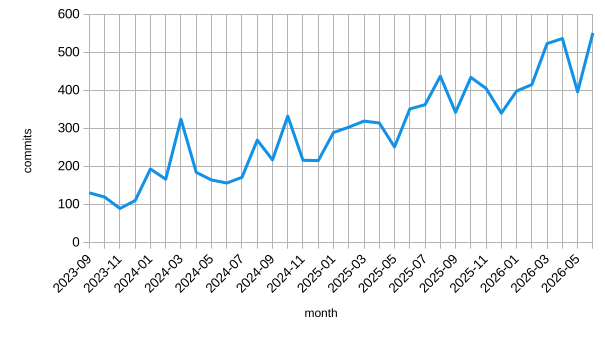
Servo 0.4.0 contains all of the changes we landed in June, which came out to yet another record 558 commits (April: 534, May: 391). For security fixes, see § Security.
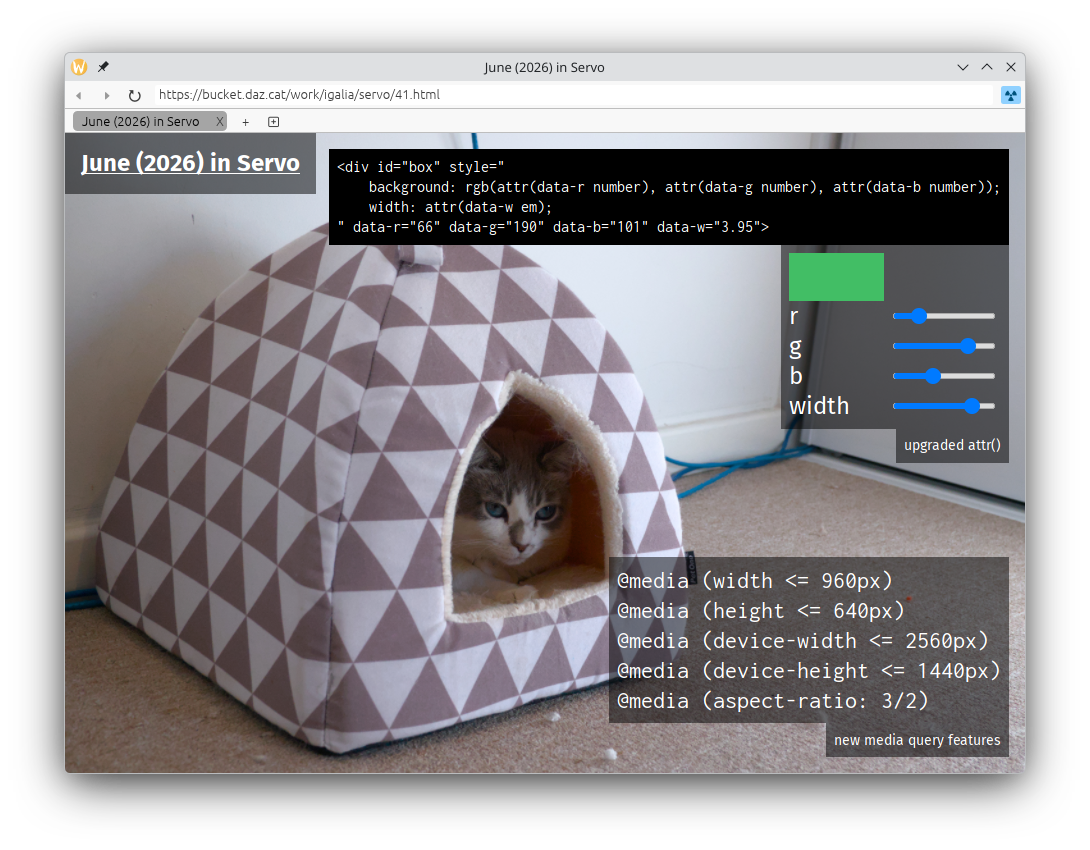
We’ve shipped several new web platform features:
- ‘attr()’, in experimental mode (@Loirooriol, #45041)
- ‘image()’, ‘closest-corner’, and ‘farthest-corner’ in ‘ellipse()’ and ‘circle()’ (@Loirooriol, #45421)
- ‘calc()’ and other mathematical expressions can now be resolved later than parse time, e.g.
sign(1em - 32px)(@Loirooriol, #45421) - ‘font-feature-settings’ in ‘@font-face’ (@simonwuelker, #45393)
- ‘@media (device-width)’, ‘@media (device-height)’, ‘@media (height)’, ‘@media (aspect-ratio)’, and their min- and max- variants (@jdm, @mrobinson, @nicoburns, @jschwe, #44978, #45707, #45490)
- ‘@media (orientation)’ (@nicoburns, #45707)
- ‘@media (pointer)’ and ‘@media (any-pointer)’ (@nicoburns, #45681)
- ‘@media (hover)’ and ‘@media (any-hover)’ (@nicoburns, #45681)
Plus a bunch of new DOM APIs:
- SharedWorker (@Taym95, #45786)
- console.dir() (@Taym95, #45109)
- customElementRegistry on Document and ShadowRoot (@shubhamg13, #45872)
- initialize() on CustomElementRegistry (@shubhamg13, @yezhizhen, #45903)
- new CustomElementRegistry() (@shubhamg13, #45791, #45550)
- textStream() on Request, Response, and Blob (@yezhizhen, #45864, #45861)
- setPointerCapture(), releasePointerCapture(), hasPointerCapture() on Element (@webbeef, #45048)
- ontouchstart, ontouchend, ontouchmove, ontouchcancel on Element (@stevennovaryo, #45049)
- crypto.subtle.digest() for KT128 and KT256 (@kkoyung, #45699)
- crypto.subtle.getPublicKey() for ML-KEM and ML-DSA (@kkoyung, #45252)
This is another big update, so here’s an outline:
You can help
Servo is steadily becoming a bigger and busier project every month, and by June 2026, we’ve been reading through over four times the commits as we did when we started in September 2023.
This is hard work, particularly since there are things we need to know that are often difficult to answer just by reading the changes:
Who does the change affect, if anyone? Does it affect users, Servo developers, embedders, or some other group?
What observable difference does the change make, if any?
Does the feature require any preferences to be enabled, or is it enabled for everyone by default?
Are any real-world websites affected by the change?
What issue or broader project is the change related to? This question is answered by
Fixes: #xxxxxorPart of: #xxxxxin the PR description.
Thanks to an initiative by @jdm, it’s now easier than ever for you to help us answer those questions, using the Servo Highfive bot! If you’re working on a pull request that you think might be interesting for the next monthly update, even if you’re not 100% sure, tell us about it by following the steps below:
You add the monthly update label to your pull request, or comment
[@servo-highfive](https://github.com/servo-highfive) monthly updateHighfive posts a comment asking you some questions
You answer those questions in a comment containing
[@servo-highfive](https://github.com/servo-highfive) monthly update answer
Security
Servo’s JS runtime, SpiderMonkey 140.10.1, had several security bugs that have been fixed in Servo 0.4.0 with the update to SpiderMonkey 140.11.0 (@jschwe, #45584). For more details, see CVE-2026-8388, CVE-2026-8391, CVE-2026-8974, CVE-2026-8975, and MFSA 2026-48.
Several more security bugs in Servo’s JS runtime have been fixed in Servo 0.4.0 with the update to SpiderMonkey 140.12.0 (@jschwe, #45766). The exact CVEs that apply to us are not yet known, but for more details, see MFSA 2026-58.
RSA operations in SubtleCrypto now do modular exponentiation in constant time (@kkoyung, #45631). Please note that our RSA implementation is currently vulnerable to the Marvin Attack – for more details, see RUSTSEC-2023-0071.
ML-DSA operations in SubtleCrypto now do the Decompose step in constant time, fixing RUSTSEC-2025-0144 (@kkoyung, #45294).
We’ve fixed an HTML injection bug (XSS) in file:/// directory listings, which affected file names containing </script> (@sahvx655-wq, #45510).
Real world compat
Layout correctness has significantly improved on lichess.org, and many websites have become a lot more readable thanks to our improved handling of variable fonts (@simonwuelker, #45768), including Zulip (servo.zulipchat.com) and Speedtest (speedtest.net).
v0.3.0
v0.4.0


v0.3.0
v0.4.0


Zulip (servo.zulipchat.com)
v0.3.0
v0.4.0


Speedtest (speedtest.net)
Many websites worked in Servo even before version 0.4.0, including Google Photos (photos.google.com) and Cash Converters (cashconverters.com.au), and continue to work in version 0.4.0. Other websites, like Google Maps (maps.google.com) and OpenStreetMap (www.openstreetmap.org), render well but have some issues with interactivity.
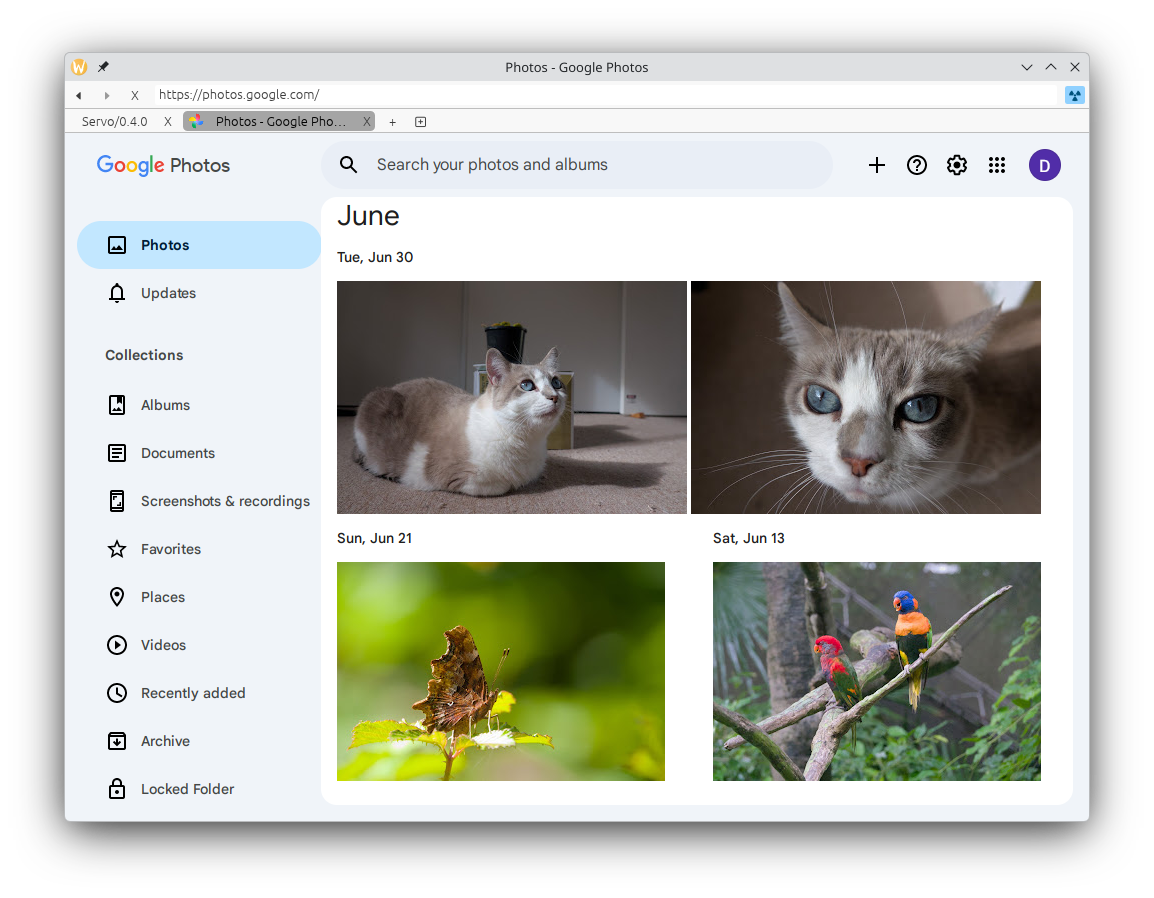
Google Photos (photos.google.com)
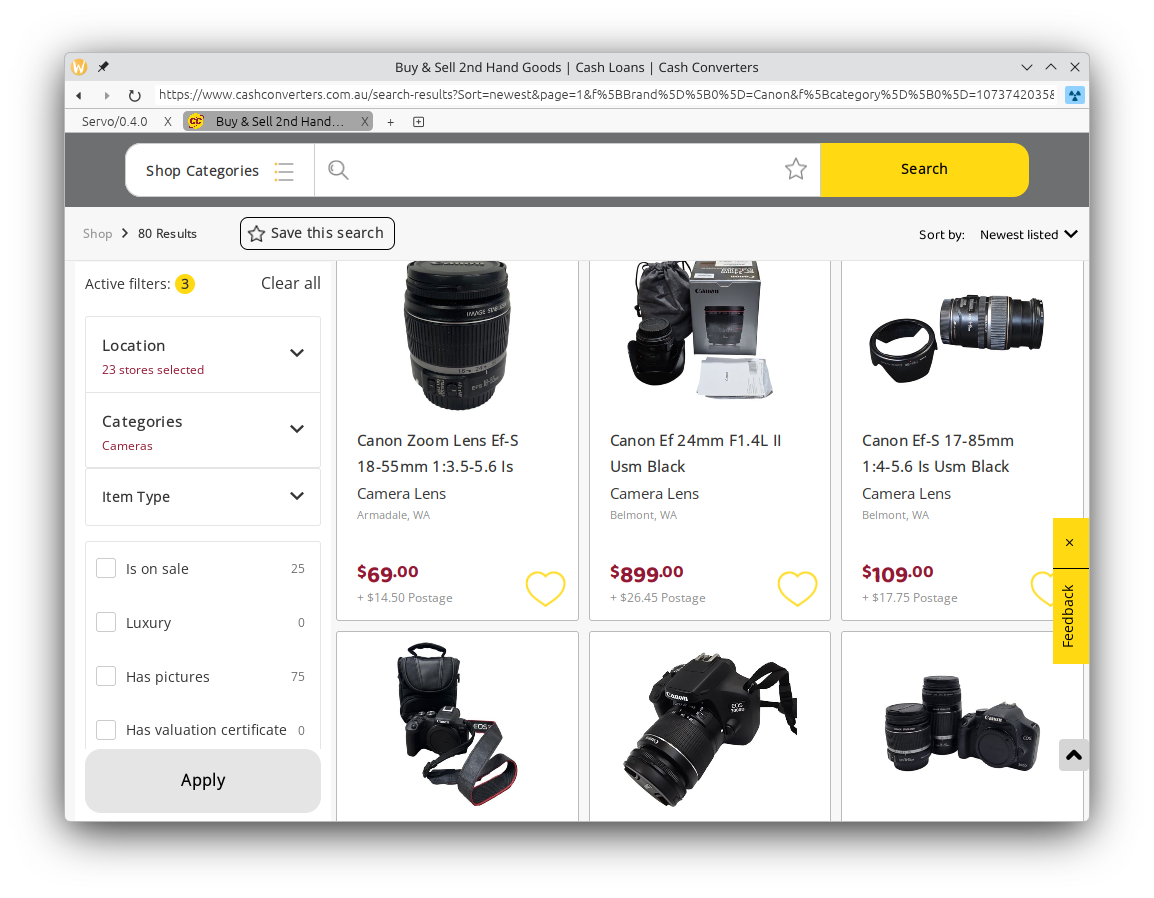
Cash Converters (cashconverters.com.au)
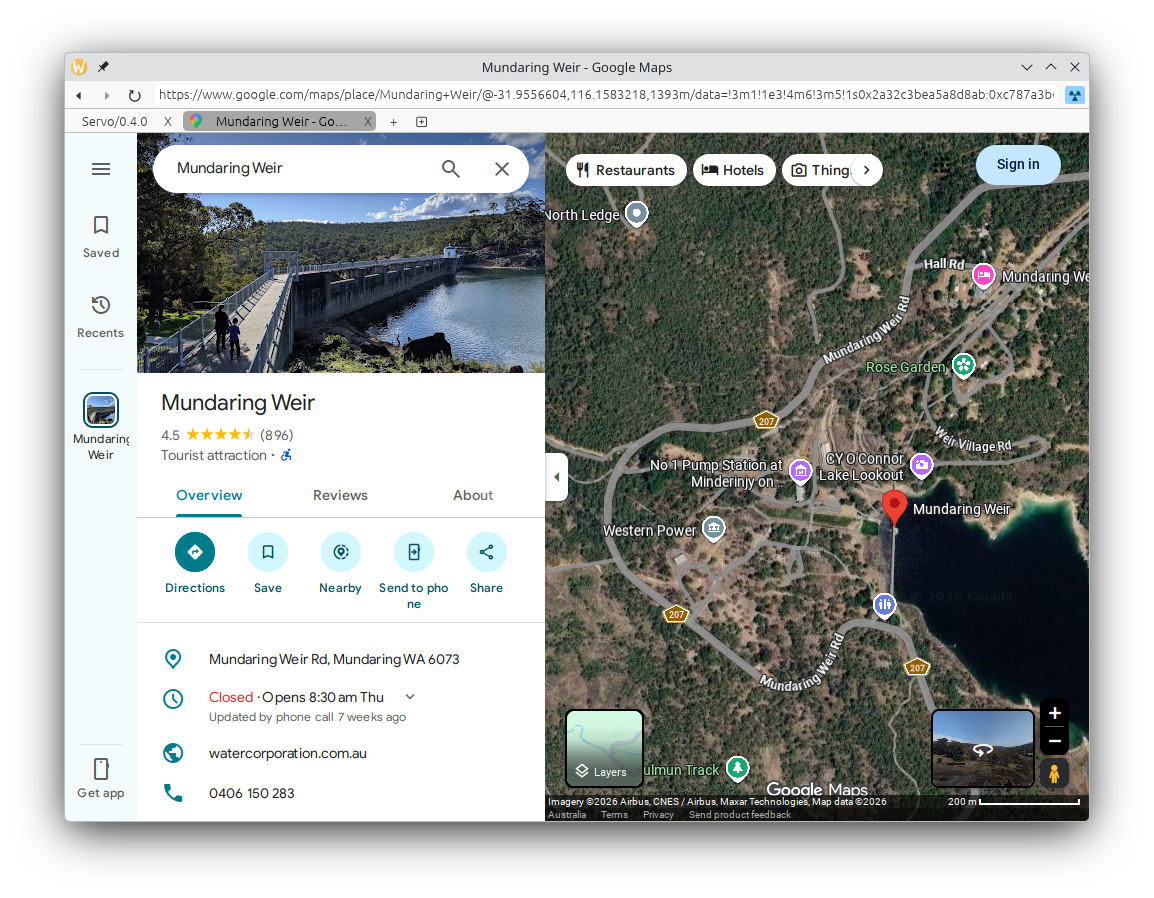
Google Maps (maps.google.com)
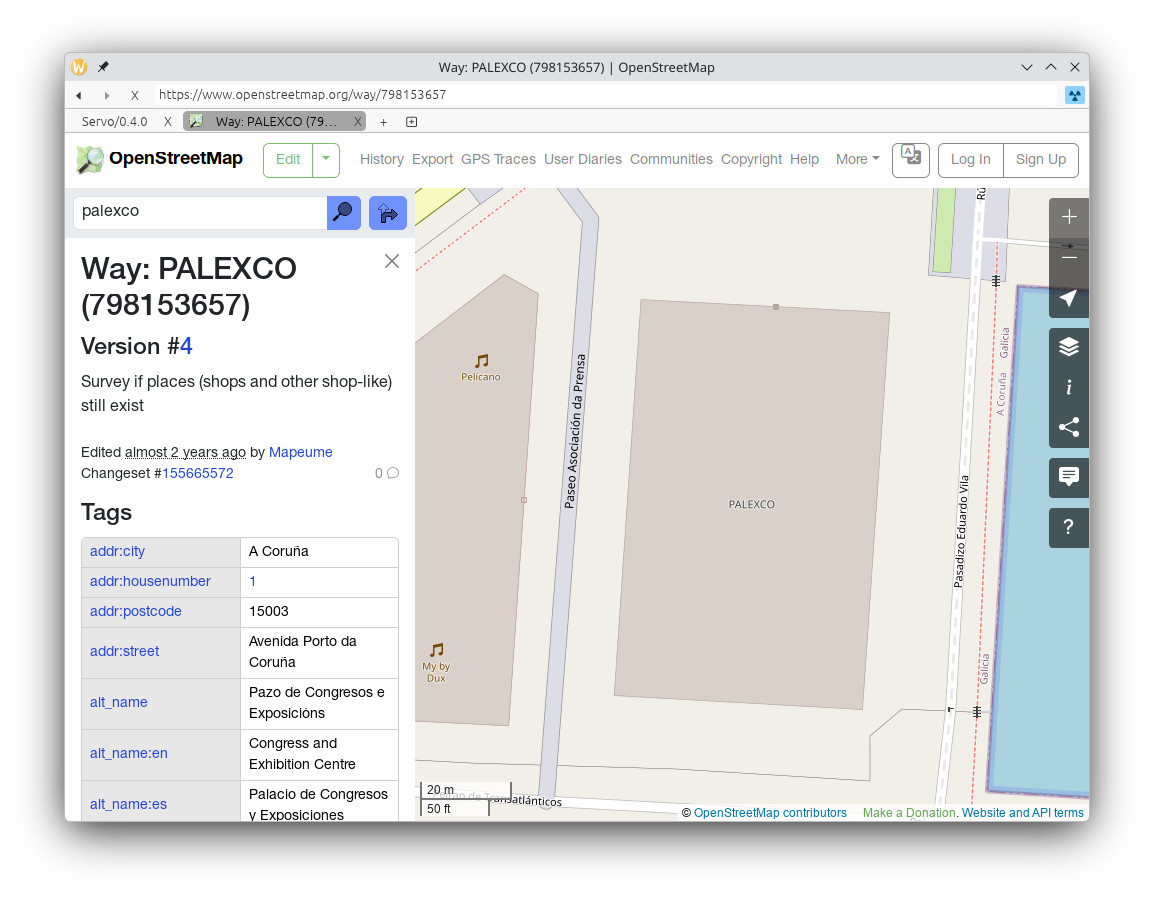
OpenStreetMap (www.openstreetmap.org)
We’re interested to hear how well your favourite websites run in Servo! Report successes in this Zulip thread, and failures in our GitHub issues.
Work in progress
We’re implementing the more powerful version of ‘attr()’ that can be used anywhere, not just in ‘content’, under --pref layout_css_attr_enabled (@Loirooriol, #45041, #45421, #45495, #45752).
WebGPU support has improved, under --pref dom_webgpu_enabled:
- implemented copyExternalImageToTexture() on GPUQueue (@sagudev, #45646)
- implemented createQuerySet() on GPUDevice and resolveQuerySet() on GPUCommandEncoder (@sagudev, #45644)
- implemented pushDebugGroup(), popDebugGroup(), and insertDebugMarker() on GPUCommandEncoder, GPUComputePassEncoder, and GPURenderPassEncoder (@jschwe, #45489)
- more conformant GPUTexture (@sagudev, #45300)
- more conformant requestAdapter() on GPU (@sagudev, #45424)
- more conformant secure context enforcement (@sagudev, #45279)
All of the features above are enabled in servoshell’s experimental mode.
We’ve made more progress towards accessibility support, under --pref accessibility_enabled (@alice, @delan, #45555, #45554, #44949).
We’ve started implementing visible and interactive text selection (@mrobinson, @SimonSapin, #46107), one of the most long-awaited features of any web browser. Stay tuned!
We’ve also started working on Web Animations, under --pref dom_web_animations_enabled (@simonwuelker, #45522, #45983), as well as webkitRelativePath on File, under --pref dom_entries_api_enabled (@yezhizhen, #45666).
Rust doesn’t have a stable ABI, so it has generally not been possible to embed Servo in another application without building Servo from source. To make it possible, we’ve started designing a wrapper C API that will let you consume Servo as a prebuilt shared library using the stable and ubiquitous C ABI (@mukilan, #44984). Eventually the idea is that we’ll create a wrapper Rust API around that wrapper C API, so you can have both the ergonomics of Rust and the build simplicity of C.
Embedding API
New in the Servo API:
Breaking changes:
WebView::send_errorhas been removed (@mukilan, #45502) – this method was always meant to be internal, and has become unused after we introduced the new WebView- and WebViewDelegate-based API
We’ve improved the docs for WebView, WebViewDelegate, JSValue, AlertDialog, AllowOrDenyRequest, AuthenticationResponse, BluetoothDeviceDescription, ConfirmDialog, ConsoleLogLevel, CreateNewWebViewRequest, EmbedderControl, EmbedderControlResponse, FilePicker, Image, JavaScriptErrorInfo, NavigationRequest, PermissionRequest, PixelFormat, PromptDialog, ProtocolHandlerRegistration, ProtocolHandlerUpdateRegistration, Scroll, SelectElement, SelectElementRequest, and WebViewVector (@mukilan, #45282, #45467).
For users and developers
In servoshell:
the Android version now requires Android 13+ (@jschwe, #46104)
the desktop version now lets you drag and drop files to open them (@simonwuelker, #45454)
the desktop version now lets the tab bar scroll horizontally if you have too many tabs open, but from one tab hoarder to another, maybe you should reconsider having so many tabs open (@Nylme, #44884)
the desktop version enters fullscreen on the monitor containing the window, even if you’ve moved it to a different monitor (@rhit-kapilaar, #45556)
the desktop UI is more performant, resizes more smoothly, and no longer gets stuck in hovered states (@mrobinson, #45289, #45456, #45290)
and (@skyz1, #45705), CSS gradients (@mrobinson, #43945), ‘font-style’ and ‘unicode-range’ in ‘@font-face’ (@Loirooriol, #45821), FontFaceSet (@mrobinson, #45390, #45382), HTMLInputElement (@steigeo, #45416), IntersectionObserver (@jdm, #45655, #45659, #45680), new Response() (@yezhizhen, #45953), URL.createObjectURL() and URL.revokeObjectURL() (@yezhizhen, #45182, #45417), and ECDSA and Ed25519 in SubtleCrypto (@kkoyung, #45833, #46017).
We’ve fixed bugs related to (@mrobinson, #45750), ‘animation-delay’ (@yezhizhen, #45013), ‘clip-path’ (@Loirooriol, #45468, #45373), ‘tab-size’ (@SimonSapin, @mrobinson, #45309), ‘width’ and ‘height’ (@RichardTjokroutomo, #44627), ‘box-shadow: inset’ (@Loirooriol, #45620), ‘animationiteration’ events (@Loirooriol, #45990), ‘click’ events (@mrobinson, #45751), ‘load’ events (@jdm, #45883), ‘error’ events in Worker global scopes (@Gae24, #45829), and document.getElementById() (@mrobinson, #45433).
Garbage collection safety
We use a RefCell-based mechanism to store many of our DOM types in other DOM types, enforcing Rust’s “aliasing xor mutability” rule at runtime by panicking if the rule is violated. But when garbage collection happens, we need to borrow() each DomRefCell to trace the references, and this is the source of many panic bugs. To fix that whole class of bugs, we initially created CanGc, a marker type that would annotate the code paths where GC can occur, in conjunction with custom static analysis (@jdm, #33140).
With the Rust type system we can do even better, if we flip that around and require any borrow_mut() call to prove that GC can not occur by passing a NoGC marker value. We can then require that a
&NoGCmust be borrowed from a&JSContext(which blocks GC) and not a&mut JSContext(which allows GC), taking advantage of how Rust references work without needing any custom static analysis.We have a large codebase that needs to be migrated in parts, so for now we’ve created the new method safe_borrow_mut() (@sagudev, #46050). We also need to update all of our script-related code to borrow our safe JSContext wrapper, rather than creating an owned JSContext on the spot.
This continues our long-running effort to use the Rust type system to make Servo’s integration with SpiderMonkey safer and more reliable (@Gae24, @Keerti707, @Narfinger, @TimvdLippe, @sagudev, @guptapiyush16, @ivomurrell, @kunalmohan, @skyz1, #45230, #45436, #45503, #45617, #45711, #45797, #45800, #45858, #45884, #45937, #45902, #45968, #45977, #45991, #46003, #46005, #46084, #45548, #45552, #45590, #45909, #45912, #45943, #46089, #46117, #46114, #45320, #45324, #45328, #45340, #45381, #45385, #45410, #45392, #45409, #45604, #45616, #45618, #45627, #45636, #45662, #45663, #45675, #45674, #45677, #45684, #45735, #45807, #45810, #45816, #45818, #45828, #45838, #45836, #45837, #45840, #45841, #45857, #45859, #45862, #45875, #45887, #45931, #45964, #45935, #45987, #45988, #46001, #46040, #46051, #46057, #46106, #46125, #45678, #46002, #45845, #45645, #45673, #45259, #45817, #45822, #45876, #45877, #45891).
Performance and stability
NoGC was designed to prevent dynamic borrow failures, but it also enables some performance optimisations! If we can prove that garbage collection is impossible in some part of Servo, we can often avoid rooting JavaScript objects when interacting with them within that region of code. This has allowed us to reduce overheads by over 1% in the layout process and in HTMLCollection (@Narfinger, #46092, #45582).
Our memory usage has improved, with BoxFragment now 17% smaller (288 → 240 bytes on amd64) and ShapeCacheEntry now smaller too (@SimonSapin, @mrobinson, @simonwuelker, #45183, #45496).
We’ve fixed some nasty memory leaks when reloading and in 2D canvases (@Taym95, @sagudev, @jschwe, #45455, #45261, #45414).
Speaking of which, 2D canvases now use up to 23% less power (@yezhizhen, #45301), and we now avoid rasterising the same SVG more than once (@Narfinger, @jschwe, #44805).
Servo now decodes all images asynchronously and fills image caches asynchronously, leaving script threads (web content processes) more time for other work (@Narfinger, #45542, #44483). On top of that, we’ve improved incremental layout (@mrobinson, @Loirooriol, #45411) and reduced reflows in IntersectionObserver (@jschwe, #45986).
We’ve started working on incremental updates for the stacking context tree, and as a side effect, we’ve made some layout-bound microbenchmarks up to 10% faster (@mrobinson, @Loirooriol, #45208).
We’ve also reduced allocations, copies, GC rooting steps, and other operations in many parts of Servo (@Narfinger, @SimonSapin, @mrobinson, @Loirooriol, #45506, #45969, #45940, #45760, #46090, #45335, #45413, #45511).
For several months, Frédéric (@fred-wang) has been fuzzing for Servo bugs, and thanks to his work we’ve fixed sixteen (16) crash bugs in June, affecting