“All the other wonderful inventions of the human brain sink pretty nearly into commonplaces contrasted with this awful mechanical miracle.”
Such was Mark Twain’s verdict on the Paige Compositor, a typesetting device which was among the most complex machines ever built up to that point in history. It was also a ruinous disaster for everyone involved — despite being a good idea.
Twain came to see Paige’s machine as an “immense historical birth”: the point of origin for new mechanical lifeforms that would someday mimic the human mind. In a 1889 letter to his invention-mad brother Orion, Twain called the Paige machine “a cunning devil, knowing more than any man that ever lived” and claimed it would make “telephones, locomotives,” even “Babbage calculators” seem like “mere toys, simplicities!”
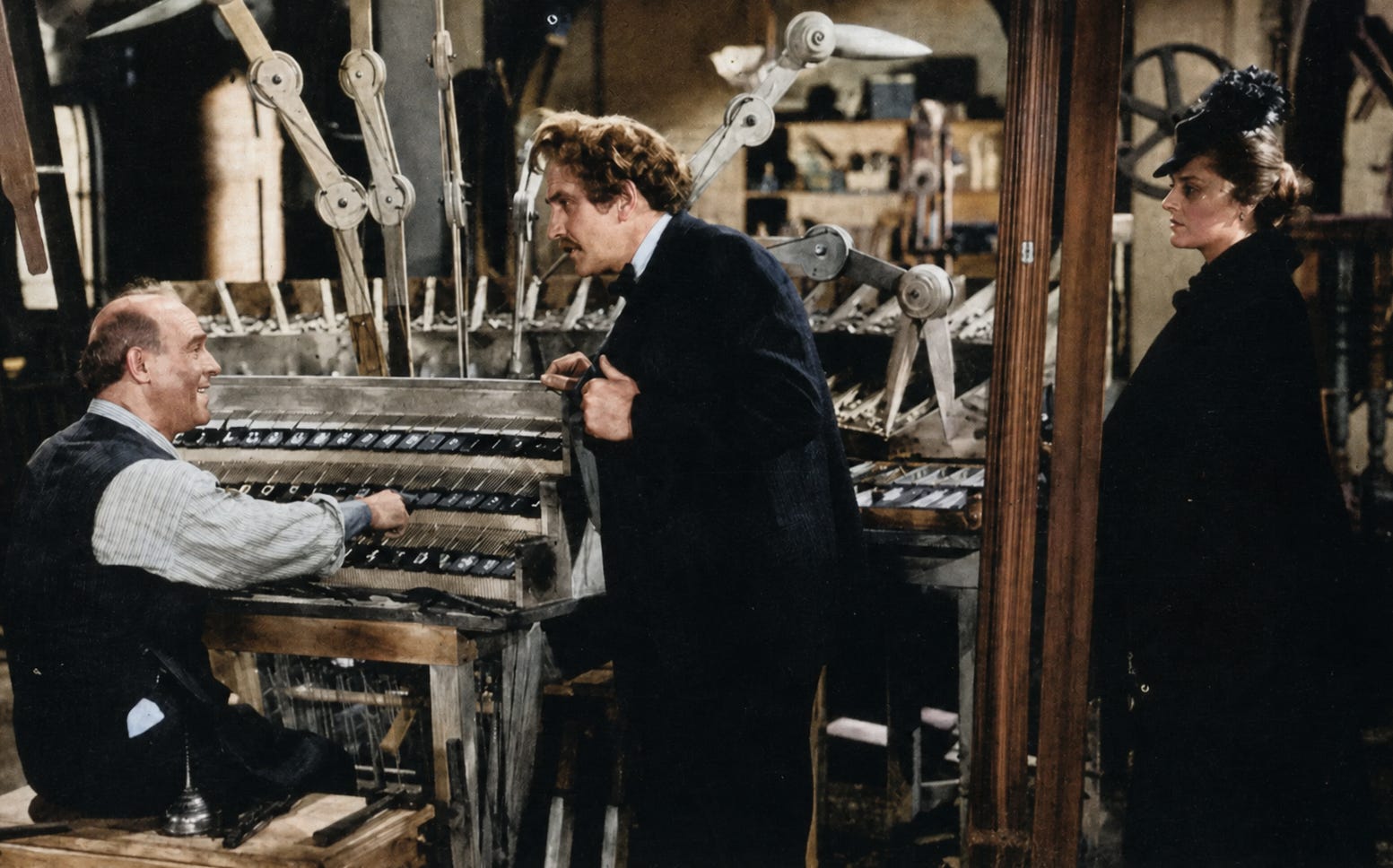
Twain visiting Paige and his machine, as depicted in the 1944 film The Adventures of Mark Twain (colorized).
The verdict of Twain’s biographers is that the author’s decade-long quest to automate the printing industry basically destroyed his life. One calls the Paige machine “a remorseless Frankenstein monster.” Twain’s most recent biographer, Ron Chernow, labels his obsession “a full-blown monomania,” and I find it hard to argue otherwise.
Reading Chernow’s biography, I was shocked at the degree to which “the Machine” took over the life of Twain’s family during his prime creative years following Huck Finn, and the extent to which its failure was responsible for both his financial ruin and subsequent depression.
So what was the machine actually trying to do?
It began in 1880, when Twain met a “little bright-eyed, alert, smartly dressed inventor” named James W. Paige. Twain had once been a “printer’s devil” himself, and although he was initially skeptical Paige’s new machine would automate away much of the costly human labor involved in setting the metal type of books and periodicals, he soon became a convert. The machine, Twain concluded, was not just a mechanical wonder but a surefire path to riches: “I never saw such an inspired bugger of a machine. Anybody can set type with it... I reckon it will take about a hundred thousand machines to supply the world, and I judge the world has got to buy them.” The financial advantages of a machine that “does not get drunk” and “does not join the printer’s union” were simply too vast for anyone to ignore.
As you can probably guess, Paige was not quite the towering hero-inventor that Twain believed him to be. He was clearly a person of real ability, but his main talent appeared to have been his skill at raising money by promising the impossible — the 19th century version of Steve Job’s reality distortion field. (“When he is present I always believe him — I cannot help it,” Twain admitted. “When he is gone away all the belief evaporates. He is a most daring and majestic liar.”)1
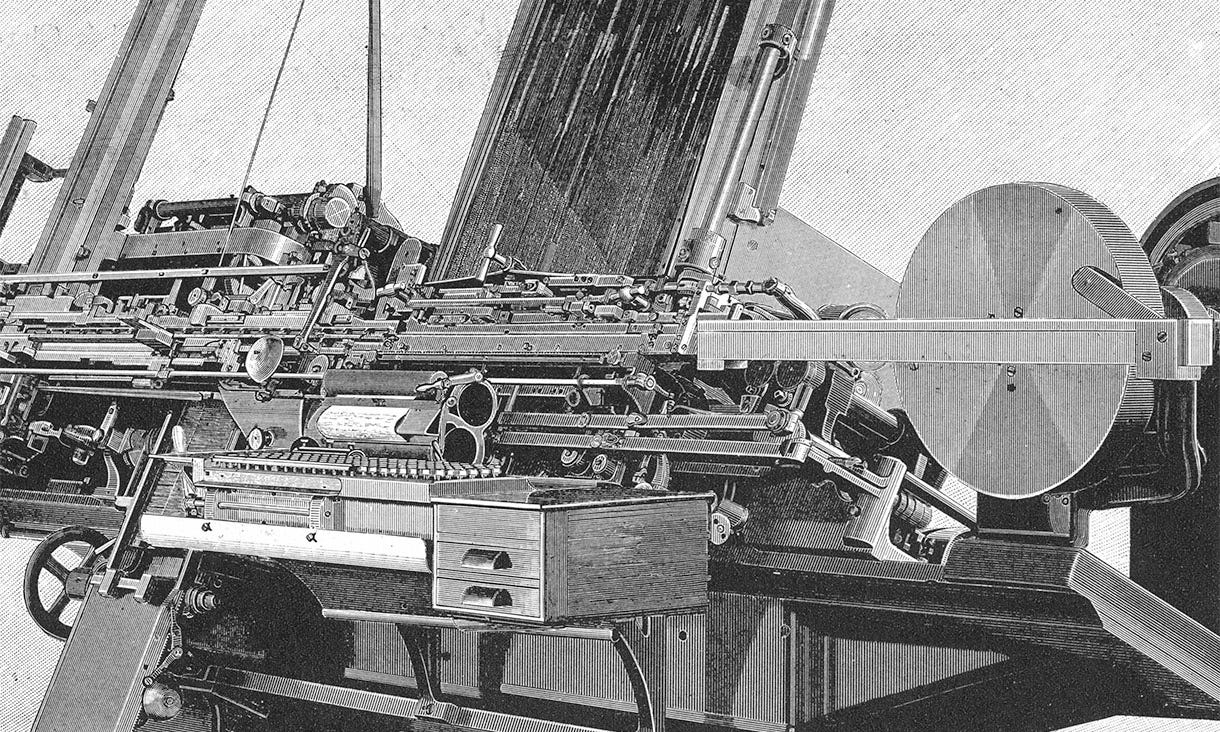
A detail of the most high-resolution surviving image of the compositor.
Twain ultimately invested the equivalent of roughly ten million dollars toward the machine: not just the bulk of his earnings from his books, but also of his wife’s inherited fortune, all of which he lost.
The issue was complexity. According to his long-suffering patent attorney, Paige “became lost in the wilderness of appalling details” as his device grew to over 18,000 distinct parts. Paige’s patent application was known internally at the United States Patent Office as “The Whale.” It took patent examiners a full 30 days just to read the initial application (you can try it yourself here).
When, at last, they requested a functioning machine, none could be found.
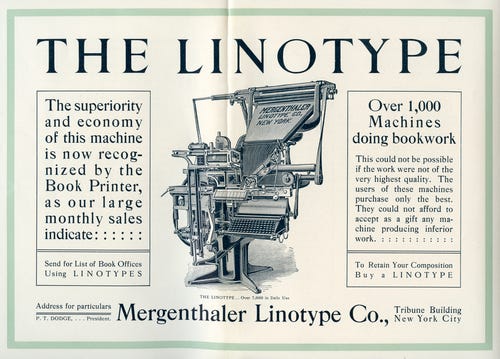
This was the crux of the problem: Paige’s typesetter was, in theory, superior to its simpler and cheaper competitor, the Linotype. But the Linotype was far easier to mass produce and repair.
The Linotype’s core advantage was that it did not attempt to mimic the human compositor’s every movement. Instead, it simplified the problem by casting complete lines of type. Paige sought to automate what humans were already doing, whereas the Linotype redesigned what the work was in the first place.
For Twain, though (and one suspects for Paige himself), the dream of mechanically mimicking human actions was what fascinated him most. Twain’s writings from the 1880s almost make it sound like he was imagining something like the contemporary concept of AGI. He came to see the Paige machine as a “creature” in its own right. When developed to perfection, it would be as “complex as that machine which it ranks next to”: the human mind.2 And it would bring immense power to those who controlled it. Twain’s housemaid later recalled: “he was expecting such wonderful things from it... he thought he’d make millions and own the world.”
Instead he went bankrupt, and Paige died a complete unknown.
Today, only one Paige machine survives. A second model “was donated to Cornell University and was later donated to a scrap metal drive during World War II.”
Twain’s vision of hundreds of thousands of human-like language machines taking over the world would have to wait a century or two.
The easy moral of the story is that Twain was gullible and Paige a huxster. Both are partly true! But it’s also true that Paige and Twain were on the right track. The production of the written word really was about to be transformed by automation. And Twain was remarkably prescient, almost uniquely so, in grasping the world-historical scale of that ongoing transformation. I’d argue that there’s a clear line connecting the automation of typesetting and counting in the late 19th century to the rise of electrical computers a generation later, and then the early Internet and AI research a generation after that.
Their mistake lay in assuming that seeing the future was the same thing as knowing how to bring it about.
I think there are three transferrable lessons we can pull from this story:
“DIY-friendly” design matters a lot. Inventors and investors encounter their would-be revolutionary machines in a pristine environment, shielded from actual use. But once a new technology is out in the world, it breaks in all sorts of ways no one imagined. People end up putting their trust not in the technologies that work best when conditions are perfect, but in those whose failure modes are predictable and fixable by ordinary people.
Society uptake of transformative inventions is almost always slower than their proponents expect. “The world has got to buy them,” Twain had written. Twain felt that he had an insider’s perspective and could intuit how others in publishing would respond to the machine. But he was a printer’s devil no longer: he was a famous, millionaire author. Twain was cushioned, therefore, from the perspective of both the workers who his machine might automate out of a job, and from the practical challenges faced by the capital owners, who were in no hurry to replace their costly existing machines with untested new ones.
Transformative technologies succeed by redesigning a task, and usually not by simply trying to reproduce the existing forms of human labor. Paige built an amazingly complex mechanical imitation of the human compositor which attempted to repeat a human worker’s actual movements. By contrast, Linotype simplified the problem by doing something humans didn’t already do. The Linotype was initially slower, but as it claimed the market with its machine-centric approach of casting whole lines of type at once, it triggered a feedback loop of further improvements which meant it eventually became far superior.3

• Odd shapes hidden in dense Amazon rainforest reveal sprawling ancient civilization.
• “Building such monumental works in the rainforest must have required a large workforce, division of labour and an understanding of mathematics and geometry. It is also clear that the construction and maintenance of such centres for around 1,500 years must have had administrative, sociocultural and cosmological motivations” (from the actual article on the above, in Nature).
• Interactive chart of the Indo-European languages by Damon Binder. Binder also made this Random Lives site: “About 70 billion people have ever lived. This project randomly samples just 250 of these lives, to give a window into what a ‘typical’ human experience was like.”
• I’ve been working on an open source tool along similar lines, the Historical Persona Generator (here’s the Github), which differs in its approach because it is using procedural generation rather than pre-written profiles — will be writing more on this when it is finished, the current version is very much a work in progress but I think it’s becoming interesting:
• I’ve also been adding more books and features to the Book Prize Index, including this fun visualization of the arguments and approaches of ~9,500 books over the past six decades.
It’s tempting to see Twain’s relationship with Paige as something like vibe coding avant la lettre. Twain was, in the 1880s, wealthy and well-connected enough to outsource his invention dreams to Paige as a full time employee, who in turn practiced a mixture of sycophantic industriousness and gaslighting that will be familiar to any user of Claude Code. Twain never got his hands dirty with the actual work of creating the machine (instead micromanaging it via letters). This meant that he never saw the abundant failure modes and maintenance issues and edge cases, but instead got only the dopamine hit of feeling like he was being productive and innovative as he received misleading written progress reports.
Interestingly, in this period Twain was reading both Charles Babbage (who similarly dreamed of creating a universal calculating mechanical mind) and William James’ Principles of Psychology (1890) which was the first work to analogize the human brain to a networked system of electrical machines, the telephone switchboard.