Dedicated to the individuals and families that welcomed me into their factories and their towns.
I hope I have done them justice in my endeavor to capture the psuchē of the German Mittelstand.1
To Bielefeld, I’m glad I can confirm that the city does indeed exist.
There is a chair you will find at cafés across Europe—and perhaps have even sat in—called Chair Nr. 14. This “coffee shop chair” became the first mass-produced piece of furniture and was invented by Michael Thonet, a German carpenter. But before number fourteen, Thonet introduced the Boppard chair, and with it, a novel technique: wood bending. By softening solid wood with heat and steam, he could coax it into curves impossible to carve by hand, and then let the wood set permanently into its new shape.
This advancement allowed furniture to progress from an era of primitive aesthetics to a modern level of sophistication that caught the eye of a more affluent clientele. At the Koblenz trade fair of 1841, Austrian Prince Klemens Wenzel von Metternich, upon seeing Thonet’s work, invited Michael to Vienna to present his chairs to the Imperial Family.
At the behest of the Austrian court, Michael relocated to Vienna and opened a shop with his sons—Franz, Michael Jr., August, Josef, and Jakob—under the name Gebrüder Thonet. There, alongside decorating the Stadtpalais Liechtenstein, he continued refining his art, receiving the silver medal at the 1855 World’s Fair in Paris for his Vienna bentwood chairs. Then, in 1859, he unveiled Konsumstuhl Nr. 14.
What was revolutionary about Nr. 14 was that its design made it the first truly manufacturable chair. Its construction allowed it to be disassembled into just a few components, simplifying packaging and enabling export around the world. After earning the gold medal at the 1867 Paris World’s Fair and claiming its throne as the “chair of chairs,” the Konsumstuhl became the standard for European restaurants and cafés.


(1) The Boppard chair (2) The Stadtpalais Liechtenstein (3) Side by side: the Vienna bentwood and Chair Nr. 14 - an icon of 19th and early 20th century cafés, it is still produced to this day
Soon after the breakout international success, demand for Thonet furniture surged, and as ownership shifted from Michael to his sons, they looked to scale fabrication. Offering expansive beech forests, a substantial skilled workforce, and lying in a location favorable for logistics, they selected Bystřice pod Hostýnem, in Moravia—what is today the eastern Czech Republic—to be the flagship manufacturing site.
When Gebrüder Thonet established the Bystřice factory it became the center of gravity of their operations, serving as the core research and development hub and main production facility. By 1913 the plant employed 2,000 workers who produced 500,000 chairs per year. Beyond the company gates the Thonets drafted the blueprints for an early factory town; they built houses for the workers, schools for their children, and routed the first major railway through the village. August and Jakob Thonet even went on to serve as mayors of Bystřice and maintained Czech as the primary language despite being German.


The Bystřice pod Hostýnem factory in 1873 and 1890. This factory is the world's oldest surviving and still-operational facility of its kind
The twentieth century, however, would drastically reform Gebrüder Thonet. The economic strain of WWI forced a merger with competitor Kohn-Mundus in 1924, creating Thonet-Mundus—the world's largest furniture manufacturer. Then in 1939, the Nazi occupation, through the Kroměříž Oberlandrat, installed state-appointed overseers and repurposed the factory to meet wartime demands, producing ammunition crates, rifle stocks, hospital beds, and wooden wings for aircraft.
The postwar period proved no kinder to the Bystřice manufactory: in 1945, the Thonet property was confiscated and placed under national administration through the Beneš decrees in the first wave of Czechoslovak nationalization. Confronted with expropriation and mounting political pressure, Victor Thonet, representing the third generation, fled the company and the town, severing the founding lineage from the factory entirely. From that moment on, the future of Thonet was permanently halved, forced to take separate paths.
On one path, in Germany, Georg Thonet, Michael’s great-grandson, rebuilt manufacturing facilities in Frankenberg, Hessen, and granted a new life to the furniture enterprise. Today, the Thonet family, now in its sixth generation, continues to run this legendary Mittelstand firm.
On the other path, in Czechoslovakia, the Bystřice factory was rechristened in 1953 as TON, an acronym for Továrny na ohýbaný nábytek, meaning “Factories for bentwood furniture.” As the years progressed, and as the country was drawn firmly behind the Iron Curtain, the factory became a socialist state enterprise led by politically placed directors. It wasn’t until 1989 and the fall of communism that the TON brand had the opportunity to retake its place in the world of furniture. Slowly but surely, it did, once again becoming a world-renowned brand, now separate from that of Thonet. The same town, the same factory, the same people—just a different name.


Thonet/TON furniture, present day. (1) Karlovy Vary, Czech Republic (2) Nürnberg, Germany (3) London, UK
It was over a year ago that I spent a weekend in Bystřice pod Hostýnem with one of the former state-appointed directors of the TON factory. Walking with him through the picturesque streets of this quaint Czech town, something occurred that I have not forgotten since. Everyone we passed knew him, and he, them. Shop owners, retirees, young families, they all stopped, greeted each other, and exchanged pleasantries. It was through him that I first learned the story of TON, and what it signifies to the 8,000 people of this village tucked away in the Czech Republic.
I hold onto this memory fondly, and it was only recently that I realized there existed a collection of similar stories that brought it vividly back to the forefront of my mind; this time in the form of the German Mittelstand. Over the course of my year in Germany, what became clear to me was that the industrial and cultural pattern I had found in Bystřice, was repeated across the country in family firms whose histories stretched back centuries.
I first learned of the German Mittelstand around two years ago during my bachelor studies while interning and working on a global merger and acquisition in the pharmaceutical manufacturing space. As we supervised the divestiture of an American company from its German subsidiaries, I was tasked with analyzing factory blueprints and mapping organizational structures. Eager to grasp the full scope of these assignments, I began researching German engineering and soon found myself peeling back the layers of German history and the Industrial Revolution.
It is down one of these rabbit holes that we can begin to unearth the line linking the medieval guilds to the Gründerzeit and, in turn, today’s Mittelstand; specifically through the story of one of Germany’s oldest family-run businesses, now in its seventeenth generation. To locate this firm, we must head to Kreuztal, a dorf nestled among the wooded hills of the Siegerland.
The Siegerland has over 2,000 years of ironworking heritage, with evidence of iron ore mining dating as far back as 150 B.C. By the 14th century, Hammer‑ und Hüttenwerke—hammer mills and smelting works that processed iron ore into bars—had become the foundational commercial units in which local craftsmen honed their trade. In the 16th century, as the city of Siegen, just south of Kreuztal, grew in wealth under the House of Nassau within the Holy Roman Empire, Count John of Nassau formalized the social structure that organized the iron smelters, blacksmiths, and metal workers into the Bruderschaft der Massenbläser und Hammerschmiede guild. Tracing the members of this guild leads to a 1502 record preserved in the municipal archive listing the name Heylmann Dresler as a Meister der Zunft. As a master of the blacksmiths guild, Dresler paid his feuerschilling—a licensing fee to the Count for the rights to use the communal fire pit, operate his own hammer mill and workshop, and train apprentices—marking the symbolic founding of The Coatinc Company.


(1) Siegen ca. 1650 (2) Illustration of a hammer mill from De re metallica (Latin for On the Nature of Metals), a 1500s mining treatise that remained the authoritative text for 180 years (3) A water powered trip hammer
Guilds (Zünfte) like the Bruderschaft der Massenbläser und Hammerschmiede first took shape during the High Middle Ages (ca. 1000-1300 AD) as professional communities of artisans and merchants, emerging from the need to oversee crafts and regulate markets within specific realms.2 They upheld product quality, protected their associates’ economic interests, and transferred skills through an apprenticeship system. Beyond facilitating economic advancement, guilds also fulfilled vital social and administrative functions. Guild representatives often held roles within municipal governments, maintained welfare funds, organized festivals, and reinforced religious traditions. Following this pattern of guild member turned civil servant, the Dreslers had, by the second generation, begun a long-standing tradition of holding public and ecclesiastical roles. From the fifth to the tenth generation, members of the family even assumed the office of Mayor of Siegen.
Yet, as the guilds matured, they began to resemble powerful monopolies of craftsmen and merchants more than simple trade associations. Developing strong political influence and rigid internal hierarchies, they organized themselves around the three-rank structure of apprentice, journeyman, and master, with initiation strictly controlled. A prospective apprentice had to prove legitimate birth, pay an entry fee, and gain the approval of the master who would tutor him. Upon completing his apprenticeship, the journeyman faced a long and arduous path as he wandered Europe in search of masters to further refine his techne. Finally, the journeyman would culminate his travels with the presentation of a magnum opus marking the transition to master within the guild. Through this system of social filtration—and through a revolving door into government—they guarded trade secrets, defended their constituents’ markets, and accumulated authority across their domains.


(1) A stonemason carved into the Industrie- und Handelskammer building in Braunschweig, Germany, where I attended university (2) The guild sign (Zunftzeich) of the Mittenwald Tailors. Zunftzeichen can be found in many of the old towns of the German-speaking regions of Europe: Germany, Austria, eastern Switzerland, and northern Italy.
Leveraging the standing and privileges of the guilds at their peak during the 1600s, the seventh generation Dreslers transformed the modest workshop into a full-scale iron-producing and trading concern, operating multiple hammer mills and forges. By the tenth generation, Johann Heinrich Dresler II had expanded upon his forefathers’ successes by investing heavily in metal production and acquiring a controlling stake in the Sieghütte ironworks, then among the most important iron-producing facilities in the Siegerland. This venture into the Sieghütter Hammer during the 1700s solidified the family’s foothold in the iron industry, a position that would prove critical as the 19th century brought both the decline of the guilds and an inflection point in blacksmithing techniques.
At the turn of the 19th century, Napoleon Bonaparte’s victory over Austria and Russia at the Battle of Austerlitz marked the dissolution of the Holy Roman Empire and the reorganization of the German states. At Napoleon’s behest, the 1806 États confédérés du Rhin converted sixteen German states into French-aligned territories, with the Siegerland falling into the Grand Duchy of Berg. Three years later, in 1809, under French sovereignty and stripped of their liberties, the region’s guilds ceased to exist with the sole exception of the weakened ironworkers. Yet even this diminished association of blacksmiths would soon dissolve as the 1830s introduced the industry-altering Siegerländer Eisenhütten- und Hammerordnung.
These disruptive ironworks regulations revoked or heavily modified many guild charters in an effort to open markets, consolidate operations, and stimulate innovation. Just as significantly, the progressive policies sought to eliminate outdated manufacturing practices and curb deforestation by forcing ironworkers to transition from wood-based to coal-based production methods. In parallel, the Hammerordnung opened a strategic window of opportunity for Johann Heinrich Dresler III, the twelfth generation of the family, to acquire the Heinrichshütte and the Kreuztal rolling mill. Beyond these acquisitions, he constructed wire mills and coke-fired blast furnaces, assembling an early puddling plant—the 19th-century metallurgical facility designed to refine high-carbon pig iron into wrought iron and ultimately steel. This mechanized complex advanced the metalworking technologies that laid the groundwork for modern steel operations, positioning firms like The Coatinc Company to capitalize on the coal-and-steel economy that would power Germany’s continental ascent.


(1) La bataille d'Austerlitz by François Gérard (2) The French Empire with the Confederation of the Rhine (3) Drawing of a puddling furnace
One cannot discuss the Industrial Revolution without first acknowledging Britain, for it was Great Britain that birthed industrialization.3 This 18th-century Island of Industry found itself caught in the perfect maelstrom: cheap fuel, rising wages, surging intercontinental trade, rapid population growth, industry-aligned political and economic incentives, and above all enterprising projectors. Together, these forces uprooted Britain’s agrarian society and overhauled it into the world’s first manufacturing superpower. Yet while textile-driven England pioneered the first locomotives, railways, and steamships, Germany emerged thirty years later at the forefront of Europe’s heavy industry and as the cradle of the chemical, electrical, and pharmaceutical industries.
The watershed moment came in the latter half of the 19th century, as the German states were reordered once again—this time at the muzzle of Bismarck’s Krupp cannons rather than at the tip of Napoleon’s bayonets. Through a sequence of wars against Denmark, Austria, and France, the Prussian Chancellor Otto von Bismarck united thirty-nine German states into the Deutsches Kaiserreich in 1871. German unification replaced a patchwork of tariffs, legal codes, and currencies with a single national market, modern legal infrastructure, and common currency_._ Flush with five billion gold francs in French war reparations and propelled by a strategic railway initiative, the freshly formed German Empire ushered in the Gründerzeit, the “Founding Era” of socio-economic explosion from 1871 to 1890. Germany’s most feverish entrepreneurial years, the Gründerjahre, from 1871 to 1873 alone saw the founding of 928 firms, as industrial giants such as Siemens (1847), Bayer (1863), BASF (1865), ThyssenKrupp (1811/1867), Bosch (1886), and Daimler (1890) etched their names into this monumental period.
Within this Founding Era, Heinrich Adolf Dresler found himself well positioned to rework the Kreuztal rolling mill into a wire mill equipped with modern wire-drawing facilities. With the additional purchase of a galvanizing plant alongside the renovated factory, the Siegener Verzinkerei Actiengesellschaft was incorporated. These modernizations signaled the Dreslers’ shift away from traditional wrought-iron processing toward the steel-based manufacturing that would fuel the buildout of Germany’s railways, steamships, bridges, and factories. Firms in the metalworking sector occupied a fortunate position to harness the momentum of German industrialization. Riding this wave of progress, Heinrich further strengthened the business by joining the boards of the Eisenzeche mining company and Geisweid ironworks while co-founding the Eisern-Siegen railway and the Siegen bank. In doing so, Heinrich embodied what it meant to be a founder and industrialist of the Gründerzeit.
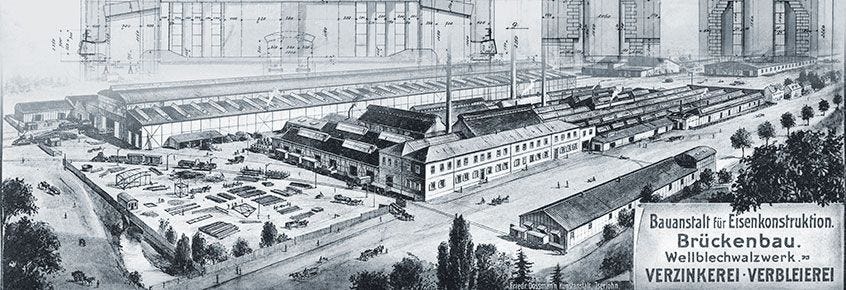
(1) The Siegener Verzinkerei Actiengesellschaft ca. 1909


(2) This era also brought a unique wave of aesthetics as highlighted in this Gründerzeit building in Leipzig designed by the architect Arwed Roßbach (3) A German 1000 mark ca. 1910, the currency of the German Empire from 1871 to 1918
Across centuries, the Dreslers survived the collapse of the guilds, the Napoleonic Wars, imperial Germany and industrialization, and would later withstand two world wars, globalization, and the transition into the modern corporate age—the latter reflected even in the renaming of the Siegener Verzinkerei Actiengesellschaft to The Coatinc Company. As regimes rose and fell, empires gave way to republics, and borders were repeatedly redrawn, one common thread endured and subtly wove through it all: the German Mittelstand.
Recounting the historical lineage of these firms only tells part of the story. The more intriguing realization was that the Mittelstand is not simply a category of company, but an ethos. Before discussing what I encountered inside these factories, it is worth first attempting to define the German Mittelstand and emphasize the pivotal role it plays in shaping the country’s economic and industrial identity.
Mittelstand is often used liberally as a label to describe Germany’s “small-to-medium sized businesses.” However, this interpretation is insufficient; Mittelstand resists translation the same way Schadenfreude or Wanderlust does.
To quote the German newspaper Frankfurter Allgemeine Zeitung:
“Mittelstand cannot be measured by size. Mittelstand is an attitude. The billionaire screw manufacturer Würth can generate as much turnover as it wants, it can never exit the Mittelstand...There are [German] entrepreneurial families whose ancestors did business in China when Mao was working in a library...As difficult as it is to define the Mittelstand, its effects are palpable.” (2013)
Acknowledging this difficulty, I would claim that what distinguishes the Mittelstand falls broadly into three causally related categories: (1) ownership structure, (2) values-based culture, and (3) industrial significance.
In 1962, in his seminal treatise Wesen und Begriff der mittelständischen Unternehmung, Klaus-Jürgen Gantzel evaluated the German Mittelstand through both a structural and sociological lens. Gantzel theorized that the essence (Wesen) and concept (Begriff) of the Mittelstand were based on ownership and control, governance structure, and communal impact. Later extrapolations of his work delineate two entrepreneurial archetypes: first, the Kapitalist, who views the firm primarily as a tool for short-term financial gain; and second, the Mittelständler, who views the firm as an intrinsic extension of self, motivated to preserve its “soul” across generations.
This distinction in ownership philosophy also reveals one of the defining structural characteristics of the Mittelstand. Since the 1930s, much of modern corporate governance literature has centered on what economists call the “principal-agent problem.” Though not formally named at the time, the issue was identified as early as 1776 in Adam Smith’s Wealth of Nations through his observations on the separation of ownership and control within joint stock companies.
“The directors of such companies, being the managers rather of other people’s money than of their own, it cannot well be expected that they should watch over it with the same anxious vigilance with which the partners in a private company frequently watch over their own…It is upon this account, that joint stock companies…have seldom been able to maintain the competition against private adventurers.”
— Excerpt from Wealth of Nations. Book V, Chapter I, Part III
This dynamic can be illustrated through the modern publicly traded corporation, in which shareholders own the company while professional managers wield operational control. The shareholders (principals) entrust decision-making authority to management (agents), whose incentives may not always align with the interests of the owners. For example, a manager whose compensation depends on quarterly performance may prioritize short-term gains, aggressive cost-cutting, or financial engineering even when such decisions weaken the corporation’s long-term health.
Within the Mittelstand, this structural separation is eliminated because shareholders and managers are often one and the same_._ Owners commonly remain involved in the day-to-day operations of the business as multi-generational managers. Decision-making is therefore not dictated by earnings reports or swayed by external market pressure, but exercised prudently by families that think in decades.
This mindset profoundly influences the internal character of the firm. Gantzel posited that the Mittelstand is driven not solely by bottom-line performance, but by fundamental values such as solidarity, stewardship, and trust. A proverb shared with me by one Geschäftsführer sums this up well: _“Kultur ist der gute Geist im Haus”—_roughly, “Culture is the guiding spirit of the house.”
The embodiment of this culture begins with recruiting talent and instilling these values. Many employees join the Mittelstand in their teens through an Ausbildung—the modern successor to the guild apprenticeship system_._ Through this process, apprentices receive not only technical training, but also professional and personal mentorship from the firm. Upon completion of the program, there is no contractual obligation to remain, yet remarkably, 60-80% choose to transition into full-time roles, frequently staying for the rest of their professional tenure. This intentional investment creates a profound mutual loyalty, anchoring the workforce to both the collective spirit of the firm and the social fabric of their town.
Rooted in the same thread of responsibility, the company simultaneously promotes the wellbeing of the broader community around it. Many Mittelstand have chosen to remain headquartered where they were founded, foregoing global capitals like Berlin, Paris, or London. Consequently, the vitality of the village becomes intertwined with the fortunes of the firm. It comes as no surprise, then, that the family name displayed proudly on factory walls is also found on local buildings and sponsorship plaques. More than just a producer of capital goods, the Mittelstand effectively becomes patron of the arts, sponsor of public works, and benefactor of civic life.
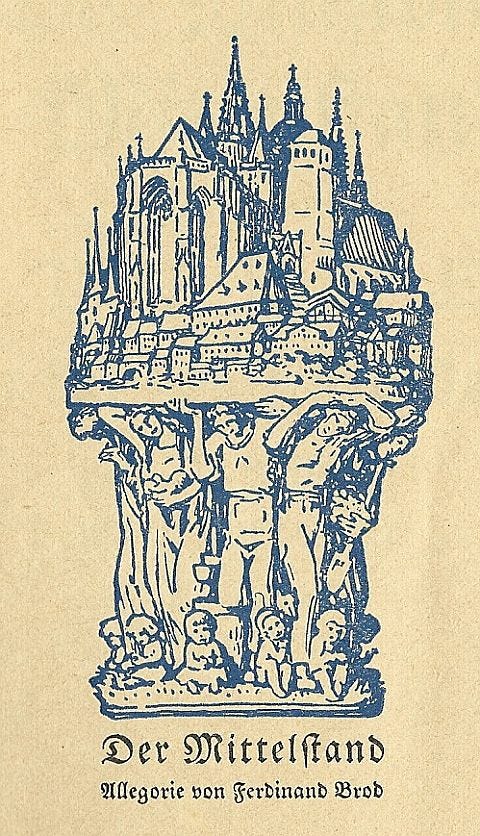
Illustration by Ferdinand Brod for the 1925 book Die Mission des Mittelstandes; 99 Thesen für das schaffende Volk. Written by Willy Schlüter and Walther Woldemar Wilhelm, this book was an ideological manifesto on the “mission” of the German Mittelstand that sought to define its ethical and social role in the crisis-ridden Weimar Republic. The 99-theses format can be viewed comparatively to Luther’s 95 theses casting the Mittelstand in a quasi-theological light.
Dually devoted to their towns, these owners do not disappear to distant corporate offices, but instead live and work alongside their employees, customers, and suppliers. Decades of repeated interaction naturally cultivate trust as businesses and families become household names. Deeply embedded both socially and commercially, personal reputation becomes inseparable from professional.
Concentrated in high-precision engineering, bespoke industrial machinery, and tailored mechanical components, these low-transaction-cost relationships are the handshake confirming dependability in industries characterized by long sales cycles and operational complexity. Under these conditions, engineering solves problems collaboratively; patient capital is allocated thoughtfully; labor markets are sustained seamlessly; and customer service becomes a vocation, not a business function.
Together, these principles underpin the extraordinary significance these companies have attained within the German economy. The Mittelstand accounts for roughly 55% of Germany’s GDP and 70% of its exports, with many firms generating revenues ranging from hundreds of millions to billions of euros. Their economic footprint is so substantial that, on a one-to-one basis, Mittelstand firms employ roughly twice as many people as Germany’s publicly listed, non-family corporations; when taken as a whole, they employ roughly five times as many. This comes even after the fact that it cost Germany €2 trillion to integrate its eastern post-communist states following the fall of the Berlin Wall. All things considered, it is arguably justified to say that the great majority of Germany’s economic stability rests upon the shoulders of the Mittelstand—just look at Brod’s illustration one more time.
Even more captivating is the degree to which these firms dominate specialized global markets. Many Mittelstand are dubbed “Hidden Champions,” holding leading or top-three positions within highly specific industrial niches despite remaining largely unknown outside of their sectors. Of the world’s manufacturing superpowers, Germany is uniquely home to approximately 1,500 Hidden Champions—multiples more than any other country. For comparison, the U.S. trails in second with a meager 350. Whether it is Ottobock (prosthetics), Claas (agricultural machinery), Enercon (wind turbines), Herrenknecht (tunnelling equipment), or Flexi (dog leashes), almost the entirety of the physical world, in one way or another, traces back to a factory in a small German town.
Yet there was only so much I could learn from browsing economic statistics and reading organizational theory. To truly comprehend the Wesen und Begriff of the Mittelstand, I also needed to walk the factory floors and pass through the small industrial towns.
Taking advantage of the breaks in my engineering post-graduate studies and current internship, I hopped on the Deutsche Bahn, and trekked across the country from Nordrhein-Westfalen to Oberbayern to learn from the masters of manufacturing themselves. Over the course of several months, I conducted over twenty interviews with owners and operators, toured ten factories—from a pencil-and-paper machine shop with a double-digit workforce to a global technology titan with tens of thousands of employees—and spent a handful of days shadowing the shop floor of a Hidden Champion to deepen my understanding of the Mittelstand methodology.
From my time spent with these manufacturers, the core takeaway here was that the moat is the tacit knowledge and intuitive engineering judgement behind the processes, and the processes are executed with an uncompromising operational excellence. Put bluntly, when I cheekily asked why I couldn’t just buy the same injection molding machines and open my own shop, a Production Leader chuckled and silently walked me into the next room. Pointing to a 56-year-old tool and die master at his workbench, he stated that I could never “buy” the generations of tribal knowledge captured within the purpose-built molds that slotted into those machines.
This mastery he was alluding to first became apparent to me during the opening dialogue I had with the CEO of a turbomachinery manufacturer. When I inquired about talent development, he explicitly referenced the firm’s inaugural vocational teaching workshop. It was founded in 1910 on the principle that quality products can only be produced by a highly trained specialist workforce. This premise that education is the foundation of every long-standing institution is found repeated across the Mittelstand as dedicated Ausbildung programs and centers.
During a tour of one of these training campuses, the Director of Education explained the first step of nurturing the firm’s technical know-how. Potential hires are engaged as early as 16 years old through field-trip factory tours, live demonstrations of day-to-day work, in-class presentations, and printed flyers posted around the local community. After a successful transition from candidate to apprentice, the new joiner can choose from a list of critical competencies identified by the educational leadership. Each year the committee meets to detail hiring needs and align programs to necessary internal expertise spanning, for example, mechatronics, metal forming, materials testing, and robotics. Once matched to a track, apprentices spend three to four years splitting their time between hands-on shop floor instruction and theoretical classroom coursework—a dual structure that culminates in certification as a Facharbeiter. This function is so core to the firm’s livelihood that the Director highlighted the €6 million investment they had made in 2025 to build their new _Bildungscampus._4 Walking through the state-of-the-art facilities that put my university’s Manufacturing Teaching Laboratory to shame, it dawned upon me that control over workforce development is a strategic manufacturing asset in and of itself.
“The beginning is the most important part of the work…for that is the time at which the character is being formed and the desired impression is more readily taken…”
— Excerpt on education from Plato’s Republic Book II
Attempting to decipher what structurally kept Azubis at a company for their entire career, I had to reflect on what had initially led me to walk away from the industry. The primary reason was the feeling that I would never be able to change anything from within, and definitely not from the factory floor. Additionally, when assessing my career progression, I had noticed that those who rose within the ranks always had to move into business administration, whether by an MBA or a lateral external hire-in. Yet, the Mittelstand had architected a subtly different incentive structure that acted as employee retention infrastructure. Through my questioning, I learned that pay parity between functions and internal promotion were often safeguarded.5 There was a transparency that a production department lead earned no less than an administrative department lead; a Head of Quality was viewed no differently than a Head of Accounting on the P&L. The majority of the manufacturing management I spoke with had actually begun as CNC machinists or industrial mechanics. Here, the ladder to reach one of these production-side leadership positions was climbed up from the shop floor, not handed down by a university degree. I found this to effectively solve several systemic challenges I had encountered: friction between cubicles and craftsmen was reduced; a skilled worker was no longer underpaid relative to a parallel track; and the glass ceiling that only paper credentials can shatter was removed. The end result is an environment allowing a single person to stay in the same factory for 30-40 years, forging tempered lore, like that of the 56-year-old tool and die master whose abilities I could never emulate.
Once the bedrock has hardened and fealty pledged to the floor, it is the manner in which processes are executed that differentiates good from great. This is typically done through some form of Lean Manufacturing—for example, Kontinuierlicher Verbesserungsprozess (KVP) and Reichsausschuß für Arbeitszeitermittlung (REFA)—but these are widely-recognized frameworks and have their counterparts in the U.S., Japan, and other industrialized nations. Therefore, getting to the heart of the Mittelstand’s operational excellence required looking past the production playbooks and dissecting the intangible conventions and characteristics that certify “Made in Germany.”
Reviewing a production schedule with a maintenance technician, I noticed several shadow boards stacked with untouched parts ahead of an assembly line. Asking how they fit into the work plan, he tersely answered that they followed a “No 80% Rule”: nothing is started that cannot be finished in full. The boards and benches, he said, were already kitted and ready to go, but what they lacked were the fabrication rigs the final assembly would be fixed to. Those baseplate frames had to be built to absolute completion before the line could begin integrating its application-specific joining technologies. Coming from a culture whose motto is “move fast and break things,” I initially found the logic backwards. But half-finished products behave differently in the world of atoms than the world of bits. Straying from the Rule introduces work-in-progress that clogs floor space, search-and-wait motions that drain labor hours, and micro-misalignments that throw off tolerances downstream. Through my naivety I perceived this to be idleness and an opposition to speed. Through the German Mittelstand I came to see this as a wall erected to defend against chaos, context-switching, and fragmented quality control.
Yet no amount of adherence to the hundred percent comes without some entropy seeping back in. An Assembly Team Lead thrust his hand toward me and, counting off three fingers, said the greatest waste on any shop floor is time lost looking for parts, tools, or information. Tying this back to the shadow boards: work materials arrive pre-positioned in foam-lined trays so assemblymen never search for parts. Moving across the line, each workbench held only the tools necessary for that specific step, labeled and hung within arm’s reach. Binders with detailed pictures and instructions hung at every station; and the most tech-forward stands even had tablets running query-able software for instant search and recall.
This radicalized approach to waste elimination showed up everywhere I looked. Stepping through two packaging operations—quite amused to find Marlboro boxes being printed alongside the familiar Pringles cylinder—the Managing Director couldn’t stop pointing out waste: a pallet a centimeter over its taped zone; a single cardboard edge protruding from a stack of a hundred labeled goods; a worker flipping aimlessly through a service manual for the machine he was hunched over. “Waste, waste, waste,” he kept muttering and signaling as we moved section to section. The same instinct for orderliness showed up at firm after firm, well beyond the floor itself. Over lunch, one Geschäftsführender Gesellschafter wrapped the philosophy across his entire company: the Kantine’s daily menu is pushed to every employee’s phone each morning so no one wastes time deciding what to eat or by cooking at home; Strauss uniforms with names embroidered on the breast pocket spare employees the hassle of picking an outfit or recalling a coworker’s name; an instant quoting tool lets sales team members have a price ready before the call ends, cutting out the back-and-forth of contract negotiation. Together, the No 80% Rule and this near-militant war on waste produced some of the cleanest, most tightly-run manufacturing operations I had ever seen.
By the end of my time with the Mittelstand, it was clear their approach to process optimization was without equal. Having spent time as a manufacturing engineer, I knew optimization is the lifeblood of any well-oiled machine, but the engine these companies ran on was calibrated differently. At one factory, a CEO who’d spent eight years cutting his teeth in the specialty chemicals industry verbalized the model I kept observing repeat across German factories. He christened this fusion of engineering judgement and operational discipline “The Greenfield Mindset.” First applied to plant design, he’d since carried it into every process across his career, on the factory floor and in the business’s core functions alike. The method: start from the theoretically ideal new process, then apply real-world constraints and work downwards from there. Its opposite, “The Brownfield Mindset,” starts from the existing process and pushes incremental improvements upwards. The claimed effect is that working from an ideal lands you meaningfully higher than any marginal modification could ever achieve.
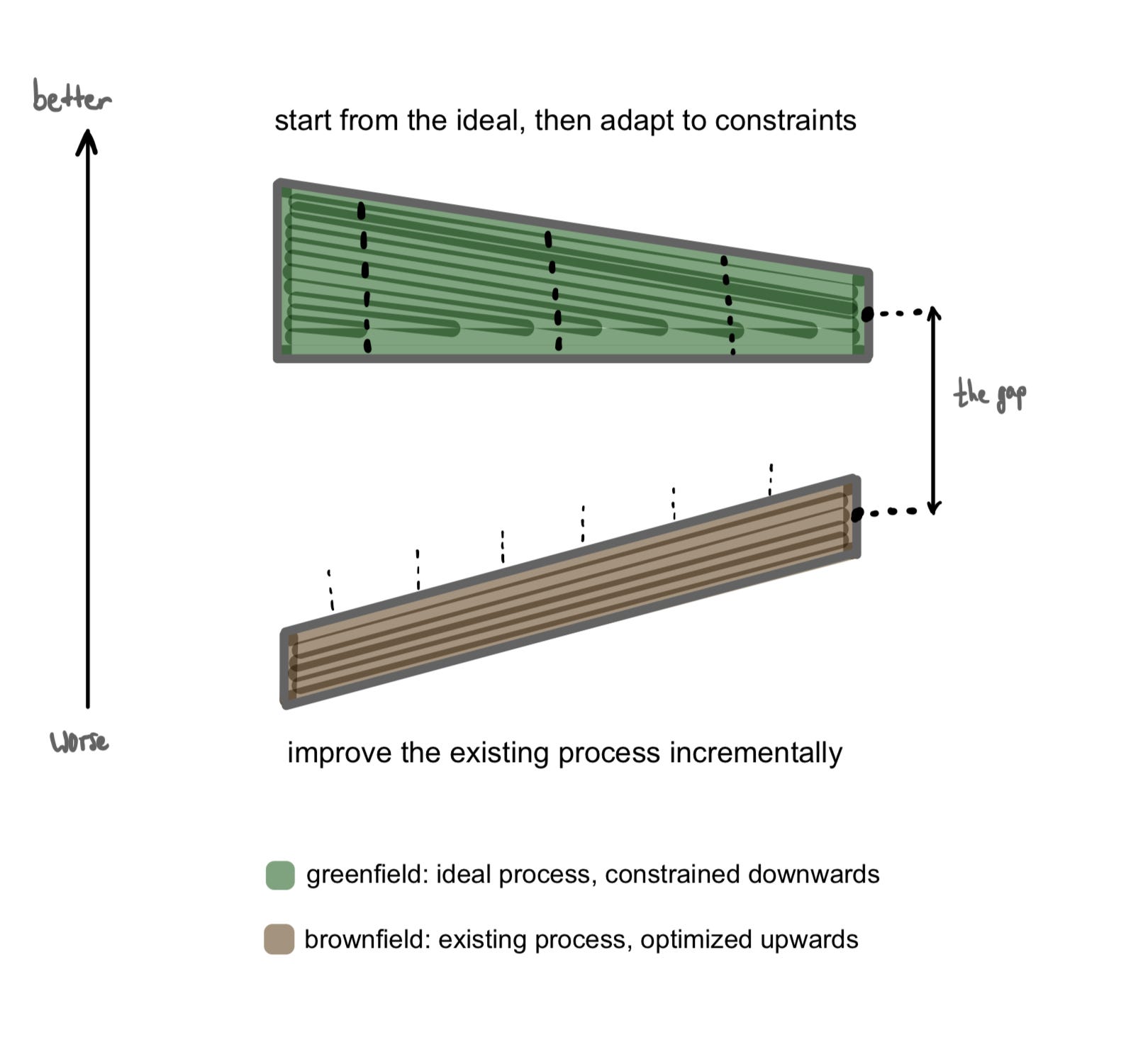
Visualization of the Greenfield vs. Brownfield Mindset
Once it was explained to me, I began to recognize the pattern throughout my tours. At one factory, I sat in on the live onboarding of a new product being transferred from a French subsidiary to their German headquarters. The original build process had been photographed, supplemented with 3D CAD drawings, and thoroughly documented in a LEGO-style step-by-step workbook. Sitting down at the meeting, I expected the point of the exercise to be standardization: align the German approach to the French one, so that the same product came out identical no matter which factory it was manufactured in. However, instead of copying and pasting the template from France, the production leader, automation leader, and full floor team were recreating the process from scratch: workbenches, staffing, line direction, part placement, which existing components could carry over, what would need to be built internally, etc. They were treating the fully documented version as a reference, using this opportunity to rethink the entire process and land on something better than either factory already had.
At a textile manufacturer, an engineer described how one of the Industriemechaniker had found a better way to build a dryer component; rather than fold the change directly into a live line, the team cleared a dedicated space to trial and error the new approach before rolling it out across production. In a final example, a CNC machinist walked me through a recurring scrap-and-rework problem with an externally sourced part. Their fix was to bring the part in-house, redesign the process around it, and machine it themselves. This change dropped part costs by 70%, enabled on-demand integration, and finally held tolerances consistently to their quality benchmarks. Each case demonstrated a step-function gain that a Brownfield improvement is functionally unable to deliver.
Leaving these factories, the gap between recent narratives around German deindustrialization and what I had witnessed was difficult to reconcile. The “conservative, change-averse” Mittelstand commanded high talent density, profound tacit knowledge, proprietary tooling, custom-configured machinery, and ruthlessly optimized processes. Their appetite for modernization was apparent: from piloting AI chatbots across workstation terminals; digitally mapping their supply chains end-to-end; running fully automated material flow through their warehouses; to at least one facility pushing toward a full 'Lights Out' configuration. Virtually every owner quizzed me about what new technologies I had seen that might be worth investigating. I did not hear any alarm bells, warning the crew to jump ship and board the lifeboats. No, in fact the posture reflected calm, collected calculation for how they were going to weather the next 50 years. Climbing the steps of each Hauptbahnhof, I was departing with a rekindled Leidenschaft for the industry. Yet, I had a lingering sensation that what these institutions had internalized ran deeper than the slab-on-grade foundation below the factory floor.
Right before crossing the Atlantic, I grabbed a coffee with one of my closest friends in a Los Angeles beach town. As the surf broke in the background, we exchanged thoughts on our final year of university, summer internships, and a broad variety of topics that steered us toward our guiding principles. In this branch of the winding conversation, he explained the concept of the circles of concern.
This second-century model, developed by the Greek philosopher Hierocles, was anchored on oikeiôsis (Greek: οἰκείωσις)—the cognitive act of recognizing something as one’s own or akin to oneself. Applied to ethics, it becomes the natural process of affiliating others with ourselves and being morally obligated to extend our sphere of concern to encompass them.
Hierocles mapped this idea onto concentric circles, labeling each zone from the innermost self to the outermost ring of all humanity. He asserted that it is our duty to draw each group a layer inward: treating strangers as friends, friends as family, and family as if they were ourselves. The result, ideally, is the reduction of the gap between the concern we show for the ‘self’ and that which we show for the various categories of the ‘other.’
Mulling over this discussion, I struggled to piece together how a single person could ever project concern beyond the second or third ring. Yet, what kept resurfacing in my thoughts was the realization that this was not the case for the Director of TON or the Mittelstand families I spent time with. What differentiated them was that they had crafted and upheld institutions capable of extending their reach far beyond the limits of individual action.
Mirroring Hierocles’ geometry: Workers are treated as family; their households, as friends; the town is drawn into tighter communal bonds; regions reap the fruits of social responsibility; and industry is advanced through shared progress.
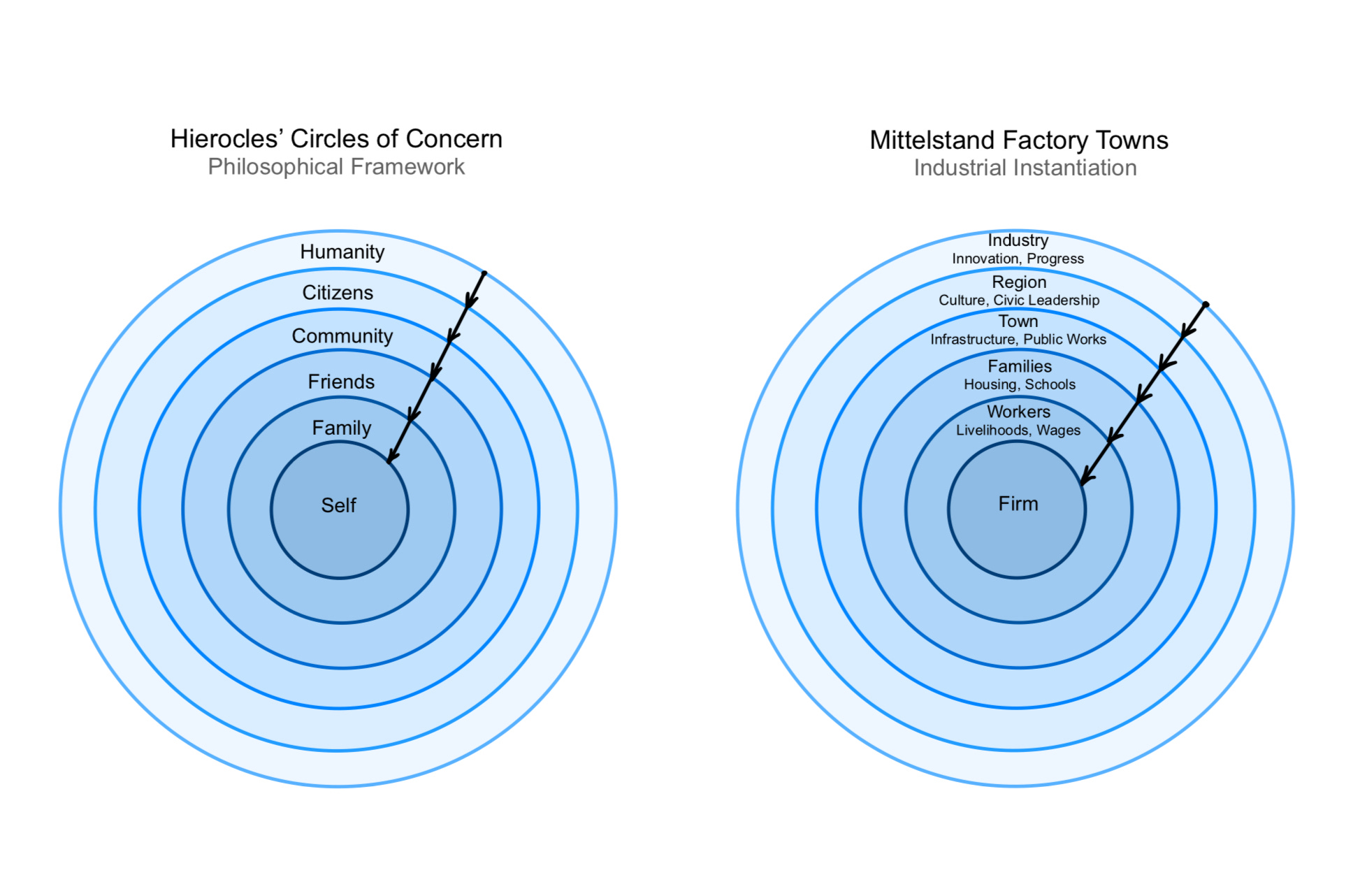
Visualization of Hierocles’ Circles of Concern mirrored to Mittelstand Factory Towns
To illustrate this structure concretely, we need only turn again to German history. Tucked into North Rhine-Westphalia, headquartered in Essen, lies the archetype of the factory town: Friedrich Krupp AG.6
Founded in 1811 by Friedrich Krupp, the steel conglomerate began as a humble foundry with five employees, yet only one generation later the lone workshop was radically transformed. Taking the reins from his father, Alfred aggressively scaled the firm into the largest industrial company in Europe employing over 20,000 people. Strained by the subsequent growing pains, the village desperately needed a solution. Whether driven by paternalism, pragmatism, or genuine concern, Alfred established an in-house construction office, erected four residential communities, modernized Essen’s infrastructure, and pioneered a corporate welfare system nicknamed “cradle-to-grave” for the “Kruppianer.”
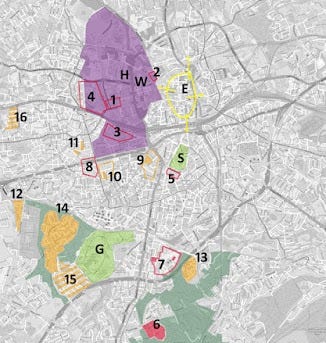
The factory grounds (in violet) grew around the Krupp family home (H) and the Steel Works (W) and were considerably larger than the old city of Essen (E, circled in yellow). The original housing was Westend (1), Nordhof (2), Schederhof (3), Kronenberg (4), and Baumhof (5) next to the Stadtpark (S). These colonies were followed by the Invalidenkolonie Altenhof (7), Alfredshof (8) and Friedrichshof (9). The Alfredshof was then later extended (10) and the Luisenhof (11) was built. Source: Snail in the City Blog
Much more than the traditional welfare housing supplied during industrialization, the Krupp Arbeitersiedlungen offered extensive amenities and comforts to the employees, their families, and the broader community. The Kronenberg Kolonie, Alfred’s last and largest residential project, reflected the manner in which he tended to his people. The nineteen hectares of land accommodated 8,000 individuals in over 220 houses surrounding a communal marketplace and beer hall. In addition to the cooperative, the colony offered a bowling alley, beer garden, post office, pharmacy, playgrounds, and even supported three schools. In its prime, Krupp was building 500 new houses a year; managing a hospital; maintaining the local theatres, sports grounds, and social clubs; and even running its own grocery stores. Advancing the precedent set by Alfred, generations of Krupps would continue to develop the region through various private and public works, for almost a century into the 1920s.
With their basic needs addressed and the workforce inculcated with the “Kruppianer spirit,” the firm crossed the fifth ring. They forged an empire that, by the late 1950s, employed roughly 90,000 workers across more than 60 factories; churned out trains, ships, trucks, and industrial machinery; constructed much of the infrastructure that knit back together the postwar continent; and booked close to a billion dollars a year in sales. Outside Germany, Krupp engineers worked out a deal to expand the steel plant in Turkey, doubling its capacity to 400,000 tons; in Greece the company engineered a $23 million oil refinery; in India, it helped construct a $178 million steel-producing center, alongside 100,000 houses for the new workers; and in Spain, Thailand, Bolivia, South Africa, and Indonesia it embarked upon projects, spanning from bridges to entire industrial parks.


(1) Krupp steel works ca. 1910 (2) The Margarethen Höhe settlement for Krupp workers ca. 1909 (3) The Kronenberg Kolonie on a map from 1898
Perhaps the best documented instantiation of this pattern, the trend was not isolated to Krupp; each firm that I spent time with mirrored the Essen steelworks. Walking through the factories, without fail, executives stopped to greet each coworker by name with a handshake and a cheerful “Mahlzeit.” Sitting in Kantinen, I enjoyed friendly conversation and the same freshly-cooked meal as the veteran Production Leader and the brand-new apprentice. Back on the floor, when I asked the employees questions, they exuded a clear sense of pride as they walked me through the weld they had just laid, the part they had finished certifying, or the production schedule they had finalized. Probing as to why they had decided to work at the firm, I was pleasantly surprised by a recurring theme: they had chosen to join a family business, not a corporation. The name stitched into their Strauss work jackets was one they felt stood by them just as faithfully as they stood by it.
Moving to the Lehrwerkstatt, where this culture first left its mark, picture boards of the current Azubi class portrayed the transformation from tabula rasa into a Gemeinschaft armed with skillsets that enabled them to find their place in the firm. Always crowning the training center was a stand proudly displaying generations of master projects marking the successful completion of one Ausbildung after the next. On more than one occasion, my guide shared a fond memory of their time as an Auszubildender and mentioned that their son or daughter was in the current class. Impressed upon me was the notion that what I was observing wasn’t the ownership handed down over generations, but the undercurrent of belonging that passed along with it.
The tours always continued beyond the shop floor, as Mittelständler revealed the nuances of their Heimaten, recounting stories that reached beyond the founders who had laid the cornerstone of the first workshop. Near Salzburg, a Head of Quality narrated the ways the salt industry had shaped the landscape we gazed upon, pointing to his house on the horizon that had borne witness to it all. Dropping me off at the train station, a machinist was beaming as we passed the house he was currently building for his new family. En route to his second plant, a Managing Director drew my attention to the new kindergarten they had endowed as children ran by squealing with joy. Roaming across a town square, another Mittelständler nodded toward the renovated opera house atop the nearby hill. On a walk with a Geschäftsführer, we peered into the three ateliers he commissioned art from, where the very canvases adorning the walls of the firm had been painted.7 Every street I strolled bore some sign of the Mittelstand that had come to care for it.
These scenes were not merely displays of corporate philanthropy; by interlinking their fortunes with the well-being of their communities, these firms also crossed the threshold of the fifth circle. The economic stability of a region, the dignity of a multi-generational craft, and the mutual trust between worker and owner compounded into Hidden Champions. Among others, I had seen clocks wound by hand in Saxony that have kept the time, first in our pockets, and then on our wrists, since the 1800s; fasteners molded in North Rhine-Westphalia that secure the frames of the trains, planes, and automobiles that take us from the office to our holidays; textile machines engineered in Bavaria that spin the threads that clothe us and the fibers that carry our calls; lenses ground in Baden-Württemberg that capture our photos, study our cells, and guide our surgeons’ hands. These Mittelstand logos line the sheets of trade Bibles tucked into work cabinets, and sit humbly on shelves, engraved on Global Excellence awards for markets we’ve never heard of. Yet it is in these overlooked corners of the country that the mysteries of manufacturing edge industry ever onwards.
I had arrived on this continent with the goal of uncovering the secrets of German engineering, expecting to improve my understanding of how factories were operated. Instead, departing each town, what struck me was that I had unintentionally answered the outstanding question from the previous summer. The Mittelstand had not simply mastered manufacturing; it had also managed to draw Hierocles’ circles closer together.
As my time in Germany and my technology investment internship come to a close, I have much of the broader discourse to reflect on. There are conversations about a shifting transatlantic relationship, the reawakening of the Western industrial base, and above all, the concern of mass labor displacement—if not erasure altogether—by artificial intelligence.
It is comforting, then, to know that our troubles are not entirely new. The ides have seen kings replaced by democracies; empires rise and fall; borders redrawn, states reorganized; and the notion of man being replaced by machine debated since Aristotle’s time.
“For if every instrument could accomplish its own work, obeying or anticipating the will of others…if the shuttle would weave and the plectrum touch the lyre without a hand to guide them, chief workmen would not want servants, nor masters slaves.”
— Excerpt from Aristotle’s Politics Book 1, Part IV
Closer to our own era, the farmers and craftsmen of the Industrial Revolution likely shared many of our same worries. While social and political upheaval did occur, I find solace in the fact that humanity always finds its way—even when that path led to factory floors.
In our contemporary society, we find ourselves walking along a similar road; only our agricultural and artisanal professions have traded overalls for white collars, swapping hammers and plows for emails and spreadsheets. If turbulent times and an industrialization of our trades are likewise inevitable, the more interesting and opportune question becomes: what will be our factories?
Admittedly, I don’t yet have an answer.
Boarding the plane to New York City to begin my professional career, I can already imagine myself lost in thought. This time perhaps, turning not back to Bystřice, but to the cobblestone alleys of Bielefeld or Braunschweig, nestled among Fachwerkhäuser with chimney stacks silhouetted in the background.
Drifting through these memories, I’m compelled to remember that the Mittelstand were here before the first Glorious Revolution, and they will certainly remain standing after the next. If there is one thing I’m taking home with me, it is that whatever factories we build next, they should probably resemble the Mittelstand.
Cover art: Das Eisenwalzwerk (Moderne Cyklopen) by Adolph Menzel ca. 1872
1. I use capture here the way a child, running through a summer field at dusk, gently encloses a lightning bug in his cupped hands, marvelling with wide eyes at the yellow-green light emanating from in between his fingers.
2. Etymologically, guild denotes a brotherhood funded by members’ payments, from the Proto‑Germanic geldą (“payment, contribution”). Today, Geld is the German word for money, derived from the same origin.
3. First Industrial Revolution (ca. 1760-1840) primarily in the U.K., introduced steam power and mechanization, core industries were iron and textiles. Second Industrial revolution (ca. 1870-1914) primarily in Germany and the United States, introduced electrification and mass production, core industries were steel and chemicals.
4. While every firm I toured had their own Ausbildungsprogramm—this is already well documented as standard across the Mittelstand and Germany more broadly—not every firm had their own dedicated building. What then also impressed me was the willingness of those with education campuses to use their extra training capacity to take on apprentices and help develop them for their neighboring firms. Yet another example of the Mittelstand taking care of their region and crossing Hierocles’ 4th circle.
5. I’m aware of the argument that pay parity and internal promotion can be a second order effect of German/European labor laws. An adjacent argument for how this hinders European innovation is articulated in the essay “Why Europe doesn’t have a Tesla.” For the purpose of my writing, I’ve chosen to frame it in a more “glass half full” manner.
6. Friedrich Krupp AG is today the publicly traded ThyssenKrupp AG, from the merger of Thyssen AG and Krupp in 1999. It remains one of Germany’s and Europe’s largest industrial groups, with over 90,000 employees and annual turnover exceeding €30 billion.
7. In my previous piece “On Art and Industry” I detailed the impact industrialization had on impressionism. I was greatly pleased to stumble upon the following anecdote during my tours:
“Claude Monet, one of the fathers of Impressionism, suffered from shortsightedness and, later in life, from cataracts. A Paris-based optician was able to help with special eyeglass lenses from [the Mittelstand] for post-cataract surgery patients. With his eyesight restored, Monet decided to rework some paintings from his water-lilies series. In 1925, he wrote to a friend saying that since he had regained his vision, he was able to work as never before.”
In order of appearance:
+-160: The Emergence and Expansion of Bended Furniture from Bystřice pod Hostýnem
Bystřice pod Hostýnem Pays Off Another Debt, Returning Honorary Citizenship to the Thonet Family
Beneš Decrees (Peter Haslinger, Collegium Carolinum)
The Henokiens International Association of Bicentennial Family Companies – The Coatinc Company
History of Ore Mining and Iron Production in Siegerland
Heinz Bensberg History of Siegen
Craftsmen in German Cities, 1600-1800
European Iron Industry from the Late 17th to the Middle of the 19th Century (Rainer Fremdling, ResearchGate)
How Markets in Europe Opened Up as Guild Monopolies Declined in the Sixteenth Century
Why the Industrial Revolution Started in Britain (World History Encyclopedia)
The Role of the State: French and German Railroads (Harvard Business School)
German State Action and Railway Policy During the 20th Century
Britain and Germany 1800 to 1914: Two Developmental Paths Towards Industrial Society (Wolfgang J. Mommsen, German Historical Institute London)
European Grunderzeit: When, If Not Now? (European Startup Initiative)
500 Years of The Coatinc Company, Siegen
How Much Did Reunification Cost?
The Secret Behind Germany’s Thriving Mittelstand Businesses is All in the Mindset
How Germany’s Family Firms Power the Mittelstand
The German Mittelstand: Antithesis to the Silicon Valley Entrepreneurship Model? (IFM Bonn)
Germany’s Industrial Family Firms: Prospering Islands of Social Capital in a Financialized World? (ResearchGate)
Wesen und Begriff der Mittelständischen Unternehmung (K.J. Gantzel, Semantic Scholar)
On the Revenue of the Sovereign or Commonwealth (Adam Smith, Wealth of Nations)
Patient Capital Will Eat the World (Will Manidis, Minutes)
Relationship Between Economics of Trust And Transaction Cost: A Brief Exposition (International Journal of Business and Management Studies)
Principal-agent Conflict in United States of America and Germany (Central European University)
The German Apprenticeship System
How to Deal with a Deindustrialising Germany (Lundgreen’s Investor Insights)
In Danger of Being Left Behind? — Media Narratives of the Digital Transformation in the German Mittelstand (Taylor & Francis)
Ideological Differences in the Expansion of the Moral Circle
Enlightened Paternalism: Krupp Factory Housing in Essen
The Margareth’s High in Essen: Improvement of Worker’s Dwelling in the Ruhr Area (UCC Geography Research Project)
Vanished Krupp Company Workers’ Colonies in Essen
Remnants of Krupp Company Workers’ Colonies in Essen
Business Abroad: The House that Krupp Rebuilt (Time Magazine)
Nothing They Wouldn’t Do — Krupp: A History of the Legendary German Firm (Richard J. Evans, London Review of Books)
Social Welfare and Business: The Krupp Welfare Program, 1860-1914 (JSTOR)
The Coming Clash Between China and Europe (Thorsten Benner, Foreign Affairs)
Places & Spaces: Germany’s Fairytale Fachwerk Houses
The Secret Cause of the Industrial Revolution (Ben Southwood, Works in Progress)
No posts