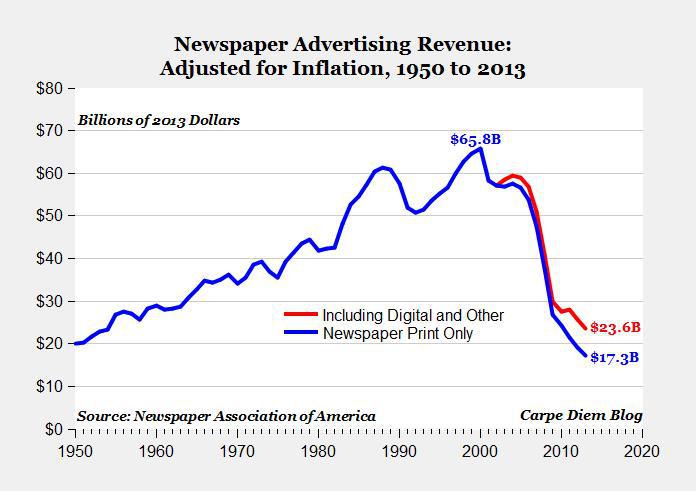
I've heard homeless former printers talking about the good days at the Burger King near the cable car turntable at Powell and Market. They thought they had careers. Now they're struggling to survive.
Knitting is not the answer. This is a survival issue. Somehow I suspect the author inherited money.
It seems to me these changes are much more daunting if you live in a country where no job means no health insurance, and where the pay gap between skilled and unskilled work is huge. That makes an existential question about work into a very material one.
That said I do think it is useful from a societal perspective that programmers are both doing this and getting hit. I'm not going to celebrate someone's job being threatened but in this particular case I think that symmetry is a major societal win for surfacing the question as to how are we collectively as humanity going to figure this whole AI situation out.
See translator jobs getting wiped out. Nobody even blinked an eye, it didn't spark any discussion, no deep thoughts were had. It did wiped out a bunch of people's lives and did NOTHING to trigger discussions around what are we going to do here.
Twitter connected programmers feeling the heat with a large audience may prove better to spark discussion
I've been working in tech for over 20 years now in various roles, and this is the least I have cared about it. I used to want to get better, and was constantly excited about learning new things just for the sake of it. Now I daydream about being homeless. I look around at all the meaningless crap I have accumulated, and feel shame that I didn't use that money to retire early.
I am surprised that remote work didn't get a bigger mention in the article. In a few weeks I will have been working from home for 12 years, and I believe it is the cause of most of most of my angst. At first, the convivence was such a relief, but it has become a trap. The effort of the commute, forcing me to go out every day and talk to human beings face to face, even just little things like making sure I was showered and dressed every day, they all felt like a burden at the time but they were good for me and I didn't realize it. Not to mention that it makes my house feel like work, and I now I hate it here.
I will say as an anecdote counter to the AI examples given in the article. I have a young co-worker who is very excited about AI and is using it way more effectively than I am. Talking to him gives me hope for the future, the kids will be alright.
But to the point of the article: I have many friends my age that are making less than half of what I do working objectively harder jobs for way longer hours, but they all seem so much happier than I am.
Then, at some point, being in tech became a gilded profession and everyone: salesmen, artists, clerks etc. joined in. Not because they wanted to be in tech.
They wanted gold.
For years it was working, but right now things shifted. You can no longer just do the thing you learned for a job and continue doing so, because landscape shifted. So they're miserable and they want to get back to knitting, pottery or whatever thing they want to do but not tech.
For people I know who are in tech for the tech nothing changed. There's new tech in town, one has to adjust, and it's still possible to discover new things and pave new paths. Tech was always shifting and I suppose people who worked in it for it always knew it, and it doesn't derail them.
Some of us started in the 80s or 90s and got into it with personal projects and treating the PC as a hobby. It is satisfying to be able to command a hunk of metal and get it to do things. And it can do boring stuff really fast and repeatedly. And that alone was exciting. The majority of us would stay up into the morning hours figuring out how to compile something. Or how to get that new driver work correctly in an unsupported OS or setup. It's a lust of computing. The gadgetry. The devices. The awestruck feeling when a new computing device or technology comes out.
I and many others like me still have that yearning and curiosity. I love strolling the aisles of the hardware store and computer stores for this very reason. The energy is electric. The immense amount of technology in every little thing is just mind blowing. THAT's why we do it. THAT's why we got into it. It wasn't the pay. It wasn't the glory. It was a group of us who wanted so desperately to have a computer club or an electronics lab for us to hangout and build stuff.
Unfortunately, as the industry grew, all the wrong personalities entered it. Project managers, product managers, scrum/agile masters, terrible mid level managers, talentless clowns, bozos, cheerleaders, jocks. The lot of them. The non-weird, non-geeky, non-obsessive, non-nerdy types. And then they co-opted the culture. They thought wearing glasses and wearing a backpack and carrying the latest tech devices made them "it".
The good thing is that the burnout hits fast for these folks. Just like the tons of medical school or law school students who are there for all the wrong reasons and realize sooner or later that this isn't at all what they wanted. Some members of this group actually become doctors and lawyers. THIS is the group that the article is talking about. They don't last, because their heart and soul are just not in it.
For the rest of us? AI, no AI, walled gardens, OSS or closed. It doesn't matter. All of this geeky stuff brings us joy. I don't want to "turn off and disconnect", I want to be connected because I love this stuff. I love the simple speaker and amp and the latest LLM. And I love the latest ADAS systems in cars. This work is meaningful to me because of both the end product and the work that it took to get there.
Unfortunately, the issue is that while we enjoy the geekery, the others ruin it for us because their lives suck.
Sorry to be harsh.
https://en.wikipedia.org/wiki/The_American_Scholar
https://andrewmbailey.com/papers/Higher-order%20truths%20abo...
It did at one time! I think that’s what’s so alluring initially about Workism. People waited with bated breath for the iPhone and iPad and its new versions. Those iPod commercials and the marketing campaigns for “rip. Mix. Burn.” did change the music world.
But the quote is also right. It doesn’t happen anymore, and I think that’s why the religion of Workism is especially vulnerable at this point.
In someways, it sorta feels like the article is cheering AI on? Like, it judges Workism, and goes on to say that AI shatters the illusion, but then.. that’s it? Deriving value from good work is pointless now and we should all just go volunteer?
I dunno, i clearly identify with those who loved work and now feel a bit lost, and yes i have been thinking about alternatives, but I feel like there must be knowledge work that is still valuable both financially and socially and also provides some sense of pride and purpose… if not, i fear the situation is much more dire than we are prepared for
I actually did go buy a farm in the 2010s, grew alfalfa, managed cattle, cared for horses, etc. Except I did it while working remote as a software engineer.
Very fun life, and I may return to it again. But it's not an AI thing, and it's not a disappearing job thing. It's just that office work keeps you so separated from the real world that you yearn for something physical.
I think a big part of it is just how incredibly toxic the web has become. If you spend any time online, as most tech workers do, you have exceptional resiliency if you're able to stay sane and level headed.
Going online it's like everyone is really angry and tired and sad all the time, and it's getting worse every year. This really took a nosedive during the pandemic, but looking back this had been going on for several years before. Every election cycle makes things worse too.
It's just been spiraling in a very dark direction for a long time. You have these blackpill depression cirklejerks everywhere. Astroturfing is getting worse every year. Like what Bannon did with gamer gate is an amateurish precursor to what everyone with is doing everywhere now. With AI you can even run these campaigns with a very small budget.
All the news is just outrage porn and non-stop predictions of impending doom. Used to be more tabloid territory but now I don't know if anywhere is spared. A lot of the focus now is on AI, but when it isn't the world is burning in some other fashion. Reading the news, we've been in a permanent state of crisis for years now.
This information diet just isn't good for your mental health. It isn't just tech workers, but they're probably more exposed than most.
Candide's closing remarks spring to mind. Tend your garden.
Because we watched our careers go from being in service of an industry of tinkerers and designers, to being in service of the worst people attempting to maximize wealth extraction no matter the human cost?
Because Snow Crash wasn't supposed to be the goal?
Because our daily complicity in what's happening is also a daily reminder that we're not brave enough to be a Mangione?
Take your pick.
The way that people are described, and the conditions portrayed, have been this way for quite some time. The only thing that is changed is now there is a clearly defined boogeyman to point to that justifies it. Because the other boogeymen make the usual authors too uncomfortable to bring up.
I feel like this can be applied to a lot of things, but this is pretty much how I've felt working in tech for the last 2ish years.
1. Do I want to have the kind of lived experiences that the field has to offer? The answer can come through some introspection to questions like: "Do I have a good devx talking to AI and understanding how it works? If not am I willing to learn how to?" or "Am I ok if development has become more intense than it was — because you will talk to AI/Machine more than before?".
2. Whatever your introspective questions are, if there answer is: "Yes I am more or less ok.", then pick a goal that lets you get those experiences and hack away.
I feel this decision making is more important than ever for people who are banked on more their skill to write decent code and not much else in the recent past. And also people with mental health issues should be more deliberate about their choices.
Because the world sure needs more goat farmers and surf instructors.
It's all pointless, you can't outrun the pointlessness - so just enjoy it!
The CEO at my company tried to PR code to my repo. It didn't make any sense but it was a whole political thing to make it go away.
The industry has always been stupid and selfish and short-sighted but now the ICs at the bottom of the pyramid are themselves being commoditized like all the workers they "disrupted".
This is a universal concept across the Internet.
If you’re on your phone all day doom scrolling you’ll only encounter sad people.
But the truth is everyone is sad or subjectively unhappy no matter if that is a real or imaginary reflection of wealth or money or access to food, cloths, coffee, restaurants ...
You can see it in SF movies: a lot of the successful ones in the last years maybe 10, maybe 20 years are not optimistic about the future. The same is in all areas of life: we seem to need always something to reach for, or something to fix, to work on, to improve so we can be (maybe have) eudaimonia (for a lack of a better word) or just a normal life.
I loved my career.
Wow have my feelings changed. I'm disgusted. It's a moral disgust. The scene turns me off SO MUCH. Just a recent tidbit: I think it is Anthropic that is buying old (some antique, vintage) books, scanning them, then pulping them.
There is no restraint at this point. Whether it's Meta and their pervert glasses and child exploitation. Or google trashing their own search.
One thing that has turned my stomach is how management has acted after discovering they could trash their skilled workers in the way that so many other industries have been able to do. If you want to know management's true character, remove the moat (that skill used to be) from the workers and watch what happens.
...Okay, I'm editing. There is a bright spot. The other day I was sitting around doing nothing and suddenly out of the blue dreamed up an app that could help build community regarding an activity I care a lot about. With an LLM I could do the whole thing myself. I'm excited about this. I might fit this in among my other projects. It's kind of like taking a hammer and chisel and cutting a piece off of Big Tech. If all of us skilled folks do this we could have an impact and serve community at the same time.
Flame wars used to be about distros and code and now it’s about how people think and opinions.
Everyone needs to go outside for a second, smell the flowers, hear the birds chip and calm down.
In 1923 there were 863,000 coal miners in the US. There are less than 45,000 today.
[1] https://deanclatworthy.com/2026/02/09/the-joy-of-programming...
I see a lot of people hyping AI and condemning it, but very few seem to be interested in working on what our future should look like.
The pleasure...
Tech for me is that third variation. Sometimes you get nothing and sometimes it totally delivers (and more!) on what it promises. This is as a user and even as a provider. You take various bits and bobs and suddenly with a slightly clever idea and you've got something that's more then the sum of the parts. Sometimes. Other times it just never comes together.
I'm not sure if that makes me happy or sad. Bit of both I suppose but I keep going back to the well because you never know.
Amd that sentiment is hardly surprising, coming as it does from a Director of AI Operations (his title on LinkedIn).
When it comes to revolting against industry change, there's a good paper by Eric Hobsbawm called The Machine Breakers. Yes, he's focused more on the Luddite-style reaction of destruction. But interestingly, he notes two types of machine breaking.
There is the type that is not hostile to the machine itself, but which was used to coerce employers to improve conditions and pay. Unpopular employers and owners were often the ones targeted with what has been called “collective bargaining by riot.” Those machine breakers were more pro trade-unionist than anti-machine.
Hobsbawm mentions that a benefit of machine breaking was that destruction built the “habit of solidarity which is the foundation of effective trade unionism.” That solidarity was more naturally built in places like coal mines where workers were closely collocated and was more difficult to build in framework knitting, where workers were scattered.
But the second type of machine breaking was more about resistance to machines themselves, especially those that were labor-saving devices. That type of anti-tech Luddism is where I’ve mostly focused my own recent research. For that second type, Hobsbawm notes that workers, manufacturers, and the general public often shared in the discomfort of machine impact on peoples’ livelihoods.
Unlike the conditions and pay, this other type of machine-breaking helped workers slow down the loss of control on their employment. That included situations where machines made workers more productive and where, as a result, fewer of them were required. Or situations where machines enabled pay to decrease, as highly-skilled and highly-paid workers were replaced by less-skilled and lower-paid workers.
The alternative was the impossibility that Hobsbawm describes as follows: “The small shop-keeper or local master did not want an economy of limitless expansion…. His ideal was the secular dream of all 'little men,' … a small- scale society of modest property-owners and comfortably-off wage- earners, without great distinctions of wealth of power.”
I'm due to update this, but I've been keeping a running list of examples: https://docs.google.com/spreadsheets/d/1M_UjOPxpbKMYes5CcWRW...
I can't put a finger on it, but it's not about younger people or Gen Z, it also applies to older people. It just feels like good work doesn't matter much anymore, and everyone tries to make the best out of it in their private life.
Unfortunately, this isn't the movie industry. We don't see a list of credits at the end of his commentary recognizing the thousands of others involved in helping him publish his thoughts.
Perhaps we can all chip in and name some of the many people involved in building the tech stack he published with. I'm sure there are THOUSANDS without even looking at the previous technologies those things like blogging platforms, current browsers or current generation phones built from.
Is that fair enough?
I'm not sad. As I look out to the next few weeks and whatever, I'm not sad. Hopefully those credits will help others also not be sad.
Here's to WordPress and Matt Mullenweg and Mike Little.
Remember that this is going to supercharge economy, sure, in the beginning it'll not be obvious, but then you are going to see how it'll enable people to stop working, just like trickle down economy has redistribut....ed...
Ok maybe that's a bad example, sure it's going to take a lot of people out of business, and yes there will be a lot of pain for a "small" part of society, but in general it will be pure gain as a whole... it's not like all that people being laid off means something like stop paying house mortgages, and then a lot of evictions and suddenly a lot of houses going of market... ... I mean even then that's not like it's going to cause all the house market to go down right?
Ok maybe a bit... but don't worry if you are near underwater with your loan someone will buy all those houses to keep your loans on check... it's not like it's going to be some private investors with all the money that will go to the top 1% and take them out of the market and make impossible for the rest of us to buy something...
I mean, my point is don't be negative, stop fighting progress, if more people can buy super yatches there will be more openings for building them!
Which is an AI booster:
https://berggruen.org/projects/ai-visionaries
You cannot read these articles posing as human interest without following the money.
https://www.nytimes.com/video/insider/100000004687429/farewe...
A bricklayer can be excellent at his job. He can work hard to become so (to paraphrase Inigo Mendoya). He should pride himself on this excellence, but it is unlikely he will think he was put on this earth to be a bricklayer. The despair of the the unemployed skilled laborer is that losing his livelihood imperils the things he does value, family and the ability to provide for them.
In a culture where the highest goods are production so you can feed the appropriate level of hedonic consumption, and without any transcendent meaning its a rough go.
Might we ask how large your sheep farm is, by current commercial (vs. hobby) standards?
Every time I told anyone that I personally didn’t like working from home, and was excited about the return to office that would inevitably come, I got SHOUTED at. Absolutely flayed for not being 110% in support of this thing that made their lives worth living or whatever.
When it first happened I thought it was a weird interpersonal conflict situation. Maybe I had broached it wrong. But it kept happening! So many people were so upset when megacorp said they had to return or find other employment.
But I’m an extrovert and working from home was suffocating.
Did someone just say "WFH"?
You are the art.
Maybe anyway. I think that probably depends on at least a couple of more breakthroughs - at least a solution to the hallucination problem, and probably some kind of true on-line learning, not just writing stuff down and reading it again later.
Modern media is on this spectrum (infinite scroll, algorithmically tailored, short form video).
When people can get dopamine by pressing a button it's easy for them to trade a rich and diverse set of values for that button. When people can get dopamine by pressing a button, it's hard to maintain a rich and diverse set of values.
Values are genuine interest (want) in taking actions and patterns of actions.
For cowork you don’t often have to commute as much (more options around), can arrive late, don’t have to dress to nice. For some you can still change your homebase at least for few months temporarily.
But you can still have physical coworkers (even if you don’t work with them), have chitchat not relate to work, go to lunch together. You can also have routine and separate your professional life from personal one.
I got into computer science because the problems in physics were either already solved or couldn't be solved without trillions of dollars invested in new accelerators.
From my point of view the tech side of things is a gig I did on the side to pay the bills. LLMs are amazing and useful. Even Knuth thinks so: https://cs.stanford.edu/~knuth/papers/claude-cycles.pdf
Now instead of spending weeks on side quests I can just burn some money and get either a counter example or proof without sinking hours/days/weeks into it.
Literally the world’s easiest ambition to achieve.
Then other is artisan, those who took pride in organizing and craft.
Second one is having miserable time. The former like me are having a blast. I love tech for that reason.
I stopped talking to people who think LLMs are waste. It's because they don't even touch it. They think it's a taboo to touch it.
So anything in tech is exciting because it enables us to do so many random things. Wish more people learnt about it.
Exactly this. We were (still are) complicit in our own destruction and worst yet when other courageous people spoke up we shout them down, hid away, laughed at their folly, or shunned them outright.
I live in the US and I’ve watched in real time every sad, terrible decision made by the current administration and every sad terrible decision by what’s supposed to be the opposition party. It all makes me want to scream.
And then I’m offline and my life carries on because none it has really affected my white privileged middle class tech worker butt.
It all feels wrong.
I know it is my own fault for neglecting my health and relationships, but I can't help but feel this career makes the most important things more difficult.
In reality, I see a lot of the current unhappiness in the Tech industry is being triggered by their pointy haired bosses wasting millions on their failed AI strategies only to embark on more failing AI strategies.
This part is strange to me. I've worked from home for about 10 years and I've never once had an issue with twice-daily showering, meeting people face-to-face, going out for coffee, going outdoors, going to the gym, etc. The fact I can just go sit in a park, on a hiking trail, or whatever and work there is a genuine "killer app" for me. I'm surprised at people who tell me that they are isolated by home work when there are so many opportunities for social and natural connection everywhere...
Yeah it did. The environments became a lot more toxic and the decisions became a lot more stupid.
I also miss working with people who actually cared about the craft. They exist on the IC level but they're burned out and on the executive level it's mostly just insecure morons these days.
This isn’t a disagreement or a hook into some discourse or anything. I don’t have a point. Just thoughts
I noticed it most when the slurs they used against us became status symbols, as a hoard of grifters traded in their ties (remember ties?) and golf doodads for SF franchise bling and proclaimed themselves "geeks" and "nerds".
I was in the doctor's office and a person was on the phone talking in the waiting room. I thought it was weird. But then I thought "if a person was sitting in the seat next to them and they were talking, would that be weird?"
I don't think we'd see two people talking as being weird. Why is it weird if someone is by themself speaking to someone that isn't around on the phone? If two people can speak in that place, it's not weird for someone to have a phone discussion.
Now playing music speakers or watching TikTok videos on your phone in a public place...psychotic!
On a recent plane ride some old guys were watching movies on their phones on full volume. I complained and they stopped, but another guy in another row started doing it again. It gets tiring.
Last week I was on a NYC subway train to JFK Airport and there was a guy blasting some loud hip-hop/trap and a small kid playing some loud game, totally oblivious to the people on the train. After they left some older guy stepped in talking on full speaker to someone for 10 minutes.
It was quite crazy tbh, and I guess people here have already given up and start accepting it since it is tiring to police somebody new every 5 minutes and could also end in violence.
My very limited understanding of farming is that it takes a huge amount of time, and you're usually up and working before sunrise, even with automation.
And a lot of them don't?
A lot of people who work on a computer all day also have back pain and inflexible schedules. Hell, I'm sure a lot of knowledge workers in other countries work in places with no air conditioning, for example - not exactly "extreme" but not climate-controlled, either.
"Bullshit Jobs"
I'm partial to what I call the "doomer effect". If you feel sad or disenfranchised you're just much more likely to spend time online talking. A person with a fulfilling social life and a job they feel satisfied with is going to spend time socializing with friends and working on their job. They may read online feeds, they may write very occasionally, but that will be the extent of most interactions. On the other hand the folks that feel the most negative tend to spend inordinate amounts of time online posting about how sad and angry they are.
In a real life conversation when a depressed friend gets on their soapbox most folks give the friend a subtle clue that it's time to move on. If that clue isn't heeded the friend often gets targeted 1:1 offers for help and can eventually just be shut out of the group altogether for being too negative. Nothing like this happens offline. If you're in a bad place, as long as a forum will have your posts you can post to your heart's content. And oh boy is it finally the time to let your hair down and tell everyone how f-ed everything is on the inside. Constantly.
This makes a flywheel. People who want to avoid negativity start avoiding negative online spaces. People who are fine with it or feel similarly keep reading. Eventually negativity becomes the default.
"Misery loves company" is much older than the Internet. There's no doubt to me that the net makes it that much worse.
As far as the disillusionment sense, I think that’s an active selection bias. I think people (including me) like to feel angry and so we go out there looking for and finding people who will give us that. The key, for me, is to curate one’s feed. On HN, for instance, I usually block the majority of repetitive boring posters using a chrome extension. The majority of these people have very low context sensitivity which annoys me.
There are also abrasive people or generally sad people, both groups of which are safely blockable because they have a comment style where P(token|context) = P(token). There is no surfeit of humans on the Internet and no surfeit of interesting information. Almost all humans can be safely excluded from my feed and I can still get information.
By the way, I know you from your search engine. This might be an out there question but do you offer your search index as a downloadable structure? If so, how much does that cost?
Would be nice if people could keep their noise levels down in general.
It feels to me like the change from:
- old: going downtown to the restaurants and shops of your small village to enjoy a relaxing evening.
- new: downtown is a crowded confusing mishmash of unregulated blaring music, over-the-top blinking flashing signs, intrusive people accosting you and dangerous thieves lurking everywhere. don't go.
there's no "regulated" that makes thing better for anyone, it just gets morphed into oppression of the vistors making them more vulnerable without fixing any problems.
Agreed.
From TFA: "This disillusionment is infectious."
I would suggest it is in part being spread by articles like this one. If you look at the press surrounding earlier advances, it was largely neutral to positive. Nowadays, as you note, it's doom stew everywhere, and the beacons of solace are pieces like this one driving home to anyone who's missed it how demoralized their peers are.
All options are good because they are all true.
I think you can extend them.
Too inward for what?
Isn't that exactly a concern for those who find meaning in other things than their job? If you find meaning in your job then getting paid enough to support your family is obviously important, but it is ultimately a secondary concern.
University graduates are often considered min-bar for white-collar work hiring, so if it takes 4 years to train someone, how are people supposed to decide on a career path when it takes less time than that to completely alter the workplace?
My daughter is entering her first year of nursing, a career path that she is greatly looking towards. Who says in 3 years that robotics companies don't actually deliver on their promises and completely up-end the care industry? While I think that unlikely, it's not like people aren't trying to automate nurses away.
That's because they're thinking that they're still going to get paid $200k/y for typing in "Duh, Claude, make me an app, here the specs from the client, doh!"
They aren't seeing that there is very little value to add when all they are, is an interface to a magic software-making machine.
He had classes set up for kids and grown-ups to learn printing and they had a ton of cool projects to show for it. We went through all his letter blocks and he told stories about a giant building in the U.S. Northeast that was just stacked with those blocks. He loved the idea of that place and saw threats to its existence as real problems, but not as existential. Faith never came up. It was just there and that's how I know it was real.
And this is different than other industries how?
Everything from electricity to the railroad to trucking to finance to environmentalism has had this arc from wild west to establishment.
At no point in history was it ever thus.
I got into IT because I loved working with technology, building communities and game servers and chatrooms and computers and the like. I got lucky that someone found me, my interest in these things, and showed me how it could be a career.
Nowadays though, so much of my time isn’t spent building so much as debunking the latest grift, scam, or lie. It’s spent unfucking arbitrary vendor changes that didn’t fix any actual problems but created a slew of new ones. It’s bristling at the notion that SAML, SSO, and SCIM remain Enterprise options so that a fraction of players can have total control over identity, instead of letting customers and users build solutions that fit their needs. So much time spent talking, not doing, and almost always in service of making some rich old billionaire fuck that much richer while I struggle to buy a home.
I got into this field because it brought disparate people together. People from all over the world, all walks of life, all backgrounds and belief systems and ideologies into a giant melting pot of community. Nowadays there’s so many corporate and nationally-erected fences that everyone is so carefully siloed into approved areas, and any attempts to cross imagined digital borders is viewed as suspect or criminal by default.
The technology of today does not enable, or empower, or bring us closer together. By design, it keeps us apart, distanced, agitated at difference or unbalanced from change. The stuff that fucking works - Home Assistant, the Pi-Hole, my Docker containers - are what is good, and leaves me time to deal with shitty OS updates breaking familial devices, or “smart” appliances that get unprompted updates that break connectivity.
We are miserable because those in charge of the direction of technology - the shareholders, the Boardrooms, the C-Suites, the VCs - all demand it be miserable and extractive, rather than empowering and liberating.
For a lot of folks, AI was the final canary in the toxic coalmine. The realization that this is not a noble cause or profession anymore. That we’re not helping people do better, at least not en masse, but instead making life actively worse for disproportionately more folks than those whose lives we make better.
And it’s a goddamn tragedy.
I've had maybe 2-3 years combined where I actually got to build something I could be proud of, and made all the red tape worth it. The rest has been navigating/paying down other peoples' technical debt and being forced to add some of my own when there's no budget for maintenance and the band-aid becomes permanent.
At the start of my career I wondered why anyone retired early when there was so much cool stuff to work on... now I get it. The cool stuff is the extreme minority of available work, and the odds of you getting to work on any of it are down to being in the right place at the right time. As for the rest of the job, I'd sooner step on a nail if it didn't come with the pay and benefits.
Does this article seem like an AI boosting article? Perhaps exactly the opposite?
I dislike this article intensely, and disagree with it, but its lot because somehow the Berggruen Institute is shadow pushing AI here
people could convene in secret, organize, and coordinate without leaving a digital trail
impossible task in the present. lot of gen z can't even read or concentrate for more than 5 minutes
There are a lot of industries (at least historically) that have organized labor.
In the UK, there was the “Wapping Dispute” in 1986 when computer technology enabled journalists to type in their copy directly, doing away with the need for workers to set type using linotype printing.
Linotype was a big improvement on the older letter-by-letter typesetting and sped up composition of text 3 - 5 times compared to hand composition. Its introduction enabled a small number of machine operators to set type for multi-page newspapers, leading to an explosion of print editions in the 1900s.
But in 1986, 100 years after the invention of linotype machines, they were being replaced with computerized direct input typesetting. As a result of the new process, UK print unions held a year-long strike.
Result of the strike: failure. 6000 printers were fired, but there were jobs for 670 new workers who used word processing.
You probably can't force your job to remain (well, I guess some people have).
it's this that AI is stripping. the work is becoming systems thinking. not bad per se, but removing the small scale puzzle aspect of the job
I am back at the office now, and am enjoying the separation between work and home.
Is it really surprising that people have this preference?
Their reaction to you in the moment might not be reasonable, but it's coming from an injustice done to them, and one they perceive you to be in favour of.
Defiantly not something most countries have setup.
The about page says this:
> In the cultural realm, Studio B is networking frontier technologists with Hollywood auteurs and science fiction authors who will shape the next narrative.
The organization was founded in 2010. Asking filmmakers about AI seems pretty on brand for their goal of talking about frontier technologies intersecting with Hollywood, does it not?
Is there some definition of “AI booster” that I’m not aware of? Or does it really just mean anyone who talks about AI in a positive light? I don’t see any smoking gun financial incentive connection here where they’re getting paid to “boost AI”
Thank you for that, and look who one of their speakers is? Hardcore technocrat and transhumanist Mr. Harari! You can read his opinions about transhumanism and the Fourth Industrial Revolution in "Homo Deus" and on the WEF website.
I have to prioritize my and my family’s own financial well being. If a company gives poor returns, I’m incentivized to reallocate my capital to companies that give me better results.
For a lot of people, that was commuting to a job outside of their home.
it doesn't but it's more comfortable to cry in a Mercedes.
Someone talking on the phone but facing away from the room isn’t usually considered rude, either.
In a waiting room or train car, if you’re sitting and talking on the phone or Zoom, you’re broadcasting into the room with your posture. Your voice tends to broadcast as well with no wall or other conversant as an immediate barrier.
Everything has this arc.
A civil engineer who signed on at a firm that did sewers, culverts and irrigation in 1970s was doing real work his customers wanted to pay for because they had water that needed to be elsewhere.
By 2000 the bulk of his trade was providing compliance solutions for customers who didn't want it, it didn't provide value for and were just doing it to check a box and get permission from the government to do the thing they actually wanted.
We do, it's known as the halfalogue and has been found to be more distracting/annoying. https://pubmed.ncbi.nlm.nih.gov/20817912/
It's also why calls/online meetings are banned in many coffeeshops in Japan.
You can tell me I'm not gonna make it and the last 5% is going to topple on the next model release, but the work I enjoy doesn't have precedents and it seems the plagiarism machine is quite bad at that specific flavour of knowledge work.
All these "Working in IT isn't stressful at all - John 25yo" memes didn't come come from nothing.
But I wouldn't really put it on LLMs/AI. It was always like this. Jokes about how hopeless development cycle is, and how everybody have impostor syndrome etc.
I think people get this meaning wrong all the time. The love of money doesn't buy happiness. Having money can definitely make your life easier, and you can spend it on things that make you happy.
Geeks and nerds are back to being derogatory.
Until recently LLMs have been really bad at this task. I always knew it was coming, but with GPT 5.6 they've suddenly become good. It's pretty clear to me that it won't be long before most of my work on this is rendered pointless because the LLM can either do the classification itself (when given agentic access to the canonical list of addresses), or write a classifier itself if given enough labelled data. Of course these two are complementary
If you are ever in a situation where you are alone and no person works for you, realize you are most likely the problem. It took me a while to figure it out and it’s hard to make friends that you resonate and align with. But there are billions of people around the world and unless you live in a small village, there are always people looking to strike a conversation; and some of those will make good/reliable friends.
Maybe instead of engineering, you’ve been subtly shifted into project management and hate that career.
But it’s tough to engineer much these days. Instead I find I’m PM’ing the bots more than solving problems.
“Night must fall, now! Darker! — darker!”
So it always amuses me when genAI advocates say things like "your job isn't going away, you're just going to be doing management" as if that is a good thing. To my ears, that reads as "you'll still be getting a paycheck, but your job is going to shitty."
Shoot me an email and we can discuss, but the index is somewhere in the ballpark of 20 TB, so there are some quite significant logistical obstacles.
Only poor people are required to humiliate themselves by asking every tom, dick, and harry for their opinion on if their behavior is acceptable.
SWE has negative social value. Saying you’re a SWE or god forbid anything in AI in a dating/courtship context is basically suicide.
We are paid so well as compensation for debasing ourselves socially. A lot of normies intuitively understand the concepts in that book even without reading it and either see you as evil or a grifter, maybe both, when you say you work in tech/AI.
A lot of people are going to have extreme schadenfreud as they watch tech workers take L after L. They really hate us, they want us bullied or dead or wishing we were.
Still, it was totally worth it because the blue collar pricks that dislike tech workers are even worse in so many ways. At least I’m not a shitty construction worker responsible for contributing to the pathetic state that our housing industry is in.
I dont disagree that depressive online spaces breed more depressive cycles, but good lord, what you seem to be implying is even worse. You can’t just brute force “hey cheer up” no matter the group structure.
like particularly this:
> If that clue isn't heeded the friend often gets targeted 1:1 offers for help and can eventually just be shut out of the group altogether for being too negative.
Is not ever helping a clinically depressed person. especially when offers of “help” are often quite victim blamey and threatening like the tone of your post here - stop bringing the vibe down, or we’ll make you feel even more isolated! good lord. Try bringing them a meal or giving them a compliment first? holy shit.
I'd like to see something like that take off, because I'd be willing to give it a try. I also think the communities should be limited. Maybe have several sizes and see how it plays. Something that never grows beyond 250. Never past 1000. Something along those lines.
Relatedly, I'm just about on board with the idea of a modern day Compuserve or Prodigy. Pay to play, but in return you get no ads, no malware, no algorithms, no AI. A gated community for the Internet.
To say much the same things stuff a slightly different framing:
The promise of "personal computers", and then the internet, making your own applications, etc. was that they would democratize and spread certain capabilities so that everyone could have their tool which accomplished their goals to make their life better. One might even call it owning your own "means of [digital] production", although that comes with some political baggage.
The depressing parts come as that autonomy is violated, as your computer becomes not your computer, but something rented to you by a remote authoritarian who demands it executes a process that improves their lives rather than yours.
In other words, I see it less as connecting groups of people than giving individuals agency--although that agency might be to create (and leave) groups.
...is my read, but the wonderful thing about text communication is if I'm in a grumpy mood because I didn't sleep well, the other reading is also entirely possible.
so the old timers not even being able to open Settings of a Windows desktop /j
Credits
Aaron Horwath is the director of AI operations at a creative technology company where he is focused on implementing AI in a way that supports both humans and business.
On a recent morning commute, I sat on a train in one of those awkward four-person configurations with a shared table. Across from me sat a typical commuter: early 30s, slacks, dress shirt, dirty white sneakers, hair a little disheveled, AirPods in, basking in the glow of an open MacBook.
For over half an hour, I listened to this young man as he was on a call explaining, in painfully monotone detail, EBITDAs, margin expansion opportunities, cost structures, ARR, etc. On and on he went until the screeching of the train’s brakes signaled our arrival at the final station. But as everyone else around us began shuffling to disembark, I watched the man begin digging frantically through a leather bag at his side. Intriguing! I wondered what he’d pull out. A copy of “Atomic Habits”? A framed portrait of Gary V? A Mac mini running OpenClaw?
None of the above. Instead, he took out two long knitting needles. Between them dangled a mound of pink yarn. He explained to me that he was making a winter hat for a niece. And for the first time that morning, I noticed a glint of pride and excitement in his eyes.
The hat was a project born from a desire, as he put it, to do something.
Among my Knowledge Worker peers, I am hearing this more and more often: people who want to pick up pottery, painting, crochet or other old-timey analog hobbies. In coffee shops and in the low-lit corners of bars, professionals are sharing dreams of “disappearing” or “living on a farm somewhere” or “going off the grid.” These aren’t fantastical daydreams; they are visions of escape shared in a tone that betrays an underlying existential angst, a fundamental doubt about work and careerism inspired by a seemingly increasingly common experience: waking up one morning at an existential precipice, struck with a sudden sense that knowledge work is, and perhaps always has been, pointless. Perhaps you too have felt such a feeling, a rising tide of overwhelming, indescribable melancholy, slowly threatening to envelop you in your Ikea office chair.
“Among my Knowledge Worker peers, I am hearing this more and more often: people who want to pick up pottery, painting, crochet or other old-timey analog hobbies.”
This disillusionment is infectious. One person speaks of it and others begin nodding: They too have felt it, the drop in motivation, the sense of being distant from their work, the lack of sleep, the concerns about the future. These conversations inevitably turn to fundamental questions about careers: What the fuck are we actually doing? What the fuck is the point of all of this?
We are, it’s true, living through a time of disruption. But what seems to differentiate this period from those of the past is the nature of the angst itself. Yes, AI is threatening jobs and disrupting industries. But Knowledge Workers have faced recessions, outsourcing, new technology and automations of many kinds before. Recent graduates always worry about breaking into the job market. Millennial professionals have navigated economic uncertainty their entire careers. What’s different about this moment is that the questions are not just economic but existential, the kind of questions that cause high-earning technical professionals to contemplate throwing it all away to start a goat farm in Washington or become a surf instructor in Costa Rica.
It strikes me as significant that the people who are usually the most insulated from economic upheaval, and seem to be well-positioned to ride out AI’s near-term impacts — highly paid executives and senior professionals with decades of institutional knowledge — are also uncertain about the future of their careers amid the rapid change nearly every industry is undergoing.
Some will say: good, fuck ‘em. In the 2010s, Knowledge Workers told everyone to learn to code while they sipped kombucha and played Xbox in beanbag chairs. Then, Knowledge Workers sat inside during the pandemic while frontline workers risked their health to make Amazon and Uber Eats deliveries. Now, those same Knowledge Workers are building AI that threatens to eliminate work for humans across industries and make a very few people wealthy beyond imagination. And these same assholes want pity now?
To that I say: fair enough. But this sweeping disenchantment begs a fascinating (or terrifying or sad) set of questions: What is this angst plaguing Knowledge Workers? And what happens to a society and its industries if an entire class of workers loses faith in their careers overnight?
In 2019, Derek Thompson wrote in The Atlantic about “American Workism” where he described a trend among Knowledge Workers, particularly in the U.S., of increasingly seeking fulfillment, community and a sense of meaning from work that previous generations had garnered from religion. As Thompson wrote, Workism is “emotional — even spiritual. The best-educated and highest-earning Americans, who can have whatever they want, have chosen the office for the same reason that devout Christians attend church on Sundays: It’s where they feel most themselves.”
People have long held careers from which they’ve derived a deep sense of meaning. Traditionally, we’ve referred to those careers as vocations: a calling, a way of life. More than a job: a purpose.
A vocation emphasizes skills, values and the desire to contribute something beneficial. Vocations have traditionally referred to careers that are challenging, socially impactful, often rewarding in ways other than financial. These are your teachers, nurses, firefighters, social workers, paramedics or even service providers with direct connections to the communities and customers they serve, like mechanics, plumbers or electricians. Even on bad days, deep down, most of these folks find their work rewarding in important and intangible ways.
But those aren’t the careers young people have dedicated their lives to. Instead, graduates are overwhelmingly taking jobs in finance, consulting or technology. There’s no doubt that getting these jobs is competitive, and that they are demanding, complex and require navigating layers of politics and bureaucracy, a ton of ass-kissing, long work hours, heavy cognitive workloads, advanced skillsets and the emotional burden of a near-constant threat of layoffs. But so much of the work lacks any altruistic upside.
“Perhaps you too have felt such a feeling, a rising tide of overwhelming, indescribable melancholy, slowly threatening to envelop you in your Ikea office chair.”
In “Bullshit Jobs,” David Graeber cataloged people who admitted their jobs serve no meaningful function. Slide decks built for projects that will never launch. Heated debates over the minute details of software features nobody asked for. Agonizing over administrative processes to help money move from one rich person to another. Optimizing every word of an ad no one will notice for a service no one needs. Resting and vesting — when engineers and other highly paid workers get to sit around and wait for their stock to vest — and promotion-driven development, where developers ignore what’s good in favor of what appears to be good when they’re up for a promotion.
The altruism in these careers, then, is hard to find. So how does anyone do it without losing their mind?
That’s the true beauty of Workism: It is manufactured to distract people from the hole in their souls that a vocation would otherwise fill. It is the opiate of commuters in quarter zips. And it works. It keeps talented people showing up at the office to argue over reports and strategy documents and rebrandings with the seriousness of pediatric heart surgery.
But Workism has a weakness. Like religion, it relies on faith’s triumph over logic. What would happen, then, if something threatened that faith? A paradigm shift that broke the spell of Workism? A sort of enlightenment that caused Knowledge Workers to start asking tough questions of their organizations and themselves. And what would happen if Knowledge Workers awoke from the spell of Workism with no financially viable alternative?
Well, it seems AI might offer us the pleasure of finding out.
Knowledge work has always been inherently abstract. Plenty of these jobs, particularly at larger organizations, are structured like Russian nesting dolls: roles designed to support other roles, which support still other roles, layer after layer, until it’s no longer clear where there’s a solid center to be found. It’s easy to see how, to a plumber, a carpenter or a line cook, work of this nature can appear like exactly what David Graeber called it: bullshit.
Knowledge work’s one saving grace, until recently, was that it was still executed by humans. We were needed. It was flesh-and-blood humans who sat down to work through a challenge, built the slide deck, wrote the customer response and developed the strategy. Even if it was existentially meaningless, there was human thought, collaborative work and creativity poured into that work, giving it life.
Now, AI agents are increasingly executing much of that work for Knowledge Workers. It is common for people responsible for integrating these tools into their organizations, myself included, to describe the future of work as one in which all humans will essentially be managers of armies of AI agents. That seems pretty great. Let the software compile the reports, chase down the data, format the deck, draft the first pass of documentation and handle the dozens of small, repetitive tasks that used to quietly eat an afternoon. But in many cases, employees under pressure from leaders to produce more are using AI agents for far more than grunt work: formulating complete business strategies, generating full marketing campaigns, building entire websites, drafting strategy for whole divisions of an organization. From a single email to an entire corporate strategy, the outputs of individuals, teams and organizations are increasingly generated in an instant by AI.
But does this power — this additional level of abstraction — take people too far, in some sense, from their work? Does something feel … off … about having someone, or something, else execute nearly all the work, even if the end product didn’t feel very meaningful to begin with?
“In societies where modern conditions of production prevail, life is presented as an immense accumulation of spectacles. Everything that was directly lived has receded into a representation.”
That’s the opening paragraph of Guy Debord’s “The Society of the Spectacle.” I will fail to summarize the book adequately. It is simultaneously exciting and impenetrable. But the main thrust of Debord’s argument is this: Spectacle is a feature of late capitalism in which life, rather than being directly lived, is perpetually mediated. There is always something between us and the thing we are supposed to be experiencing. I don’t talk to my mom; I text her. I don’t travel; I watch other people travel on YouTube. I don’t have sex; I watch porn. In late capitalism, the medium replaces the experience.
Workism is a microcosm of the larger spectacle: a world where appearing busy, important and uniquely knowledgeable is as valuable as actually being any of those things, and where work needs only to appear impactful rather than actually be impactful. As Debord writes in Thesis 12: “The spectacle presents itself as a vast, inaccessible reality that can never be questioned. Its sole message is: ‘What appears is good; what is good appears.’” This is Workism’s most convincing argument: The work must be important because, well, we’re all here, aren’t we? Signing in. Staying late. Every week.
“The questions today are not just economic but existential.”
Adding AI to the spectacle feels existentially daunting because it moves us even further from the work we do, and its value. I don’t build the pitch that wins the client; I write the query that tells the AI to write it, and then I check the work afterward. I don’t gather the materials and write the industry newsletter; my agent does it. Before, that work might’ve felt cheap and unsatisfying, deep down, but it was still ours. Now AI is being forced on organizations in ways that call the value of the entire enterprise of Workism itself into question.
And this is where things get particularly interesting. I don’t think Debord imagined something so seismically paradigm-shifting that it could abstract work to an extent that it would shake the working class, or, in the case of Knowledge Workers, enough to rupture a spectacle like Workism. But with the introduction of AI, it is as if, over the past 30 years, we have been slowly taking steps away from the direct experience of life and work, and AI risks pushing us far enough that the illusion becomes entirely visible.
Organizations find themselves in a pickle. They want to integrate AI into their operations, as do their shareholders. And they will. In the short term, the potential efficiency gains are too good to pass up. And, done right, it can offer benefits to both businesses and employees. But what makes many executives most excited about AI — less collaboration, fewer people — risks dismantling the structures that hold the very organizations they lead together.
What if the enlightenment from Workism, ironically, is delivered by Workism’s most revolutionary product? And what does that mean for the employees who have spent their careers praying at the Workism altar?
To understand why AI threatens to kill Workism specifically, we have to understand what has kept faith in Workism alive.
In Thompson’s article, he states that one thing people look for in Knowledge Work jobs is community: to spend time with like-minded people with similar interests, to collaborate with others to solve problems. Relationships are the foundation of the human workplace, and Knowledge Work’s redeeming value. None of us will make it to Knowledge Work’s pearly gates, but at least we will make our false journey together.
Ironically, it’s a growing dream of executives that an organization of employees armed with a swarm of agents and powerful LLMs no longer need to collaborate with one another to gather information, ideate or execute a project. In their vision for the future, work goes from a messy experience of learning and exploring to something more akin to assembly-line production. As Debord wrote back in 1967, “This proletariat is being objectively reinforced by the virtual elimination of the peasantry and by the increasing degree to which the ‘service’ sectors and intellectual professions are being subjected to factory-like working conditions.”
But sometimes messy inefficiency is a feature, not a bug. In a recent episode of Bill Simmons’s podcast, the writer Chuck Klosterman argued with Bill about the role of technology in sports, particularly when it comes to refereeing. Consider tennis. The days of Johnny Mac blowing up at a referee over a bad line call are over. With Hawk-Eye technology, the judgment is right 100% of the time. In the NBA, the challenge system now helps to ensure that bad calls do not change a game. The MLB has integrated an automated ball-strike system. These technologies have been implemented with very different levels of success, but the goals are the same: Get officiating right more often — maybe always. Who could complain? It’s so efficient!
“What would happen if Knowledge Workers awoke from the spell of Workism with no financially viable alternative? It seems AI might offer us the pleasure of finding out.”
Klosterman argues that bad calls are a natural and fun part of games. In fact, bad calls have created iconic sports moments that people still talk about. Sports are human constructs and the messiness of human error, whether by player or referee, is part of them. Getting calls right 100% of the time may be objectively better, but it is subjectively less interesting and entertaining. And entertainment is the goal of sport.
Knowledge work is strikingly similar. Sure, an AI that can produce in minutes a spot-on project that would have taken hours is cool. But the rate of slide deck creation isn’t what is going to retain talent. Employees overwhelmingly choose to remain or leave their roles because of their colleagues and/or bosses, and the quality of the experience of the messy middle a workplace offers. Those are the elements that make work fun—and valuable.
But not everyone feels that way. In my experience, there are two broad categories of Knowledge Workers. The first are outcome-first workers. Their focus is on the business, on winning, on efficiency. Human needs and faults and emotions are an obstacle to be overcome.
The second group has an experience-first perspective. These workers love the messy middle. They value the journey. They want their organizations to perform well but as a natural consequence of collaboration, debate and shared struggle with people they actually like. Many experience-first people are artists outside of work. Photographers, directors, screenwriters, sculptors, painters, poets, writers. Many are active volunteers. For these people, to be pulled away from their economically unviable passions requires something in return: a company experience with freedom for exploration, creativity, problem solving and cool colleagues.
Research suggests this group needs that environment to do their best work. Harvard Business School’s Teresa Amabile spent decades studying what produces genuinely creative, high-quality output. Her Intrinsic Motivation Principle determines that people do their most creative and innovative work when motivated by the work itself — the interest, the challenge, the enjoyment — not by outcomes or metrics. The environments that kill creativity are political, risk-averse and relentlessly outcome-focused. The environments that stimulate it are collaborative, idea-driven and free. The messy middle, in other words, isn’t inefficient. It’s the condition under which genuinely valuable work gets produced.
“Workism is a microcosm of the larger spectacle: a world where appearing busy, important and uniquely knowledgeable is as valuable as actually being any of those things.”
It’s important to note that the impact of removing the messy middle from the work experience of these two groups is asymmetrical: For outcome-first people, it is a victory. For experience-first people, it undermines the foundation of work.
As I’m writing this essay, big companies are on a layoff bender. Thousands of people are being fired all over the place. Executives are often claiming these headcount reductions are a result of AI. They aren’t. At the moment, AI automation is not creating anywhere near the increased efficiency necessary to justify hundreds of thousands of lost jobs.
We’ve been through waves of hiring and firing a thousand times before. But this time might be different. In the past, there was always a fresh cohort of workers waiting to be brought in. But what if talent stops coming back? What if the AI transformation gone wrong makes top talent — particularly those who are experience-first by nature — lose faith in Workism en masse? What if, when companies go to replenish headcounts, talent freed from the Workism spectacle has turned to different versions of their lives? What if their side projects suddenly became profitable? The talent pool increasingly doesn’t own homes and doesn’t plan on having kids, so it has perhaps never been easier to make a career pivot toward something that is genuinely satisfying in ways corporate life isn’t.
What would Debord say? Well, he had serious doubts about the possibility of leaving the spectacle behind.
As Debord puts it, “Complacent acceptance of the status quo may also coexist with purely spectacular rebelliousness—dissatisfaction itself becomes a commodity as soon as the economy of abundance develops the capacity to process that particular raw material.”
At some point, in other words, the spectacle will put economic pressure on you that you’ll need to meet. In today’s world, that might mean starting a YouTube channel and a Substack about how you abandoned your tech career to start a horse rescue farm, ultimately turning yourself and your life into a commodity that feeds the larger societal spectacle. Or it might mean starting a company of your own, thereby suddenly needing to create a spectacle attractive to potential employees. Either way, you are doomed to exit one version of the spectacle only to be absorbed into another one. That’s the logic of the spectacle: It reabsorbs even the dissatisfied in order to sustain itself.
Debord believed escape from the spectacle was impossible. He went on to dissolve his own movement rather than watch it become institutionalized, and then drank himself to death in the countryside.
Some will certainly leave Knowledge Work — the most disillusioned, the most artistically talented or motivated, the most existentially sensitive to a sudden moment of enlightenment, the financially able. But many more will remain, either by choice or necessity, to face a work experience where the humanity of work is eroding away. Are those who chose to remain, or who simply cannot leave, doomed to spend their careers existentially distraught?
“The environments that kill creativity are political, risk-averse and relentlessly outcome-focused. The environments that stimulate it are collaborative, idea-driven and free.”
Debord also believed the spectacle could be undermined through deliberate acts: hijacking spectacular images and turning them against themselves, drifting through urban space in ways that resist its geography and constructing moments of genuine, unmediated experience that the spectacle cannot metabolize. At work, that might mean jumping on a call to talk through a problem with a colleague instead of querying an agent for the answer. Or executing work the old-fashioned way — meandering, exploratory — with the understanding that it may be slower but might produce something more genuinely human. Or simply deciding that certain work is best left to human hands entirely. Anything that preserves the elements of work that have made it worth doing in the first place.
But perhaps the most powerful action of all is simply to maintain an awareness (and remind others) that Workism is a spectacle. For most employees, we owe it to each other to remind one another that this work is not, in the grand scheme of things, all that important. It is illusory. No one has ever died over a spreadsheet. The world does not wait with bated breath for product launches. A marketing campaign will not change the world. Almost no one will remember all the work we do. But they might remember the types of people we were, the relationships we had and how we treated the people we worked with.
And once freed from the false satisfaction of believing we are changing the world with our day jobs, perhaps we will be inspired to fill that hole with something real — true altruism, not its artificial Workism substitute — by actually trying to impact real people, in our communities, in real ways.
Even if it’s just one knitted hat at a time.
https://www.youtube.com/watch?v=cT6O-4zbP6E
I'm not a farmer so I can't speak to how much of this is unreproducible, but it does seem very interesting. The paper pot transplanter blew my mind.
There were really 2 sides to the original 'tech' industry: military and consumer. The military side was always about profit, because it was just an extension of the already extant WW2 military industrial complex (and frankly, IBM falls here despite their mainframes being largely used in civilian businesses).
But the consumer side that really grew out of universities into early gaming, internet, and consumer electronics tech, was very heavily driven by design and garage-start tinkerers. That's not to say no one wanted to make money, but it wasn't MBA-bro-driven back then.
This is why reputable journalistic outlets disclose financial ties to entities they report on, even if the connection is barely relevant. NPR will tell you about every ad buy that relates to their reporting.
This source could have and should have mentioned this connection in a disclosure, and it would not have detracted from the article. But the fact that it is effectively hidden is a detriment to the level of trust the reader can put into it.
You can create laws to keep making work for a class of workers, but it ends up unpopular. Instead of a social safety net as it was intended, it turns into a corrupt drain on society at large, and a relative disadvantage to your economy versus those that are more ... agile, let's say. Check out e.g. the underpaid but overstaffed government bureaucracies and police forces in most Latin American countries. Giving a third of your society badge and a lousy paycheck often does more harm than good.
I don't consider this observation to be right wing (per the sibling post), it's just how things work. While there's nobility in work and psychologically it's better to keep people employed, I'd just as soon give all the gas station attendants a lifelong retirement UBI so they'd get out of the way and let me pump my gas.
Railroads were the tools of robber-barons even in the 1800s. Electricity was captured by the major electric companies before most millennials were born. Finance was a stodgy-suit-wearing-white-guy's game when my dad got into it in the 1970s.
I knew that's what "finance jobs" meant back when I was a kid building fan pages on GeoCities. But GeoCities and Limewire and Napster and Gaia Online never led me to think that's were I'd end up if I worked in tech.
If our boomer parents had warned us about crapitalism as kids, we might have seen it coming before we had already sunk decades into it as an interest and career path.
For them it really is doom and gloom, and they spread it to the rest of society like a contagion by their writing much like the the banking crisis in 2008 poisoned the entire economy.
I'm not sure if it's true, but it makes a lot of sense to me.
I mean that's you agreeing with Elon Musk, I disagree, I think AI is just normal technology [1], there's a lot of us. Like tech revolutions before, it'll have huge effects on productivity alleviating major scarcities. That's boring to the algorithm, not enough conflict, but it's exciting to a lot of tech workers.
No messiah's and no Jihads, just excited about going to work to make sure we can do more with less tomorrow than we can do today.
[1]: https://knightcolumbia.org/content/ai-as-normal-technology
Means they are invested in AI companies
> shape the next narrative
With pro AI narratives because they have an interest in pro-AI
> Aaron Horwath is the director of AI operations at a creative technology company where he is focused on implementing AI in a way that supports both humans and business.
It matters little if your employer does not recognize/value that? Given the quality of most software nowadays, the output of Claude driven by a monkey appears to be perfectly acceptable for a lot of companies.
(yes, there's likely a big reckoning coming where all the slop and tech debt suddenly catches up with them, but that could be a decade off and you still need to pay rent in the meantime)
Teams should really be choosing their model of work themselves, and anyone who doesn't like it should shuffle off to a different team within the company. Top down RTO is nuts.
* simplifying, of course.
I’m genuinely curious about your perspective as I have almost the diametrically opposite view. I love chatting with the bots as they can build the thing I want, how I want it, much faster than I could. The output still feels mine. Maybe not line by line, but definitely architecturally. The speed makes me feel, sometimes, almost superhuman.
Do you take emotional ownership in the shape output artifact itself, or merely that it works?
I think it's pretty strongly related, honestly
Wow, what a way to be bitter and defensive.
It's not popular, but the reality is that many don't want help ----- but only because they don't understand they're making terrible decisions due to chemical imbalances or chemical dependencies.
It's never popular, but it's the truth. It's also super, super hard because these people are already at risk of being taken advantage of, and I'm literally talking about letting someone else take control of their lives. It would require an insane amount of oversight, audits, and checks and balances. I don't know of anywhere equipped for this
There is a lot of research that spending time in nature, even if the nature is not ideal (bare trees, winter, bad weather, too hot), has measurable impacts on human cognition, memory, and similar mental benefits. It's not even correlated with mood improvements: even if you return indoors more miserable than you left due to the weather, you still measurably mentally benefit from spending time in nature.
Find some shade and don't stress it Europal! (I hate climate change too.)
There's more toxicity, more waterfall, more authoritarianism, less autonomy, more pressure. Consequently lower productivity, too.
Sometimes AI is just the label that gets slapped on "all the ways the tech industry has changed over the last 3 years".
I don’t even buy a lot of things, really, I still don’t own a car and hope I never will. But now I just don’t feel quite so wracked with guilt over getting a haircut or getting the organic raspberries or whatever. There are so many little waste-of-time tasks that I don’t have to waste as much time on. I dunno. It’s funny. “Selling out” is real easy. It makes everything real easy.
I do wonder if this is the first step down the path to “I am a prisoner to my Stuff. Where did my life go”
Just thinkin out loud into the internet
I’ve been at companies that were founded on sales of physical goods that literally had vendors pick them for vended goods because they found the software made purchasing more convenient - as in they literally had customers tell them they bought their physical goods because of their software. They didn’t need the software. The software wasn’t critical to acquiring goods. They could have purchased goods elsewhere of similar quality and often potentially lower cost. The customers cared about the software, the software (that was not part of their core business) drove the core business.
Edit: I originally had a lot more typed about how craft matters and not being strictly about perfection. It wasn’t necessary to drive the point, so I removed it. People do buy craft and many pay a hefty premium for better craft (in all aspects, both producer COGS and customer needs/desires).
I could give you a detailed response but, given your tone, instead I'll say: assume the best and don't make everything about yourself. Several people I know have struggled with negative mental health effects of finding themselves in a caretaker role for a mentally ill friend or partner. In my experience offline groups (not individual relationships) have pretty good immune systems for this. They also often do band together to support or help a struggling friend.
In the same way that you expect a depressed person to receive charity, please offer it in your responses.
But most people will still opt to stay on the slop-filled web because it’s free and because they like being angry. And as long as they stay the societal problems that stem from the toxic internet will live on.
Maybe AI people specifically get that kind of reaction, but that's a pretty hot topic at the moment.
I've noticed or experienced absolutely none of this. The closest thing I can relate to is that I operate on a different intellectual plane from some of my blue-collar friends. This causes a divide and probably limits intimacy, but does not result in negative relationships.
Regarding the dating world, it impresses people that I'm an SWE. My role is a boon, maybe because it signals intelligence; I'm not sure.
Strongly disagree here. Would encourage you to try to reframe some of that. Sorry if that comes across as patronizing.
No one beside myself has ever told him to stop because I think being old gives one a bit of a 'get out of jail free card ' with regard to social behaviors.
I would love for you or someone like you to happen upon him and tell him to knock it off, but alas that seems fleetingly rare.
There are angry people on the Internet but real life has rarely reflected them.
So, what is this magical not-a-manager but also at risk of AI taking it away career? Are you sure it actually exists?
The title says they make $13k per week, which would be $676k... so $13k must be just during the weeks they produce. And it seems to be based on the grocery-store price of that food, rather than the actual wholesale price that they're able to sell it for.
I wanted to watch at least enough to understand how the title is misleading. If two people could make $13k/week on an acre there would be a hell of a lot more people doing it.
It's still cool though, they've clearly worked hard and made great use of their land.
All of American society tried to warn boomers about this their whole lives, and they consciously rejected it in favor of a movie star who promised the economy would magically be amazing if only we didn't allow the government to have any say in how business works.
"Hey, don't let industries conglomerate because they will do bad things to customers and in general it's pretty inefficient for the economy" was known when Railroads did it two hundred years ago. But that didn't stop Reagan insisting that letting businesses buy up all their competition would magically make prices fall, and it didn't stop the american public from consuming that bullshit with abandon.
Like, I don't know what more you want. My social studies textbooks were pretty clear about the times we had to break up monopolies, why we had to do it, and how it had clear benefits.
I wonder what they’ll do next with EVs becoming more popular? Outlaw home charging?
If you want to maximize "Engagement", which these companies explicitly do, then you WILL maximize rage and doom and gloom. They drive engagement more than anything else.
I think the optimistic excited people are thinking more 'What a time to be alive' than 'All praise be, for they have come'
Which is not to say there won't be people deifying AI, I just don't think there are many of those yet.
The cynical side of me thinks it will happen, but right now I feel like most of those who seem susceptible to that kind of thinking are tending towards the Butlearian.
Where is the financial tie between this organization and the AI companies?
The throwaway account's comment above implied some financial connection, but when I clicked the links all I saw was a couple videos where one of their other journalistic outlets had interviewed some filmmakers about AI.
I don't see anything to support this accusation that they failed to disclose reporting about some financial investment in AI companies.
"The Power Mac G4 is so fast that it is classified as a supercomputer by the US government, and we are prohibited from exporting it to over 50 nations worldwide," Jobs said the Apple Expo, CNN reported in September 1999. (edit: added link)
https://www.businessinsider.com/apple-steve-jobs-us-export-c...
I was expecting AI to put me, a software developer, out of a job after everyone else, because I thought coders would be needed to write the AI for everyone else, one job task at a time. Right now, it's looking like LLMs can translate not only English into Spanish, but business requirements into code. Sure, not perfectly, but well enough that I feel like I'm living that joke about a mechanic who charges $1 for a new bolt and $999 for knowing which bolt. #LeopardsEatingPeoplesFacesParty2026, but seriously, LLMs have been able to train new AI for a while now.
I hear similar from professional clothing photographers who find that even if they want to support the human models, they're forced by economics to use the GenAI models. I hear rumblings of problems from copyeditors, translators, and mathematicians. It's affecting a lot of people at the same time, even if they can all point to ways it kinda still sucks or "lacks taste" or "has no common sense" or whatever. I can point to the models doing bad code, but I know from experience that "bad code" can win awards at the product level.
Robots have been milking the cows and sorting the post for decades now. But even the first agricultural revolution had a lot of people moving out of the country and to the cities because they could no longer work on the land.
Ironic that I only hear praises of AI-driven cars from one place, which has been saying "just a few years" for the last 13. The economic impact if that actually ships without any caveats would also be huge (which is something I'd want people to keep in mind if they feel like responding with how good Tesla's current version is, I've heard that for the last three versions at least).
"Normal"?
It will cause huge disruption on its way to increasing efficiency, and if we maintain our freedoms, increasing welfare.
But:
AI cannot do your job
Your boss bought AI to do your job
You're fired
Gaming got very corporate very quickly. Atari sold itself to Warner in 1976. Magnavox was a defense contractor. I don't have to tell you about Fairchild or Mattel or the Connecticut Leather Company. On the arcade side, Bally, Midway, and Williams had been making pinball machines for decades.
I'll grant you that there were a lot of "garage-start tinkerers" on the home-computer software side.
But you don't give out UBI and let people become potatoes. You give out UBI to allow them to meet their basic needs and then have them work a job they kfhr genuinely be OK at, and, ideally, enjoy. Ideally.
It's also not like I would do more work for less effort and be home by lunch. It will still be same 8 hours of doing something and be compensated to have the same general level of lifestyle with or without AI.
I'm certainly not excited to have a new office chair or a coffee machine.
I can see it as a foreign adversary psyop (they benefit from us being demoralized) or as a side effect of the attention economy (more clicks is all that matters) or even a hyper-partisanship epiphenomenon (whichever side is currently down wants people to think everything is awful).
But "our misery is some potential investor’s financial prospect" sounds like some schlock B-movie plot. How is that supposed to work? Are they secretly feeding creatures from the 4th dimension by harvesting misery or something?
EDIT: wow, I had this lodged in my brain without even realizing it was an XKCD reference
I don't think I'm smarter than my colleagues who use LLMs, for what it's worth. I just have the advantage of continuing to think, try, improve etc.
https://www.youtube.com/watch?v=KtACIFEddhM
"If you're not taken, gay, or furry, the consensus is that dating in SF sucks..."
I'd prefer to stay nearer this end of the scale, not that end.
That, too, is a job that's gone. I used to know some actress/model/waitress types in LA. They'd sometimes do catalog modeling: "OK, the next one is the blue sweater, and hurry it up, we have thirty more to do before lunch".
He’s an advocate for universal basic capital, and this article is about how AI taking our jobs might free us from “workism.”
https://en.wikipedia.org/wiki/Nicolas_Berggruen
In other words, this article is directly tied to the opinions of its financial backer and isn’t being presented in an independent journalistic way.
To be clear I’m not even saying that this is a bad dude or that the organization has bad opinions.
I admittedly am not an expert, but I don’t think this is true? At least not in the “AI is building itself” sense, which is how I interpreted it.
I can imagine an alternate future where AI advances without all of the social, environmental and economic harm that it does, where there isn't a literal cult of neo-reactionaries using it to advance their authoritarian political agenda, where mass copyright theft isn't an issue, where the internet isn't consumed by slop and businesses aren't trying to put their workforce out on the streets as fast as possible. Where people don't literally believe it will evolve into some kind of techno-God whose judgement we should fear. Where we're not shoving it into every nook, cranny and orifice of our society, even when it doesn't work, because it's "inevitable" and we "just have to learn to live with it." A world where AI is just technology and not whatever this insanity is that it breeds in people.
I wish I lived in that world, because the hacker in me finds the technology fascinating, and I'd like to be able to use it without abandoning my morals or supporting the infrastructure of fascism.
Nobody bans them from paying those models some kind of aid. Oh, they mean they want to support them with other people's money. Yeah that's not so easy.
This is true only in the headlines and the loud CEO pronouncements that we for some reason take at face value. In the numbers it's almost more boring than the industrial revolution. A "white collar reshuffling" [1] the industrial revolution was not.
[1]: https://www.hiringlab.org/2026/08/05/q2-labor-market-outlook...
On the other hand investors benefit when they competitors are crashing.
For many labor is just expensive cost running company - I can see how some people salivate
So yeah, even if no one ever really enjoying being a gas station attendant, getting up and going to a job to earn money and pay rent gives people a sense of purpose. And UBI definitely risks robbing people of that purpose. The alternatives to UBI soon though might be creating fake jobs or letting people starve.
Surely, on Hackernews, we know we can get excited about technology that maybe boring to most of the public. And in this case, I think the technology has wide-ranging productivity enhancing applications
Maybe your question is about why the tech billionaires are trying to get the public so excited about it? Totally different question.
>> It will still be same 8 hours of doing something
Yes but your 8 hours of work will serve more people. Will you see the fruits of that productivity gain? Very good question, but again, orthogonal to the usefulness of the technology.
Fear is the best driver of attention and clicks.
Someone can choose to pass on a light-hearted fun article. If they feel their life or the fate of the universe is in the balance, they will read it.
There isn't some evil mastermind behind it, just the banal economic incentives and evolutionary psychology.
Edit: by way of example, when every woman I know got pregnant, their social media instantly filled up with stories about dead babies. Nobody hard coded that, but the algorithm picked up on the fact that pregnant women will pay attention to stories of dead babies. After all, it is incredibly heartbreaking and the next Tick Tock might include the fact that will save their own baby.
It takes a lot of self-awareness to say "while I might learn information that saves my baby, that is incredibly unlikely so I will refuse to watch this 30 sec video or read this article"
Not a joke.
All the folks talking about it, it sounds like some sort of fantasy cope to get people going along willingly into the void.
To gaslight you would be to try to convince you that your experience is not what it was. I have no doubt that one's social context determines the outcomes here a lot.
How so?
> Still, the bulk of the work is in the details.
The bulk of the work is in describing the details of what you want to see happen to another entity, which is what managers do. Someone else, or something else (like a compiler), will carry out the actual work to see your idea become a reality. Are you under the impression that managers don't do anything or something?
> We can play semantics on what it means to be a manager but the jobs as they were are going away
Are they? It is becoming easier to pass a lot more information off to the worker bees, so conceivably you should be able to do more management now, but the general act of describing what you want to the worker bees to do and seeing them carry out the task is no different. The telephone also increased the capacity of a manager being able to relay information, so while there is still evolution happening, what we're seeing in increasing the information density isn't unprecedented.
And, sure, maybe that will go away eventually. It is conceivable that AI can become the manager too, going off and coming up with its own ideas, plans, and delegating it all without any human intervention. But at that point you won't be a manager. Manager would be the very job on the chopping block.
If you want to say that managing a computer isn't managing I'd accept that stance in general, but the whole basis behind the idea of "everyone will become managers" is entirely premised on the idea of everyone managing computers, so that angle doesn't work within the context of this discussion. You cannot make that claim here.
Being almost more boring than the thing that caused Malthus to become wrong is quite an accomplishment.
Stops being "other people's money" once they get paid.
So today it would be mainly just busywork, I’m doing those like twice a year, but need to put gas in my car once a week (roughly).
Does this distinction matter practically? It's not the fall that kills you, it's the sudden stop. Do I care if I'm the one falling from 10 meters high?
On the east coast I could understand not wanting to get out of your car in the winter. And an attendant standing out in the snow is a tough job. Not sure it should be mandated. But in Oregon there's really no time of year it's that great a hardship to pump your own gas.
The attendants weren't fired, btw. At most stations they're still there and they'll offer to pump your gas. You're just allowed to do it yourself now.
There isn't some evil mastermind behind it--at least, in the click-case; in the psyops or vote-for-us! cases there might sort of be, but even there they aren't profiting from the misery per se.
Most trains however have a space [0] at the end of each car where you enter and exit. That space can also have a toilet, bike storage, various (locked) train controls, sometimes even a few seats [1] where you can sit if your call will be a while.
0: https://www.cornwallrailwaysociety.org.uk/uploads/7/6/8/3/76...
1: https://www.modernrailways.com/sites/modernrailways/files/im...
I doubt anyone would, and that is why we even talked about the time when programmers weren't managers. Again, there really was a time in early computing where humans mechanically transcribed human-level descriptions into machine code. This is the origin of the term "coder". That was the job — encoding one representation into another. Unless you are trying to draw a distinction between programmers and coders? Most seem to consider them to be one and the same. But it wasn't long before we figured out how to make the computer the coder, so humans only had to worry about management of the coders.
> That, to me, is over-generalising what management is
The key difference in traditional use is that management is expected to manage people. As I mentioned before, I'd totally buy into you holding that same position. Except the idea of "everyone will be managers" hinges on the idea that they will manage computers, same as programmers have already been doing for decades. So that position doesn't work here. You cannot maintain that management is only management if it is people being managed, but then accept that in the future we will all be managers...
Straight up, there is no future where everyone will be managers of people. If everyone is the manager, what people would there be left to manage? It is impossible. Everyone becoming the manager is only possible if you include other things like computers. Which is fine, but we already manage computers. There is nothing new on that front. Computers were built to be managed. They are useless otherwise. Programming, for instance, is already always management (where you include computers as something able to be managed), even if there was a brief moment in time where it was more than that.
I get that it's cute and philosophical to think everything is management and I'm one to generalize stuff as well ad-nausea. But when people don't find satisfaction in their work anymore and the excuse is "well, think of it as a promotion", that to me is taking the analogy too far because it suits the current trends.
But we're discussing now what it means to do management. We'll just have to agree to disagree and call it a day
What other branch is there? You are either delegating or doing all the work yourself. Those who delegate become seen as managers, as that delegation requires managing the people (or, possibly things, depending on how you see that) that the work was delegated to. Those who receive the delegation and carry out their task individually are those considered to not be managers, but rather individual contributors.
> However, never would I say that when coding, I'm "managing the computer".
Why would you say anything while coding? I guess if you had some kind of voice-to-text system you might say something, but it wouldn't be "whee, I'm a manager now!!!!" — it'd be specific instructions directed at the computer so that it knows what task you are delegating to it.
> A compiler is a tool, not an unpredictable process I need to manage.
A compiler can be predictable if you perfectly describe the task you want it to carry out. However, that rarely happens in practice. Communicating your intent is always the hard part.
Which isn't much different than people. There are exceptions, but generally if you clearly define what you want them to do, they will execute it perfectly. Management of humans is all about coming back to make sure that what you described was correct and made sense to the receiving party. Which is the same thing you have to do with compilers.