They make for nice conversions to bike paths and hiking trails at least?
[1] https://en.wikipedia.org/wiki/Bridge_to_Nowhere_(San_Gabriel...
Tucked away in the mountains of western North Carolina is a mysterious and unusual tunnel. It stretches for about a quarter mile and is wide enough for two lanes of traffic.
But you won’t find any cars passing through or even any lights guiding the path — inside the tunnel, pavement suddenly turns to dirt, and the road abruptly disappears.
The tunnel’s uncanny quality has caused locals to give it an alluring nickname: the Road to Nowhere. But the tunnel’s dead end is only the beginning of its story. It’s one shaped by a fraught local history and serves as a stark reminder of the price that often comes with the pursuit of progress.
WUNC producer Charlie Shelton-Ormond narrates from inside the Road to Nowhere.
On a sunny summer Saturday, a smattering of hikers, fly fishers, and tourists explored this eerie piece of infrastructure. Positioned on the eastern edge of the Great Smoky Mountains National Park, the Road to Nowhere has become an attraction for folks spending time in the area looking to experience a slice of local lore.
"It’s really cool how all the light gets shut off. But I wouldn’t want to be here by myself, you know, close to night," said Will, a young hiker visiting from Johnson City, Tennessee. "But it’s super cool, I didn’t know it was a thing."
The tunnel is just a few miles northwest of Bryson City, North Carolina, a small mountain town known for being a gateway into the Great Smoky Mountains. A winding mountain road connects Bryson City to the Road to Nowhere, which eventually turns into a trail leading further into the Smokies on the other side of the famed tunnel. But what caused this strange passageway to be here in the first place?
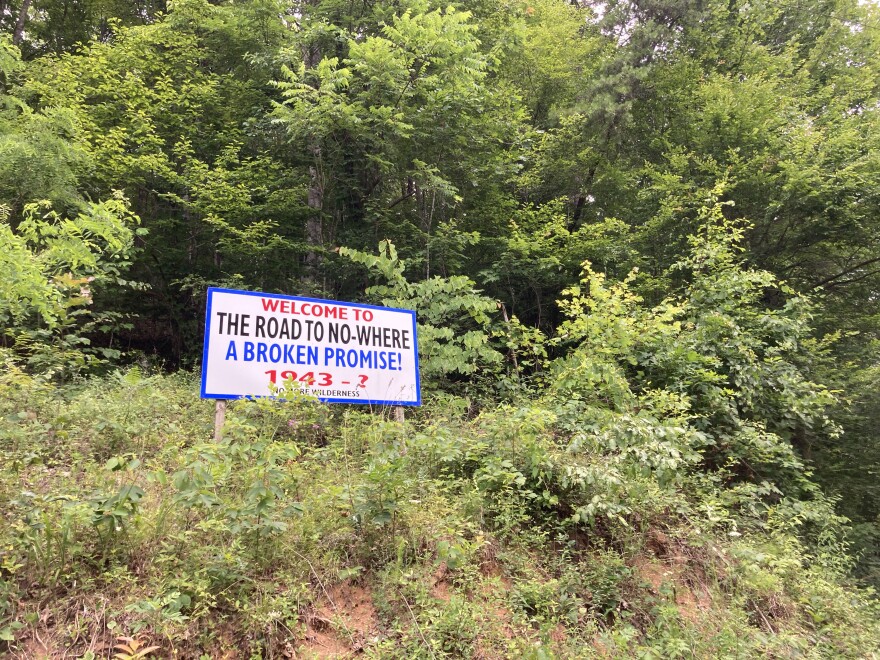
On the route to the tunnel from Bryson City, a roadside sign offers a clue.
Charlie Shelton-Ormond
/
WUNC News
A sign criticizing the unfinished road project that led to the Road to Nowhere at the Great Smoky Mountains National Park on June 28, 2026.
Located west of the Road to Nowhere is a massive concrete wall that holds the answer to the tunnel’s origin. Fontana Dam sits at 480 feet high, the tallest dam east of the Mississippi River. Unfurling out of the dam is Fontana Lake, a popular recreational site for the region. But a century ago, this human-made marvel was only an idea. Instead of a lake, you’d find a lush valley and dozens of small mountain communities.
"The saga of the Road to Nowhere just kept kind of snowballing," said Lance Holland, a local historian who’s lived in Bryson City for decades. Holland has written a small collection of books on the area around Fontana Lake, including his latest, "The Little Tennessee River: Following the Cherokee Path."
The Road to Nowhere saga started in the early 1900s, with the Aluminum Company of America (Alcoa). Back then, Holland says the company was on a hunt for cheap sources of electricity across the country.
"And eventually they found their great bonanza with the Little Tennessee River," he said, referring to the river that runs through the mountains of southwestern North Carolina. "So they made a plan of developing the entire river and started buying up all the bottom land they could get their hands on."
Alcoa started on plans to build a dam in the region, but in the 1930s, a new, government-owned behemoth entered the picture: The Tennessee Valley Authority. Tasked with generating inexpensive electricity, improving flood control, and upgrading river navigation, the TVA locked in on the Little Tennessee River as a site for its work, and wanted to take over Alcoa’s plans to build a large-scale dam.
"Alcoa said, 'Look, we're in the aluminum business. We'll give you all the land and stuff in exchange for cheap electricity,'" Holland said. "And then because of political infighting within the TVA, (the plan) all kinda fell apart."
But Fontana Dam’s dormant plans radically changed in December 1941 after the attack on Pearl Harbor. All of a sudden, the United States had entered World War II, and the TVA kicked into high gear to build a series of dams, including Fontana Dam, across Appalachia. Its mission was simple: supply as much power as possible for the war effort. With Fontana Dam, a main objective was to deliver power for airplane production to Alcoa’s nearby aluminum facility.

Charlie Shelton-Ormond
/
WUNC News
Inside the Road to Nowhere tunnel at the Great Smoky Mountains National Park on June 27, 2026.
However, there was one big problem with the TVA’s plan. The location for Fontana Lake was home to more than a thousand families — members of mountain communities who had ancestral roots going back generations. For Fontana Lake to be made, these families would need to leave the place they’d called home.
"Alcoa had for many, many years been buying land to build hydroelectric dams, so it wasn’t that a new concept dropped out of the sky," Holland said. "The big difference was that when TVA sent in their appraisers, there was no negotiation on the price. You either took what they appraised your land for or they condemned it and took it away from you."
Nevertheless, Holland said the vast majority of people who lived in the valley sold their land and relocated without much hesitation.
"People were patriotic back then. They were doing their patriotic duty," Holland said.

Charlie Shelton-Ormond
/
WUNC News
The Road to Nowhere tunnel at the Great Smoky Mountains National Park on June 27, 2026.
"We were told it was to help the war effort to build the dam," said Delia Woodard Watkins. She grew up in the area and was a teenager when the Fontana Dam project was proposed. She shared her experience in 2009 in an oral history interview for Western Carolina University.
"You had to take whatever money they offered you and move. But the thing that made us feel well at all was that it was going to help us win the war."
However, relocating hundreds of families with patriotic persuasion and a checkbook didn’t solve the TVA’s issue. As they moved, many families were leaving something important behind — a piece of them that was impossible to move. This valley was also home to dozens of ancestral cemeteries, and the TVA’s dam and lake project was set to cut off communities’ access to these sacred spaces.
"The big kicker was the cemeteries," Holland said.
So, to bring its dam project over the finish line, the TVA, along with the Department of Interior, formed an agreement in 1943 with Swain County and the state of North Carolina. The deal was that after the TVA completed the dam and lake, the National Parks Service would build a new roadway so people could retain access to their family cemeteries. However, mention of the cemeteries as a purpose for the new road was not specified in the agreement’s memorandum.
"Nobody objected because they were going to build the road, and then the people could go back, you know, to their cemeteries or all their old home places," Watkins said.
But the plan hit a road bump, literally, once construction on the new route began in the 1960s. Lakeview Drive was set to be 34 miles long and extend into the North Shore area bordering Fontana Lake, the home for a majority of the cemeteries. But the Parks Service got about seven miles into its construction when it started cutting through Anakeesta rock, a multi-colored, shimmering rock that produced an acidic runoff when it’s exposed to air and rainwater.
"It got all in the creek and killed some fish, and so the environmental movement pretty much got the road stopped," Holland said, referring to various environmental groups who pushed back against the project.
With this acidic Anakeesta igniting environmental concerns, construction on the new road came to a halt in the early 1970s. Pretty soon, sentiments about a "broken promise" rose amongst descendants of the North Shore.
"Nobody objected because they were going to build the road, and then the people could go back, you know, to their cemeteries or all their old home places." — Delia Woodard Watkins
What was intended to be a consolation for families who relocated was turning into a hollow gesture. But, despite frustrations with a stalled roadway, many descendants did not let a lack of pavement prevent them from maintaining a deep connection with their ancestral sanctuaries.
On a drizzly Sunday morning in late June, 70-year-old Henry Chambers patiently waited for a boat in a cove on the southern edge of Fontana Lake. His destination was across the lake and up a winding trail along Hazel Creek in the Great Smoky Mountains.
About six miles into the mountains sits Bone Valley cemetery, the site of the day’s special event. At around 9 a.m., Chambers sat by himself waiting for the last boat of the morning, but assured there was a crowd already gathering over at the cemetery.
"We’ve already got about 80 across. The rain scared some of them away, but most of them who are going to be here are already over there," he said.
Chambers is a co-organizer of the North Shore Cemetery Association. It’s a group of descendants with family connections to those displaced by the dam and lake in the 1940s. For 50 years, since the late 1970s, the group has journeyed into the Smokies every spring and summer to visit 28 of the 36 cemeteries that are still scattered across the North Shore region of Fontana Lake. Chambers said rain or shine, it's a priority to visit each cemetery they can safely access.
"We get one shot a year. One cemetery, one decoration a year," he said.
The group gathering at Bone Valley cemetery was there for a Decoration Day, an annual remembrance event with a deep history in Southern Appalachia. A Decoration Day is an opportunity for descendants to come together as a community and adorn ancestral headstones with plastic flowers.
Today, there are more than a thousand graves across the North Shore. The vast majority of them predate the construction of Fontana Lake. Descendants can still be buried in the region, but the difficulty of a full-casket burial in such a remote location has made it incredibly rare. However, Chambers said many descendants still want to be a part of the North Shore after they die.
"We don’t know how many have scattered ashes," he said.
Chambers’ boat ride across the water soon arrived and took him to the north side of Fontana Lake, where he met up with a group of park rangers who help escort Decoration Day attendees through the tough mountainous terrain. After winding across narrow, muddy trails on an UTV, Chambers eventually met up with his fellow descendants gathered at a campsite near Bone Valley cemetery.
At the campsite, a buzz of familial chatter mixed with the sizzle of frying pans as cooks prepped a lunchtime meal of fried fish, hush puppies, and other fixins brought by attendees. Meanwhile, a stream of people casually ventured a final quarter mile up a trail to enter the cemetery and enjoy a time of reflection with their ancestors’ headstones.
"'Decoration' was always special to me ever since I was a child,” said James Calhoun, a 91-year-old North Shore descendant who’s been coming to the area for these celebrations his whole life.
"My family would take us to the cemetery and we’d decorate the graves. It’s something you did every year and … old habits die hard, I guess," he said
In the absence of a road, the journey required to access the cemeteries in this remote slice of the Smokies has inevitably strengthened descendents’ communal bond. Traversing across a lake and through miles of rough, serpentine trails is no easy task. In turn, each person’s presence confirms their devotion to this ancestral space. Many people noted how much they’ve come to appreciate the somewhat arduous trek to reach the cemetery, emphasizing how it has strengthened their relationship with fellow descendants.
It’s a bond that has also helped many people put the Road to Nowhere in the rearview. In 2000, Congress allocated money to have Lakeview Drive finished, but construction never started up again. In 2010, the federal government agreed to pay Swain County $52 million for never completing the project, putting discussion on the Road to Nowhere’s possible completion to bed.
"I tell people, 'You can’t live in the past.' We have no control over what’s happened in the past," Henry Chambers said. "We do have control over the future. Now we might not be able to get everything we want. But it’s like climbing a set of stairs, you do it one step at a time."
To close out the day’s ceremony, a group of singers led the crowd in a few gospel songs, including "Shall We Gather at the River" and "Amazing Grace." A fiddle player followed with a contemplative rendition of "How Great Thou Art." Afterward, the community gathered their things and, thanks to the park rangers’ guidance, started their return journey back to a world of highways and cell phone reception.
In a week’s time, Henry Chambers would be back in the North Shore with another group, making an additional trip to visit a different cemetery. And in a year’s time, many of the same faces will likely return to Bone Valley for their annual expedition, people like Jessica Gunter, a North Shore descendant who was present with her daughter that day.
"It’s special, just the ability to be able to continue on with my daughter. She told me today, she said, 'This is something I want to remember in my memories,'" Gunter said. "So we want to continue that with our kids so that they’re able to come and bring their kids some day."