
(Credit: Photo by Yuriy Ivanovskiyo on Shutterstock)
In a Nutshell
- Coconut oil-derived biofuel blended with standard jet fuel achieved thermal efficiency comparable to pure jet fuel in engine testing.
- Higher biofuel blend ratios reduced unburned hydrocarbon emissions, which researchers linked partly to the biofuels containing none of the aromatic compounds found in conventional kerosene.
- Carbon dioxide concentrations in the exhaust stayed level with pure kerosene across all blends tested.
Coconut oil has long had a place in kitchens and beauty products, but researchers are now making a serious case for putting it in jet engines. New research found that aviation biofuel made from coconut oil can power a small jet engine about as efficiently as traditional jet fuel, with lower unburned hydrocarbon emissions, though the blends burn more fuel and emit slightly more carbon monoxide.
Aviation accounts for a meaningful share of global carbon dioxide emissions, and pressure on the industry to find cleaner fuel options has intensified in recent years. The International Civil Aviation Organization has identified sustainable aviation fuel, commonly called SAF, as the single most effective strategy available for cutting aviation’s carbon footprint. But many current methods for producing SAF are themselves energy-hungry and costly, which chips away at the environmental benefit. The new study, published in the journal Fuel, zeroes in on a production approach designed to sidestep that problem entirely, using a technique that requires far less energy to make the fuel in the first place.
Researchers at Osaka Metropolitan University tested biofuels made from coconut oil through what they call a “co-solvent method,” a process that mixes acetone with alcohol and coconut oil to produce high-purity biofuel without the intense heat and pressure required by conventional production methods. Rather than stopping at production, the team took the next step and burned the fuel in a small jet engine, measuring both engine performance and exhaust emissions.
A Greener Way to Make Coconut Oil Jet Fuel
Most SAF production routes involve intense industrial processes, including high-temperature refining steps that drain energy out of the fuel’s lifecycle before a single flight takes place. The co-solvent method works differently. By adding acetone to a mixture of alcohol and coconut oil, normally incompatible liquids blend uniformly and react completely at relatively low temperatures, producing biofuel with purity levels exceeding 97%.
Coconut itself offers a practical advantage as a raw material. Roughly 30% of the coconut is discarded after extracting its internal moisture during processing. This study used oil from material the researchers describe as discarded and non-edible, including the large seeds and leftover flesh, so the fuel draws on parts of the crop that would otherwise go to waste. The process also produces biodiesel suitable for vehicles and marine vessels, plus high-quality glycerin as a byproduct.
Two types of biofuel were produced and tested: one made using methanol and another made using ethanol. Both are plant-based fuels commonly studied for diesel engines, but this research examined their behavior in a jet engine, a question that has received comparatively little scientific attention.
Inside the Engine: How Coconut Oil Jet Fuel Actually Performs
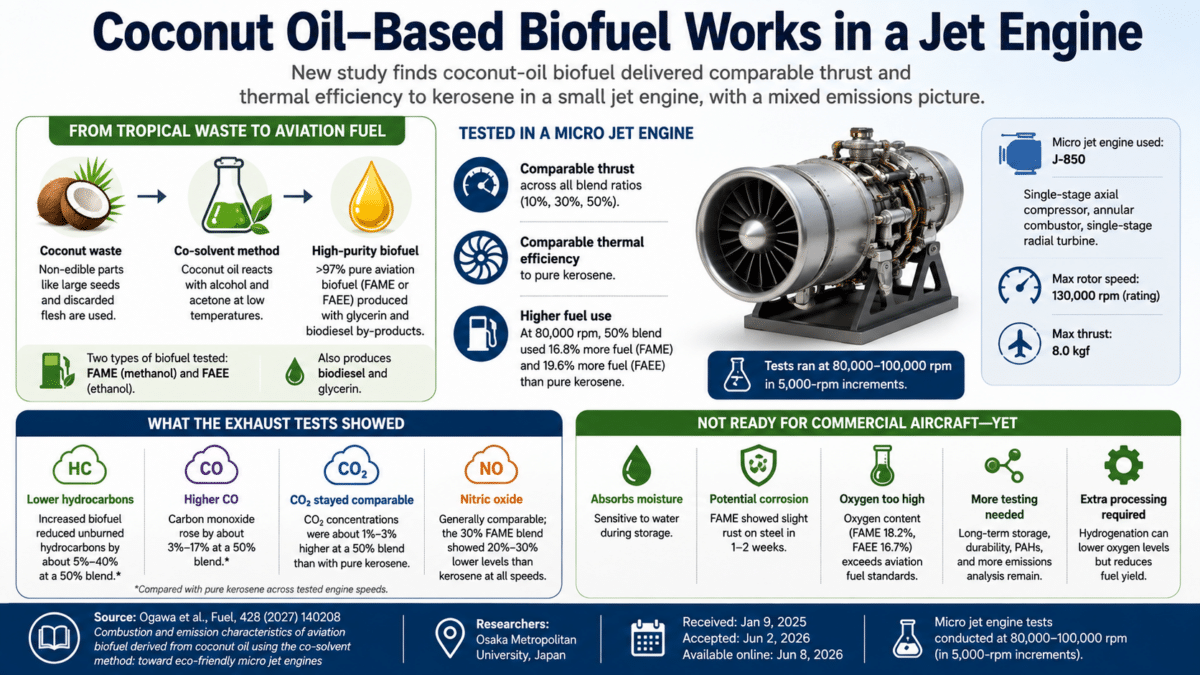
Researchers tested the fuel in a small commercial jet engine capable of reaching speeds up to 130,000 rotations per minute. Researchers blended the biofuels with conventional kerosene at ratios of 10%, 30%, and 50% biofuel by volume, then ran the engine across a range of speeds. Measurements included fuel consumption, engine efficiency, and exhaust concentrations of four pollutants: unburned hydrocarbons, carbon monoxide, carbon dioxide, and nitric oxide.
In terms of fuel efficiency, the biofuel blends required more fuel to produce the same amount of thrust. At 80,000 rotations per minute, a 50% methanol-based blend consumed about 16.8% more fuel than pure kerosene, while the ethanol-based version consumed about 19.6% more. This is largely because the biofuels carry less energy per kilogram than kerosene, so more must be burned to maintain the same output level.
Despite burning more fuel by weight, the blends converted heat into usable work at rates comparable to pure kerosene. At 100,000 rotations per minute, the thermal efficiency of the highest biofuel blend differed from pure kerosene by a small margin, and thrust output remained consistent across all blend ratios tested.

Infographic by StudyFinds
What Comes Out of the Exhaust
Emissions are where coconut oil-based jet fuel shows some of its most encouraging results. Increasing the proportion of biofuel in the blend consistently reduced unburned hydrocarbon emissions. At a 50% blend ratio, hydrocarbon concentrations in the exhaust dropped by roughly 5% to 40% compared to pure kerosene, depending on engine speed. Researchers said the drop was likely tied in part to fuel composition, since the coconut-derived biofuels contain none of the ring-shaped, aromatic hydrocarbon molecules present in conventional jet fuel.
Carbon dioxide emissions remained at levels consistent with pure kerosene across all blending ratios tested. While higher biofuel content increased total fuel consumption, the CO2 in the exhaust did not rise proportionally. Researchers say that pattern may point to some unburned biofuel leaving the engine, a question they flagged for future investigation.
Carbon monoxide emissions, a product of incomplete combustion, did increase modestly at higher blend ratios. A 50% blend produced roughly 3% to 17% more carbon monoxide than pure kerosene depending on engine speed. Researchers linked this to the biofuels being harder to ignite than kerosene and carrying less energy, both of which can create fuel-rich zones inside the combustion chamber where oxygen runs short.
Nitric oxide emissions, which can contribute to ozone depletion at high altitudes, were broadly comparable between the biofuel blends and pure kerosene. A 30% methanol-based blend showed nitric oxide concentrations 20% to 30% lower than pure kerosene across all operating conditions tested, a result the authors say requires further study to fully explain.
Challenges Still Ahead for Coconut Oil Jet Fuel
Several practical hurdles stand between this biofuel and routine use in aircraft. Coconut-derived biofuels absorb atmospheric moisture during storage, are susceptible to gradual oxidation over time, and can cause slight corrosion of metal components. Stainless steel exposed to the methanol-based version showed signs of rust after one to two weeks. The authors note that extended testing over months to years is needed, and that antioxidant additives and better-sealed storage containers are worth investigating.
Oxygen content in the biofuels also falls outside current international certification standards for aviation fuel, meaning additional chemical processing would be required before these fuels could fly in commercial aircraft. A hydrogenation treatment could bring oxygen levels into compliance, though the researchers acknowledge that process would reduce fuel yield.
Coconut oil-derived biofuel is not a ready swap for conventional jet fuel yet, but the performance data from this study makes a real argument that the concept is worth pursuing. If the production advantages hold up and the remaining fuel-quality problems can be solved, coconut oil could become one more candidate in aviation’s search for lower-impact fuel, one rooted in a tropical nut.
Paper Notes
Limitations
This study used a small-scale micro jet engine rather than a full-size commercial aircraft engine, so results may not directly translate to larger propulsion systems. Exhaust gas measurements were taken 30 millimeters downstream from the engine nozzle exit, and the researchers acknowledge that ambient air may have diluted the sampled gases, potentially affecting measurement accuracy. The study also did not measure certain toxic compounds, specifically polycyclic aromatic hydrocarbons, which the authors identify as a priority for future research. The study did not complete long-term testing of fuel storage stability and material corrosion, which would require months to years of observation. Oxygen content in both biofuels falls outside current international aviation fuel standards. Additionally, the turbine inlet temperature measurements carried uncertainty due to steep temperature gradients inside the engine, and the relatively low nitric oxide concentrations measured may benefit from validation using higher-precision analytical methods in future work.
Funding and Disclosures
This work was supported by an Osaka City Innovation Support Grant. The corresponding author, Shinichiro Ogawa, disclosed an employment relationship with Osaka Metropolitan University. All other authors declared no known competing financial interests or personal relationships that could have influenced the work.
Publication Details
Authors: Shinichiro Ogawa, Takuto Hongo, Yasuaki Maeda, Huynh Phuong Uyen Nguyen, and Koichi Mori, all affiliated with Osaka Metropolitan University, Sakai, Osaka, Japan.
Journal: Fuel, Volume 428 (2027), Article 140208, published by Elsevier.
Paper Title: “Combustion and emission characteristics of aviation biofuel derived from coconut oil using the co-solvent method: toward eco-friendly micro jet engines”
DOI: 10.1016/j.fuel.2026.140208
Received: January 9, 2025. Accepted: June 2, 2026. Available online: June 8, 2026.
About StudyFinds Analysis
Called "brilliant," "fantastic," and "spot on" by scientists and researchers, our acclaimed StudyFinds Analysis articles are created using an exclusive AI-based model with complete human oversight by the StudyFinds Editorial Team. For these articles, we use an unparalleled LLM process across multiple systems to analyze entire journal papers, extract data, and create accurate, accessible content. Our writing and editing team proofreads and polishes each and every article before publishing. With recent studies showing that artificial intelligence can interpret scientific research as well as (or even better) than field experts and specialists, StudyFinds was among the earliest to adopt and test this technology before approving its widespread use on our site. We stand by our practice and continuously update our processes to ensure the very highest level of accuracy. Read our AI Policy (link below) for more information.
Our Editorial Team
Steve Fink
Editor-in-Chief
John Anderer
Associate Editor