DW also, similar stuff, but the guest is quite good: https://www.youtube.com/watch?v=Dcl5Mn373Oc
Anton Petrov covered it from a much more science lens a couple months back: https://www.youtube.com/watch?v=eRoU3whzX_Q
I am glad that I live far away from the effects but it is sad to think of people losing all kinds of things for the lack of respect of Mother Earth!
There are still ~4 months till peak El Niño, and then some months to spread effects.
Example: https://x.com/EliotJacobson/status/2091911667903041543
Like, it truly takes a level of willful ignorance to have something so dire happening, and just choosing to either ignore it, or ignore the evidence for it.
Like, even if you think the science isn't that accurate, the impacts, the massive potential harms, should outweigh the choice to just ignore it. Then again, there are people buying wooden homes in wildfire, hurricane, and flood zones, so who knows; maybe doing risk management as a job has just inured me to head-in-the-sand reactions, since I've seen what happens when you don't beat the odds.
This isn't a personal risk, either, like riding a motorcycle where you're the only one who's going to get hurt when your number comes up. This is literally going to kill millions.
You cannot outrun agriculture and crop failures, infrastructure failures, insurance costs accelerating to properly price the risk, wild fires, etc. US cattle herds are at record lows from climate related input costs. Romanian, Hungarian, and Bulgarian nuclear reactors no longer have enough water to operate. The Colorado River Basin will only continue to dry out. And so on.
Some will be impacted more than others, but everyone will feel some impact, and it potentially will only worsen over time. If you believe in climate change, do your best to mitigate the impact for the remainder of your lifetime. If you don't believe, oh well, good luck.
https://x.com/ZackBornstein/status/1877055187241594986
Londoners Find ‘Horrendous’ Cracks in Their Homes After Successive Heat Waves - https://www.bloomberg.com/news/articles/2026-08-23/londoners... | https://archive.today/koMaT - August 23rd, 2026
> “The impact that climate change is having is undeniable.” -- Laura Hughes, Head of general insurance at the Association of British Insurers.
> 20%-25%: The average property devaluation as a result of subsidence, according to the Federation of Master Builders
The Age of Unstoppable Wildfires Has Reached Europe - https://www.bloomberg.com/graphics/2026-europe-summer-wildfi... | https://archive.today/OjDZH - July 30th, 2026
Climate Change Is Already Showing Up in the Cost of Living - https://www.bloomberg.com/news/articles/2026-04-24/climate-c... | https://archive.today/EYTqo - April 24th, 2026
Heat Strains US Power Grids That Need Off-Season Repairs - https://www.bloomberg.com/news/articles/2026-05-19/rising-he... | https://archive.today/K9VF0 - May 19th, 2026
US Spending on Climate Damage Nears $1 Trillion Per Year - https://www.bloomberg.com/news/articles/2025-06-17/us-spendi... | https://archive.today/9IJWo - June 17th, 2025
(Texas night time temps are staying high enough [~78F] that the utility equipment does not get time to cool off and cycle, leading to more faults, for example, and the manufacturing supply chain for transformers has a backlog measured in years)
Are you not on planet earth? Unless you're on Mars, you're not far away from any effects.
https://abcnews.com/US/solar-generates-energy-coal-us-1st-ti...
"Solar and storage provided 90% of all new power added in the U.S." is mind blowing. How about we give the US credit for this?
Fossil fuel extraction is not the problem. The problem is fossil fuel usage. Given the world consumes fossil fuel I prefer they use American fossil fuel vs. Russian or Saudi fossil fuels. I don't understand why we are dwelling on the wrong metric here. Also consider the US has just removed a sh~tload of fossil fuels from the world economy. How about some extra credits there?
Similarly data centers are going to get built somewhere. If they're already built I'd rather they are built in places like the US.
Instead of politics and blame we need to focus on markets and let them take care of the problem. This is already happening with solar. Where I would be critical about US policy is that I think they are introducing more tariffs on imported solar panels. This might fit into governments make things worse and hopefully everyone regardless of their political affiliation can push back on this specific item.
The world all going to act together stronger than the markets is not going to happen. You can argue that is unfortunate but it's also where we are.
The bad news is that if it's hot again next year, La Nina will actually help hurricanes form.
P.S. for pedantic folk: yeah, it's far from the actual boiling threshold of ~100°C, but to boil the humanity, you don't even have to go 80-90% of the way there
Pros: my next iPhone will travel faster from China to Europe.
#alwaysLookAtTheBrightSideOfLife
There was too few “there are green technologies superior to the carbon based ones” (heat pumps got really good).
Well, there are two problem spaces - innovating ways to reduce emissions AND inventing new ways to help people cope with rising temperatures - and I hear very little about the second one despite the immediate humanitarian need for it
> Behind this climate hysteria is an even deeper delusion, though: that degrowth will deliver us all from the sins of modernity. That energy use in and of itself is suspect. That salvation will be delivered through abstinence. It's all nonsense.
Maybe slightly off-topic, but here a prominent figure in SV who now also got into Linux is mocking those concerned about climate change.
it was a nice run while it lasted, but seems humanity is nearing its end as the world/nature is trying to purge humanity to save itself.
> Ocean acidification has been called the "evil twin of global warming" and "the other CO2 problem". Increased ocean temperatures and oxygen loss act concurrently with ocean acidification and constitute the "deadly trio" of climate change pressures on the marine environment. The impacts of this will be most severe for coral reefs and other shelled marine organisms,as well as those populations that depend on the ecosystem services they provide.
Also kinda depressing to realize that no matter how much one person does, it won't make a dent globally. And what really stings is that even when decisions get made they're either too late or half-assed. Guess all we can do is hope we don't live to see things get really bad...
The weather this year up in Canada here has been extremely odd. Constantly. You can tell something is off.
As we are at or nearing +1.5C now, with global emissions at an all time high [ perhaps peaking soon ] theres a good chance we are headed toward +2.6C by ~2060.
Keep in mind the CO2 stays up there for a long time, centuries, so when we get to net-zero its max-CO2 and therefore max-heat.
It's going to get ugly when large swaths of the human population struggles to get food & clean water.
If we truly cared about climate change we would stop buying from China. But we all know this won't ever happen because we don't really care enough. It's just virtue signaling.
Buy an AC you're not saving the planet by sweating your ass off.
It's everywhere else that'll be getting record breaking heat/drought and snow, which have been far more damaging. The disaster radius of hurricanes reaches far more inland than just the coast.
One can observe a problem while not advocating support for it.
It is quite true that energy decision making has been tremendously politicized, and I don't think that's good for anyone.
And FWIW, I don't buy the "but the countries that bred like rabbits for the past few decades are owed their due reserved quota". Having a massive population isn't something you need to be rewarded for, not to mention that the math doesn't even make sense. For China and India to get their "per quota" backlog, we're basically so firmly in self destruction territory that it makes no sense for anyone else to even bother.
https://youtu.be/_xZCh8eDZFc?si=AHyDPgoDucsCRllS&t=402
They claim the panama canal is continuously fed by freshwater for the canal locks (which segment the canal into sections with different water levels, and which enable ships to be raised or lowered to the next water level during travel along the canal).
It's 2026, why are humans dumping freshwater into the oceans? This can perfectly be done without wasting freshwater.
Archimedes screws can essentially be operated quasistatically at extremely high efficiencies. The energy released when lowering can be stored either in gravitational energy of a mass, or be used to power a second parallel lock operated in counter phase (so while one lock is lowering ships say eastwards, the energy is used to raise ships traveling westwards, and afterwards their roles reverse). To speed up a second gravitational potential energy store (and optional flywheel) can be used to accelerate and decelerate the pumping. Apart from some frictional losses (minimal compared to the potential energies involved) this doesn't cost energy, and is easily covered by a small number of solar panels.
Is this misreporting by the BBC, or is it mismanagement by the Panama Canal operators?
Keep the freshwater, use it for irrigation etc, make Central America more attractive to South American refugees and the migration burden on Mexico and US lowers.
The operation as currently described is so inefficient, even for the 1960's!
All the downvotes are just showing why no action is being taken even though right now we are literally terraforming the planet with no plan, and it is going to stop the transatlantic currents that keep Europe from becoming arctic.
But sure, just do nothing until Europe becomes an uninhabitable tundra and it is too late to take action. Great plan.
June 2026: New coal-fired plants in Anchorage, Alaska, and Mt. Storm, West Virginia, would total 2.85 GW. They would be the first new U.S. coal plants to come online since 2013.
https://www.utilitydive.com/news/doe-announces-850m-moderniz...
Meanwhile in China (from 2023):
China permitted more coal power plants last year than any time in the last seven years, according to a new report released this week. It's the equivalent of about two new coal power plants per week. The report by energy data organizations Global Energy Monitor and the Centre for Research on Energy and Clean Air finds the country quadrupled the amount of new coal power approvals in 2022 compared to 2021.
"Everybody else is moving away from coal and China seems to be stepping on the gas," she says. "We saw that China has six times as much plants starting construction as the rest of the world combined."
https://www.npr.org/2023/03/02/1160441919/china-is-building-...
Meanwhile in India (2026):
India plans to increase its coal production by nearly 100m tonnes to 1.15bn tonnes in the 2025-26 fiscal year to help meet the country’s rising demand for electricity to support economic growth and contend with heatwaves, which have become more severe and more frequent because of the climate crisis.
The planned increases come despite signs that the world is beginning to turn its back on coal in favour of renewable electricity, Global Energy Monitor said.
The US could switch every ICE vehicle to EV's and install solar and wind turbines in every inch of the country and it won't combat what's going on in China, India and other developing countries that rely on coal for cheap energy.
[1] https://ourworldindata.org/how-much-energy-do-data-centers-a...
What do you mean we are doing nothing?
Unfortunately, given current trajectory that's how the mother nature is going to bring back balance. I wouldn't be surprised even billions die.
- The problem dimension is hard to visualize for most people. Similar to space distances are hard to understand.
- There's nothing an individual can do about it other than trusting their local institutions and voting. Recycling, being a rational consumer, choosing greener options have negligible impact and it's main benefit is making people feel good.
- The consequences are slow to materialize. Sure, it's a bit hotter or more rainy in some places. It'll take a few more of these for population as a whole to feel inclined to become more involved in the matter. Which might be too late.
Either way, not much to do about it.
You could be right, but I think the more likely outcome is a 'Ministry for the Future' scenario where India or China just decide to unilaterally implement geoengineering and dare the rest of the world to stop them.
Somebody (maybe Stalin) once said something like one death is a tragedy, a million is a statistic. A disaster on the scale of millions of deaths doesn't register in a lot of people's brains. It has to be made smaller, more personal.
Do you mean the war with Iran that released in the initial weeks over 5 million metric tons of CO₂?
For example, a science model might predict only a 5% drop in global food production. That is easy to ignore because we waste so much food. But that 5% might be enough to trigger countries to impose food export bans, and some dominoes falling later, there are localized famines in particular places with 50% loss of food supply. That then triggers wars. It's impossible to predict if and when such types of event chains will happen. The only way out is to be very conservative, and aggressively defend against failure.
Unless there's something lacking in the brain of climate change deniers (which as nice as it might be to believe that, there's no evidence to back up), they should be able to match the many people who are reacting in horror and fear to it.
If it weren't for the huge efforts put into it by china to make solar and batteries so cheap and capable we wouldn't be nearly as far along in the solar transition as we are. Solar is growing in spite of US policy, not because of it.
Turns out humans will always choose status symbols and vanity over facts. Oh well
We’re not letting the market handle it and we’re going in a backwards direction. Can’t really crow about our accomplishments given that.
[1] https://www.theguardian.com/us-news/2026/aug/06/rwe-deal-win...
What other endorsement could one possibly need?
Your sacred market has been killing us all and will continue to keep killing us all if it makes a few pennies.
> Instead of politics and blame we need to focus on markets and let them take care of the problem.
Blind faith in the markets is what got us in this mess.
> Fossil fuel extraction is not the problem. The problem is fossil fuel usage.
Yes, and usage is not decreasing. As solar is growing, it's only adding capacity, not replacing fossil fuels. 2025 was the record year for global emissions and fossil fuel consumption.
But sure, let's let "the markets" dictate our ecological policy. Maybe they'll mercifully let us stop burning oil sometimes in the 2150s.
> Also consider the US has just removed a sh~tload of fossil fuels from the world economy. How about some extra credits there?
Huh? Americans very consistently rank among the biggest emitters, basically only surpassed by citizens of petrostates.
I'll just put this here: as long as burning fossil fuel is profitable, "the markets" won't help at all, quite the contrary. And oil being unprofitable isn't happening anytime soon. Our societies are already suffering from Climate Change immensely, and it will only get worse as the years go by. We should have stopped emissions yesterday, we can't let "the markets" take away our agency on the matter and decide our fate.
Beef production in the US is already down from 30 years ago. At some point you won't be able to raise cows anywhere, less alone feed them. Corn and wheat have seen tremendous fluctuations in the past and will likely continue to fall. Imagine corn yields dropping by more than 80% in the US [1]. Of course MAGA people will probably only notice once the shelves aren't being restocked.
The problem is politics and banana republic levels of corruption (aka lobbying) preventing chinese evs to enter the market. If you opened the automotive market to competition ie:
> focus on markets and let them take care of the problem.
then the need for fossil fuels would decline.
If I tell you the Earth is going to get 2 degrees C warmer, Americans are going to think, "2 degrees, not that much, barely noticeable." If you tell them it's 4 degrees F, they'll think, that's not a ton, but it's definitely noticeable.
Climate change is Schroedingers extinction event. It's only bad when you can solve it with solar panels and wind. It's nothing to worry about when you can solve it with fission and eventually fusion.
I thought this too, feeling a bit more smug living in southern Ontario, safer than my family in BC and Alberta next to raging forest fires and potential drought.
But seems we now get a few weeks of forest fire smoke every year even down here in lush green great lakes land.
And the number of tornadoes and ice storms seem to increase every year.
Plus watching the Children of Men style xenophobia and callous disregard for climate refugees set in all over the world.
Blech. I love my kids but I think my perspective would be much different and positive if I'd just remained childless.
Ice age was only 6 degrees less than now, half of Europe was under ice
Maybe this helps: Think about when we have a fever of "a few degrees", say, instead of 37 degree Celsius, we have 40. It shows that also a few degrees can make a huge difference.
It also explains why boiling water doesn't spontaneously just explode into vapor once it hits that temperature
Too often the words are whatever they have to say in order to secure continued membership in the group: The Emperor's New Clothes are a glorious blue today.
P.S: Also, we have always been [about to start|recently victorious] in the [illegal war|undeclared "excursion"] against Irania, and the tariff-free chocolate ration has been raised to twenty grammes per week.
But this did lead to one of the more ridiculous head line from a few years back.
Thawing Permafrost Is Artificially Chilled to Stabilize Alaska Oil Pipeline
https://www.scientificamerican.com/article/thawing-permafros...
However, there are regions of the oceans which currently absorb lots of CO2 which will absorb much less as time goes on. One important example is the AMOC, which, by turning over lots of water, helps sink surface dissolved CO2 into the deeper ocean. In recent years, oceanographers have observed a weakening of the AMOC, which was predicted but is happening much earlier than expected. This is one of the important planetary tipping points, which could cause a dramatic shift in the planet's climate.
But don't worry -- the Trump administration is defunding programs like the Office of Oceanic and Atmospheric Research, decommissioning the Ocean Observatories Initiative, and is planning to shutter NOAA's research arm altogether -- thus solving the problem once and for all.
Go home, look at all the objects in your house, do the same thing. Then tell you that this has nothing to do with you.
It might just be a context thing and people are on average smarter than what the comment section makes out but yeah, wasn't filling me with confidence what I saw.
https://en.wikipedia.org/wiki/Polycrisis
edit: To be clear, I still think there is time to react, and stop the worst impacts. We just need to get way off the rails of the route that we are currently on. If we put half of the heroic engineering + global capital that we put into fossil fuel extraction into better things, we could get most of the way to the goal. Fossil fuel extraction is like many simultaneous Manhattan Projects. It's nuts what we put into that.
Would be super cool if some of the breakout sessions titled "surviving WW III," were replaced by "avoiding WW III."
Those aren't small things to ask and I understand why people and governments pretend to gaslight with just energy, as it asks for no impact on daily life.
One thing I will definitely not be doing is staying around the Palm Springs area, which I usually do because of the risk for earthquakes if the heavy rain flow into the Salton sea.
If you look at total historic emissions to date, the US is responsible for 25% of all of them, and the EU is close behind at 22%. China is at 13%. And if you look at historic emissions per person, then each American has produced ~8x as much as the average Chinese person.
https://ourworldindata.org/contributed-most-global-co2
Yes, the west has played the dominant role in GHG emissions. I don't blame China for now, quite recently, increasing their GHG emissions as they try to get to standards of living we've had for many decades. As we led the way into the industrial revolution and high GHG emissions, we should also lead the way back out. And yet US emissions per capita are still about 50% higher than Chinese!
Personally, I don't put much faith in weather predictions that are more than a week away.
13 hours ago
Mark PoyntingClimate reporter

Getty Images
The world's oceans are hotter than ever recorded, new data suggests, as they suffer from human-caused climate change and the growing El Niño weather phenomenon.
The average surface temperature of the planet's seas outside the polar regions hit 21.1C (70F) on Saturday, according to figures from the European Copernicus climate change service.
That edges past the 21.09C recorded on three separate days in March 2024, and is far above average for the time of year.
Warmer oceans can have wide-reaching consequences, including supercharging extreme weather, raising sea levels and harming marine life.
"This record is another clear signal of an ocean under growing stress," said Dr Samantha Burgess, deputy director of Copernicus.
"El Niño is adding heat to the system, but it is doing so on top of decades of human-driven warming," she added.


The data is based on sea temperatures 10m (32ft 10in) below the surface, using measurements from buoys, ships and satellites, which are combined to produce a global estimate.
While the margin of record is currently very small and any global estimate comes with uncertainties, scientists say its timing is particularly notable.
Average worldwide sea temperatures tend to reach their yearly peak in March or April, which corresponds to the end of summer in the southern hemisphere - and not in August.
The southern hemisphere contains more of the planet's ocean surface than the northern hemisphere and so exerts a bigger influence on average sea temperatures.
What is especially concerning to scientists is that the oceans are already so hot when the natural El Niño weather phenomenon is still some way off its expected peak.
This could see ocean temperatures climb yet further.
"The fact that we are already breaking records is an early indicator of how strong the El Niño is becoming," said Dr Jeremy Grist, senior research fellow at the National Oceanography Centre in Southampton.
"All things being equal we might expect the ocean temperature record to be broken again in March [or] April 2027," he added.


The waters far away from El Niño's Pacific hunting ground are also extremely warm, including around the UK and Europe.
The western English Channel has seen almost continuous marine heatwave conditions for more than three years, peaking at 7C above normal in July, according to Prof Tim Smyth, director of science at Plymouth Marine Laboratory.
“This is unprecedented,” he added.
Scientists say such widespread warmth around the planet is a clear sign of the growing effect that human-caused climate change is having on the world's seas.
"The latest Copernicus data reinforce the troubling upward trend in ocean temperatures,” said Smyth.
Warmer seas help to fuel more extreme weather. They can provide storms with extra moisture and energy, and can intensify heatwaves on land in some coastal regions by reducing the cooling effect of sea breezes.
Warmer water also takes up more space, raising sea levels and bringing a greater risk of coastal flooding - while intense ocean heat can be devastating for sea habitats, such as coral reefs.
The increasing frequency of marine heatwaves is already "putting increasing pressure on marine ecosystems and the communities that depend on them", Burgess said.



Not according to the federal government's data. BTUs from fossil fuel production set a record last year and is on a faster pace this year. Your bringing up a few coal plants is only tangentially relevant.
https://www.eia.gov/totalenergy/data/monthly/pdf/sec1_3.pdf
> The US could switch every ICE vehicle to EV's and install solar and wind turbines in every inch of the country and it won't combat what's going on in China, India and other developing countries that rely on coal for cheap energy.
Are you familiar with the concept of necessary but not sufficient?
In any event the war with Iran is speeding up the future that was coming anyway. China's EV and solar exports are surging throughout the world. Both China and India have said for many years that their emissions would rise and then fall.
I suspect we are going to be like the aphids on a rosebush that will suck it dry just trying to live and most of us go with it.
If we were to live closer to what many philosophers and religions of modesty, we probably would have never gone down this path. Yes, we wouldn't have most of the great stuff we have today but we also wouldn't be looking at a system that can lurch over and crash. There is no winning move in the universe just dances and responses.
1.5% of global energy use would be a shocking amount. Aviation is at about 3%. 1.5% of global electricity is about 0.2% of global energy use, a much more manageable figure
Instead much of it is being handled by bringing new fossil power plants on line that would not have been built if not for all the new data centers.
The other things that are causing significant increases in electricity use, like more people getting heat pumps and EVs, are all very spread out and so are much less likely to force new fossil fuel power plants.
That we are still adding any fossil fuel based system today is something I would have figured would have stopped by now. I figured we would still have some legacy stuff, but overall would be decommissioning more than we would add. Instead, we just add to everything.
First, you are ignoring gas. The US stopped building coal plants because of the fracking boom. That gave the US huge sources of natural gas which was cheaper than coal.
China has little natural gas but abundant coal, so when they need fossil fuel for something they cannot yet do with renewables they use coal whereas the US uses gas.
Second, you are looking at number of plants, but not looking at capacity factor (which is a measure of how much they are actually used). The new Chinese coal plants have lower capacity factors. They are being built as backups and peakers rather than baseload, designed (or retrofitted in the case of existing plants being upgraded) to be able to cycle up and down to balance wind and solar.
Many are idle so much that their owners have financial difficulty keeping them open, and the government has had to start paying them for their idle time so they won't go under.
Many are also built to replace existing plants that cannot not yet be replaced with renewables, so are at worst neutral on coal usage and are usually actually more efficient than the old plants so there is a reduction.
Their use will continue to decline because China is massively deploying renewables. They also are adding massive amounts of grid battery storage and UHV transmission lines (60000 km so far spanning the country with another 12000 km under construction or permitted--the US is a bit behind that at 0 km), which means the can move electricity from where renewables are strongest to places with high needs but fewer renewables much easier that most other countries can which is further going to reduce the amount of time those new coal plants run.
Third, for India, even if we compare by country rather than by the correct per capita measure (see other comments below for explanation of why per capita is the correct measure when comparing energy policies of different countries), India's current emissions are only 68% of US emissions even though the have 4.3x as many people. That 10% increase you cite that they plan for coal in 2025-2026 still leaves them doing WAY better than the US.
India is also expanding renewables rapidly. They have around 10 nuclear reactors under construction, and are adding lots of solar and wind. They are currently up to 136 GW of solar capacity (64% of US and 11% of China), and last year added around 38 GW (the US added 34 GW). They added 6.3 GW of wind compared to 6.2 GW in the US.
They are almost certainly not going to get anywhere close to the US total emissions. (And per capita where they emit 1/6th what the US does they are definitely not going to even remotely near the US).
https://www.carbonbrief.org/analysis-chinas-co2-emissions-ha...
China's 2025 five year plan targets peak coal before 2030 and might have already reached it in 2026. https://energyandcleanair.org/china-energy-and-emissions-tre...
These charts address your points:
https://ourworldindata.org/profile/energy/china https://ourworldindata.org/profile/energy/united-states https://ourworldindata.org/profile/energy/india
India is a bit more concerning for a number of reasons (lower per capita income means they are lower on per-capita emissions currently and hence have more room to grow, and they don't have the resources that China does to build out renewables) but criticizing China from a renewables perspective (there are a whole lot of other valid reasons to criticize them) is insane.
that would be 0.3% of global energy use
In this scenario, haven't you poured a bunch of ocean water into the lake? I don't see how to can fill the locks with ocean water and not have it pour into the lake.
Lets say the EU does geoengineering and then there are crop failures in India the next year. Their fault or not, they are going to get blamed for it and actions taken. The EU would become the scapegoat for any kind of weather/climate issues in future.
This is the trolley problem done at a global scale.
https://en.wikipedia.org/wiki/Panama_Canal
Construction began: 1 January 1881
Date completed: 15 August 1914
> The energy released when lowering can be stored either in gravitational energy of a mass, or be used to power a second parallel lock operated in counter phase (so while one lock is lowering ships say eastwards, the energy is used to raise ships traveling westwards, and afterwards their roles reverse). To speed up a second gravitational potential energy store (and optional flywheel) can be used to accelerate and decelerate the pumping.
if the canal didn't exist, and we were designing it as a greenfield project in 2026, that would definitely be a design worth considering.
could it be retrofitted onto the existing canal? sure, in theory.
in practice, they currently handle 36 ships per day, and lowering that limit by just 2-4 per day is significant enough that it makes international news [0]
so whatever retrofitting you have in mind, the construction would need to be done completely non-invasively, without disrupting the daily operation of the locks. it's nowhere near as simple as you're making it out to be.
0: https://www.lemonde.fr/en/economy/article/2026/08/21/panama-...
However, we need a global consensus for geoengineering. That's just how that works... the Jet Stream. Meanwhile one country believes that global warming is a benefit, aka Russia. They currently appear to have control of the West.. so what in the actual f?
For a far more dire diatribe:
"Today the US government announced CO2 tariffs against polluting nations - products sold in the USA need to be produced in carbon-neutral manner or face punishing taxes.".
Pipe dream, of course, because the populace will vote for the guy offering cheap instead of sustainable...
They also represent investment in economic growth that doesn't come from resource extraction or travel or manufacturing.
And we keep coming up with ideas to make it worse: blockchain and now AI.
1.5% is a //huge// amount. If it was a “drop” in your bucket, it would only hold 67 more of those drops.
https://www.bbc.com/news/articles/c1e1vg0gjl5o
Yes we're still building renewable energy, but goddamn is our government making it hard.
Why would this not be the energy of running an LED light for 15 minutes?
A more fair metric would be Co2 emissions/person and I’m getting
USA 14.3 t, China 8.8 t, EU 5.5 t, India 2.2 t
Although things like adoption of EVs does probably have a great positive impact on the local pollution levels.
The markets have failed everybody, and politicians who believed in the markets were wrong, and should be in jail now for criminal negligence.
Someone pointing out that the US is adding large amounts of solar with minimal government effort isn't "rose-tinted", it's just factual.
> absolutely braindead political opposition to energy modernization
The good thing is that in the US some people having strong political feelings about something doesn't really stop us from doing things. So not only have we added lots of new solar, we did so with a "braindead" government. That means there's a lot of people in the US who understand the changing needs we face and that having a moron in the White House doesn't really affect that.
That is such an understatement
This is the key point. While yes, it is brilliant that we are adding loads of solar, wind and whatever - it is the final emissions that really matter. Regardless of how well meaning we are intended with our build outs, the emissions is really the only metric that counts when we are focusing on climate blow back.
And then they'll blame Obama.
Its reasonable to question whether our agriculture at scale is adaptable to such sudden climate change.
But...
The political criticism in the US (and in Canada where I'm from) against fossil fuel extraction makes no sense. We should want that fossil fuels are extracted here. Not overseas. It's true some element of the "right" are ideologically driven here in the wrong direction but many in the "right" are also pragmatic. Instead of fighting we need to get to common ground and the way to get there is by market forces. Most would prefer the get solar energy if it's cheaper vs. more expensive fossil fuels. And certainly if all else was equal (panels made in the US, American jobs, whatnot). So you can take the adversarial route or you can take the pragmatic route and make real progress.
The other stupid political battle here is boycotting Tesla. How does that make sense? We "punish" Elon by using more fossil fuels.
Scratching my head on that one.
I mean... is something not better than nothing? Or do you only get rewarded if it's 100% perfect? If so then by that metric nobody should be rewarded here. There's nobody in the world who has done enough, certainly none of the major economic powers.
Nuclear, batteries, solar, wind, hydro.
You know people can just look this stuff up right?
The RWE paid 1.26 billion to acquire the lease on offshore wind. Payment is a refund.
Further, offshore wind is expensive in terms of maintenance. Stopping the project now is protecting billions in expenses in the future.
Still a ways to go but trending down for some time now. India and China are trending up and might cross us by 2030-2035 unless they reverse direction.
But really, there is growth under the policies, so saying "despite" doesn't work. You could try to argue that the policy makers tried to kill solar but achieved the opposite result. But at the end of the day the current policy environment led to a positive result. Correlation isn't causation but if I was writing a policy and I wanted to guarantee the opposite outcome I'll bet ya I could.
I happen to know some Americans who have worked really hard to advance renewable energies and have made an impact. To just view the US with one lens is not right is maybe the point I am making, without poking.
China makes cheap solar panels because there's a market for them. Panels aren't the only component in a solar system either. A lot of the technology comes from the US and American companies as well. Germany apparently gets some credit as does Australia. The Chinese did what they do best- low cost manufacturing. We got there together.
Sadly, there is no way to counter a conspiracy theorist because if you question or counter then you are just part of the conspiracy too. Governments know that they need to do stuff but they also know that ignorant voters who read trash tabloid newspapers will vote them out next time because they might have to pay a little more for their electricity or cars.
Serious question.
Economics is what makes this country work. If converting to renewables makes more money, that's what will happen and the people making the money will find a way to justify it politically.
Eating meet, beef especially, with fish a close second, is insanely impactful on the planet. Cows use tons of food, fresh water and release tons of methane, a gas 200 times worse than CO2.
Do you use AI?
Just saying, we could care but being light on the planet is very difficult without dramatically changing our life styles.
I know I do so much, but honestly an emission tax is the very first thing we need out there.
Because we can't be blamed into being eco-friendly as individuals, it's up to taxes to regulate consumption.
Also the multi-decade latency means it move slow enough that many can ignore it but it move quick enough that unaddressed it causes major issues.
No it strengthened social bonds, both toward family and friends and equally against others. It makes people VERY tribal.
Cortisol is also released in long term stressful situations. With a rising tide of poverty and climate blow back, I suspect stress will increase and so too will said tribalism.
What we see today with the rising popularist and isolationist political parties is but an echo of the future.
We see some of these tendencies when a few thousand or tens of thousands of refugees turn up in a country. What happens when this becomes millions? I have said it for years, many will be welcomed with open arms - those arms being machine guns, bombs and drones.
This is the dark future I fear and I hope I am wrong.
I do not have kids, it wasn't by choice. But what looked like something of a negative might actually turn out to be a near miss in future. Just keep your kids safe and try to have peace and compassion to others that are trying to do the same.
Regardless, governments do not typically care about public sentiment when making strategic moves for long-term time horizons. It's why we have a strong military and why despite so much whining about its cost, the F-35 exists and is being fielded by as many squadrons as can get their hands on it. If they wanted to build out nuclear power in a civilian capacity, they would. We already do it for subs and ships.
So with a fever, 37c jumped up to 43c goes from normal and stable to a very quick death.
There are no climate refugees... Yet.
7 feet = 2.1336 meters 1 inch = 2.54 centimeters
greed
While each action is tiny, collectively they add up.
The rain drop doesn't blame itself for the flood.
Easy to say, difficult to do.
Or it says facility inspections cause autism and transgenderism so they have to deregulate for their pals.
Or that nuclear safety itself is a symptom of low testosterone and turns the frogs gay.
...
This criticism would hold more weight if environmentalists held a shred of power. They aren't the ones at the steering wheel.
The current estimate is that we're heading for +3C warmer, which is gonna have some big impacts.
It's like boiling a cup of water vs an Olympic sized swimming pool. The latter is going to take a lot more energy than the former.
Unfortunately for where I'm at, the prediction due to el nino is more drought, which sucks because we are already desperately dry. Hopefully the following la nina year will bring us some moisture.
I'll comment directly; Has anyone considered that this is a literal global problem, and that just maybe it might require some global cooperation? Any one nation "most at risk" from a global problem is only "most at risk" temporarily. This is absolutely 1000% a problem that will affect everyone everywhere on this planet soon enough (already is IMHO), no matter the current situation. The longer we continue these childish "but they aren't doing their part" arguments, the worse it's gonna be in the end for everyone involved. We're letting petulant toddlers in grown adult bodies decide for everyone that death and destruction is the future we want. This is absolutely not a situation we can solve on a place-to-place basis. The one place we have to worry about now is the entire planet FFS! And it's not a magical switch we can just "turn off" once we think our "enemies" are appropriately fucked over. The changes happening to our ecosystems will take literal decades or even centuries to recover from, even if we were to stop adding to the problem right this very instant. Not to mention the whole worry about "tipping points" (many of which we've already blown right past as if it's "no big deal").
Maybe it will be shaped some more by another supervolcanic 'burpie', like https://en.wikipedia.org/wiki/2022_Hunga_Tonga%E2%80%93Hunga...
saturating the atmosphere with water vapor like Hunga Tonga did, or Sulfur dioxide, or black soot/carbon in form of fine particular matter, Methane, or whatever. It all depends on the nature of the eruption.
If humanity as a species could do anything about events of that magnitude, it would have to cover the earth and the oceans with a grid of giant atmospheric processors like in the movie Alien, not too far apart, powered by at least nuclear, if not by fusion. And then some bigger rock impacts from above, which is not a question of IF, but when, as history shows over and over again.
Got any ideas about how to achieve that in time? With all the other shit already going on?
What site? I was commenting on a youtube video.
If you misattribute my comment as replying to something else, thats your superficial attitude not mine...
We are actually in the worst place, given realtive population density. My well is drying up. The Danube and many other rivers are drying up.
Then, when the AMOC stops, and we join Canadian weather with English-level insulation... we are all truly fucked in winter. At scale in the mid-term, only Sri Lanka is going to get as screwed as EU citizens, but the EU will get fucked even sooner.
Given population numbers, it appears that the EU is totally screwed when it comes to climate change. Our geopolitical enemies are well aware of this fact.
There are still things we can do, like insulation, and using our fierce financial pressures to change the world. We just need to wake tf up.
This is why so many AI proponents always talk about future gains rather than what is happening today. It a lot of what it claimed to be coming doesn't happen then it will all look very silly.
Time will tell and depending on were you sit, either we will be there shortly or it will never happen.
Who cares? Tell them to go pound sand or stop burning so much coal.
Countries are already water seeding. This kind of worry that someone might complain about the eu trying to save itself is so low on the list of things that matter. Let them complain, and the eu can complain about all the other countries geoengineering by burning fossil fuels.
It's even possible to upgrade a lock while in use, you just add new inlets and outlets for the new archimedes screw system, an unused archimedes screw or inlet/outlet is just a differently shaped boundary wall...
Even in 1881 all the necessary physics was already known, but I'm less surprised less informed people could rise to the top that easily back then.
I'm more surprised by the post-war 60's when physics and engineering became a lot more democratized, less elite...
In lieu of that, there's nothing to build consensus around.
Why? Does china or the us need a consensus before taking existential risks like making ai? Or detonating a nuke that had a tiny chance of setting the atmosphere on fire? Or attacking random countries with almost no rationale or plan?
This kind of thinking is why the EU is screwed. No other major power cares that much because they aren't at the same level of risk as the eu.
0.5% is about the entire energy consumption of two Swedens or half a Thailand.
A) the BBC retardedly misreports how the Panama Canal is operated today, or if
B) they correctly report how the Panama Canal is operated retardedly
which is why I phrased it that way...
I am only interested in the physics, not the politics...
Nope. Every moment that hardware is not ran is wasted money that could have been used to buy something else that's actually productive.
Secondary effects like depreciation make this phenomenom even stronger. You've only got a few years to exploit any given piece of hardware before it's obsoleted by newer, more efficient hardware.
That's why any hardware investment with a high upfront cost operates as close to 24/7 as possible — nuclear power plants, factories. Continuous operation amortizes the costs as well as possible.
It isn't because people are malicious, it is that people tend to normalize the conditions they are raised in even if they are wildly exceptional.
There are other EV manufacturers. Boycotting Tesla != buying ICE vehicles. That’s a bad faith framing.
And Tesla is not the only game in town for electrification, and it's been like that for years already. Tesla's EU sales plummeted while overall EV share rose quickly during the peak of the 2025 "boycott". Someone who was going to buy a Tesla but got turned off by the Musk-Trump coalition just bought an electric/hybrid from someone else - there is no movement to buy gas cars just to spite Musk (unlike, say, the "roll coal" crowd).
Pragmatism is better than adversarialism, sure, but when it comes to the environment the locus of adversarialism is more lopsided than you're trying to make out.
The graphs I see all have ridiculous ranges, either +1.5C hopium or +6C hellscape - whereas +2.6C within 20 to 30 years seems a most likely [and unpleasant] scenario.
To say they’re winning the race implies there even is a race.
It’s a super car vs a snail.
About the (unrelated) boycott question, I would invite you to consider the reasons motivating people to boycott Tesla. If think everyone do that to "hurt" or "punish" Musk, perhaps that's why it doesn't make sense to you.
That said, I can't quite understand the complaint. It's either take the freshwater out of the lake and into the ocean or take the ocean water into the lake (or invest build the entire length without using natural bodies). The former seems to make a lot more sense and is effectively what's supposed to happen with water eventually anyways.
No, we couldn't, because degrowth solutions aren't really an option.
Do you reward a bull after wrecking a China shop because it decided to at least leave the employees in alive with near fatal wounds?
Doesn't matter what side you're on, it's always "enough water to irrigate 27 soccer fields" or "as much energy as 1/5th of the average hamburger"
The US and Canada combined are responsible for 28% and 31% of the global oil and natural gas extraction respectively. If this share were eliminated, then it would force global demand down via the supply/demand price curve especially as there are competitive clean alternatives to burning fossil fuels for energy these days.
We're approaching a global crisis point - and every country needs to reign in fossil fuel extraction and consumption. It's morally indefensible to continue profiting from the sale of products that are f*cking up the planet. Just because there are others that are immoral, doesn't give you an excuse to act without morals. Or claim it's better that you act immorally than someone else.
We don't care about that notion of "fair": the cold hart truth is that China has 1.4 billon people.
Another way to put it: China has one billion more people than there are in the US.
Or another way to put it: 4.1x more people.
Which means China is emitting nearly 3x more Co2 than the US.
Our only hope is that China is using coal and fossil fuels only has a mean to sustain its insane growth while they transition to solar and nuclear (which they also do, at an amazing speed).
Hillbillies and redneck with their gigantic pick-up trucks in the US are really the least of worries.
On one hand, heat + humidity will literally kill some vulnerable people. One the other hand, heat + extreme dryness will literally kill people via wildfires.
Before summer comes around I need to clear various dry leaves and branches and general fire-fuel garden waste from around my house and yard. Somehow, my house doesn't have a water tank, and that makes me feel vulnerable, and it's only recently that I've felt that as a potential threat, mental note: water tank + pump near the top of the to-do/buy list.
It would however be a really good first step to make the energy discussion a bit more honest. We don't need combustion engines in order to generate energy.
I don't really see any purpose if we have to be confined to computer enabled cars with built in surveillance with no resemblance of quality, control or freedom.
?
All power plants have maintenance charges. Unless I missed something, this statement is a non sequitur.
On top of that, Wind is practically free compared to the maintenance and running coats of other options.
But in reality entrenched market players have access to political influence that lets them stay entrenched. They’ve spent a lot of money since the Industrial Revolution to make sure we need them.
It’s not a perfect free market. There’s no such thing. Politics has a huge influence in economics and vis versa. They’re intertwined.
Edit: typo, changed is to isn’t
The Trump administration told them it could continue to make the process drag out for more years as it has been or they could spend the money on fossil fuels. It was not any kind of market decision.
Per capita decreasing is not nothing, but unfortunately the climate doesn't care about that particular metric.
They didnt cancel the contracts, they paid the companies to stop doing work that those companies(i.e. the market) wanted to do
> Further, offshore wind is expensive in terms of maintenance. Stopping the project now is protecting billions in expenses in the future.
Source yourself that this is worth it as per the market if you are going to claim this is a market decision
Texas is doing something right, that’s for sure. But it’s not so clear what that thing is that the topic can be considered settled without debate.
But as it is shrinking rapidly, there is an eye being kept to see when we hit a "Blue Ocean Event". That is coverage less that 1 million sq KM as that is effectively gone as far as functionality goes. Only 15 years ago this was thought to be something that might happen in the 22nd century, it looks like we might see this in the next decade.
You can test the impact of this at home. Get a glass of water and put some ice in it with a thermometer. Once down to temperature, the water won't change much as the ice will melt to keep the temperature stable. But as soon as it is all gone, the temperature will start to rise rapidly. This is because of Latent heat fusion. The amount of energy it takes to change ice to water.
https://en.wikipedia.org/wiki/Enthalpy_of_fusion
The amount of energy it takes to break the bonds of ice at 0c to into water at 0c, is the same about of energy need to take that 0c water up to 71c. When the arctic is gone, we lose a HUGE buffer on global temperatures.
The last decade has seen a 0.48c increase in temperature and due to the decade base line shifting every year and it is increasing in pace.
https://www.intelligentliving.co/global-warming-acceleration...
The more realistic climate scientists think we will blow past 2c by roughly 2035. We are on track to 3c by 2050 and emissions growth has yet to stop despite all the additional renewables being built. This is why many have said next year with the flow on effects of El Nino that we will be getting a preview of 2035.
If China and India are going to "make up" for their historic per capita greenhouse gas emissions -- after both breeding continent-sized populations -- the worst case scenario is 100% guaranteed and everyone else might as well go wild as well. 3 billion people cannot continue the mistakes of the past, but a lot of very foolish people seriously make that argument.
By the way, I highly recommend the Priority 600 :-)
Even beyond that, it is simply a false statement. Among the most, yes but consistently "the most", no
https://ourworldindata.org/grapher/co-emissions-per-capita?t...
I don't know if any country has the industrial base to do it yourself, as you say, but if any does, it's almost certainly China just due to manufacturing output and expertise alone. They're, what, 30-35% of the world's output? Set aside 30% of that and they can still feed a lot of exports to other countries - more than anyone else - to bring in money. And nobody else has anything close to the leading-edge hands-on know-how to build all the stuff that would be required. As you mention, there's a lot nobody has yet. So the country best at building cutting-edge hardware is gonna have the head start.
If you're a western pessimist, that whole mega-project could easily unlock even more manufacturing, materials science, etc, progress that could be applied to the rest of their output too, furthering the gap between them and everyone else. (But I guess if they did single-handedly save however many billion people from displacement, and the majority of developed countries from massive crisis/invasion/etc, that's probably the least of our worries!)
Nobody (well, almost nobody, I guess) considered it an explanation or model of climate change.
Also what if that complaint comes back in the form of a Nuke as they see it as an act of war?
When things become existential, a lot of things that seems unlikely end up on the table as moral corruption sets in. "Either they go or we do!"
I’m curious why this calculus makes sense to you?
I’ve been friends with eco-activists who are very against anthropocentric ideology. Their perspective was that the deaths of billions of people was worth it. But this brand of conservatism is one that I’d really like to understand better
are you aware that they did that already?
https://en.wikipedia.org/wiki/Panama_Canal_expansion_project
and that it took almost 10 years to complete?
if they had put you in charge instead, do you think you could have gotten it done faster?
Well, let's say we use sulfur. For the sake of argument, let's say it's not the EU, but some private SV-funded org.
So, what is the legal/geopolitical liability for that? What if >99% scientific consensus says that that org's upper atmo sulfur injection led to the most insane monsoon/desertification half-century in 1 billion's people area, in known history? What then?
What if the EU's geoengineering dropped Russian temps by -2C on average? Do you realize the geopolitical b.s. that would start? Forget the fake NATO bullshit, now they have a real argument!
We live on one tiny globe ffs, we need to agree on this shit.
By agree, I mean we need to allow risk to be diversified, like we need a global risk pool for geoengineering, and we better get on that soon!
It sounds like it's a huge problem, doesn't it? Well, one of the benefits of giving all the power to around 3000 billionaire dudes is that this is a far smaller number to get to agree on something.
Instead of multi-billion citizen democracy, and all the issues that involves... we just need to convince 3000 dudes.
Is this actually a potential benefit of wealth & power concentration? It really seems like it is!
Canada was able to give me a rebate on my EV purchase. Where do you think that money comes from? I drive a Tesla because at the time it was (and maybe still is) the best EV. I benefit from the network of superchargers. It is one, if not the, of the most efficient EVs in terms of energy/km. Batteries last a very long time due to battery management. It has been very reliable for me. My decision (way back) was really strictly on what is the best EV with no political considerations (and that was before a lot of the more recent political issues).
Imagine one lock is currently filled to the high level, while the other is currently filled to the low level. The locks have been closed. As you let water from the high lock flow into the low lock through Archimedes screws, those screws can lift a weight, until they have equilibrated at the midpoint of the high and low water levels. But you have raised the weight and can now use that to power the draining of the lock that has only halfway sunk in level, by pumping its water to the lock that has only halfway risen. Apart from friction there is no energy consumption. Slow quasistatic transfer drives the friction energy consumption to 0. In practice you want to use an "extra" weight to attain higher pump speeds, and then recover the kinetic energy. That will consume more friction energy, but a small number of solar panels suffice, the energy is not used to lift water, but to overcome friction (haste makes waste).
In fact, I'm unaware of any new AI data center also being built with 0 carbon generation. Do you have a source?
It is right because all the planet cares about is the amount in the atmosphere.
It is completely wrong because whatever total amount X of CO2 emissions we decide we need to limit humanity to, we have to somehow allocate that CO2 emission budget to people.
Unless you can make a good case that some people have some sort of natural or divine right to a bigger share than others the only way to do it is for every person to have the same share. (Maybe on top of that there can be some system of trading, so that people whose emissions go toward things that the world finds more useful can trade for a bigger share, but it would still have to start from everyone is equal).
Since it is countries that would be the ones actually enforcing whatever the limit is, the country effectively ends up as the entity in charge of the shares of all its population, making the allocation at the country level equal on a per capita basis between countries.
Another way to see that anything other than per capita is nonsense is that anything else would allow groups of people to manipulate their allocation by splitting the country into multiple countries or merging multiple countries into one.
1. Get rich from cheap coal
2. Pull up the ladder behind you
I'm sure everyone will comply.
Ohhh, carbon neutral energy generation, if only we could use that to replace the non-neutral energy sources, instead of using it to power virtual X-Ray goggles so MAGA incels can goon at "naked Taylor Swift". Or to answer "please do my work for me" of lazy fucks planet-wide. You know, to stay relevant to the comment thread of "Oceans hit highest temperature on record"...
https://en.wikipedia.org/wiki/Solar_power_by_country#Global_...
Many countries on that list dwarf China in a solar watts per capita, so are they winning this hypothetical race then?
But sure, them adding that alongside all of their new coal plants is nice. Also, they waste the most solar energy of any country.
https://www.reuters.com/business/energy/china-leads-wave-cle...
You really think you're going to convince people to become poorer? Not possible in a democracy. It'd require some kind of ecofascist totalitarian thing where you take peoples' energy and resource use away and fire tear gas and rubber bullets at them when they protest.
Or we could build non-carbon-based energy sources. Cause we have those, and they work. You can also have safe sex if you put a rubber thing on your wing-wong.
I just don’t understand why they are diversifying between solar and coal, instead of just putting all new investment into solar or other renewables.
And that's ignoring the consequences of that on e.g. people in cold climates that rely on gas for heating or people that rely on gasoline for getting to work. The correct approach is to reduce the usage of fossil fuels which will lead to reduced extraction naturally.
You're not 100% wrong but the impact is marginal. Partly because some energy markets are a cartel. The prices aren't strictly governed by supply and demand but rather supplies are throttled to drive prices.
This is why that's the wrong thing to focus on. If we (e.g. Canada and the US) have strong economies that allows us to do more. Both internally and by influencing others. For example I can afford to drive an EV and use a heat pump because the Canadian economy does well, despite those not being economical options. Many early adopters of solar and EVs and other environmental approaches were only possible because we have strong economies, and those drive down prices for everyone.
If China was split up into 20 countries would that be better because the emissions were divided by 20 for each individual country? I honestly don't know how so many people fail understand this very basic point.
Also talking about breeding continent sized populations, the USA is third with 340+ million and rapidly expanding at millions a year. The median country size is around a population of 9 million so the USA having 340+ million is clearly deeply irresponsible.
> China bringing enormous greenhouse gas burning capacity online
Your knowledge is out of date, Chinas total CO2 emissions have likely already peaked back in 2024: https://www.carbonbrief.org/analysis-chinas-co2-emissions-ha...
> If China and India are going to "make up" for their historic per capita greenhouse gas emissions.
Except China likely peaked their emissions at a much lower per capita rate than even the USA does now. India will probably be the same.
> the worst case scenario is 100% guaranteed and everyone else might as well go wild as well.
It can always be worse.
> 3 billion people cannot continue the mistakes of the past, but a lot of very foolish people seriously make that argument.
Sure and a country of 340 million cannot continue to burn as much as it is doing but continues to do so.
Also how much money is the USA going to send to developing countries to help them develop without burning fossil fuels? Oh yeah they cancelled it and they continue to be the worlds second largest emitter.
I'm sure they influenced the policy and were happy (and wrong) about it, but they were in the opposition, and had been for several years.
If China or India split into 5 different political systems each, suddenly the calculus changes?
Talk about foolish.
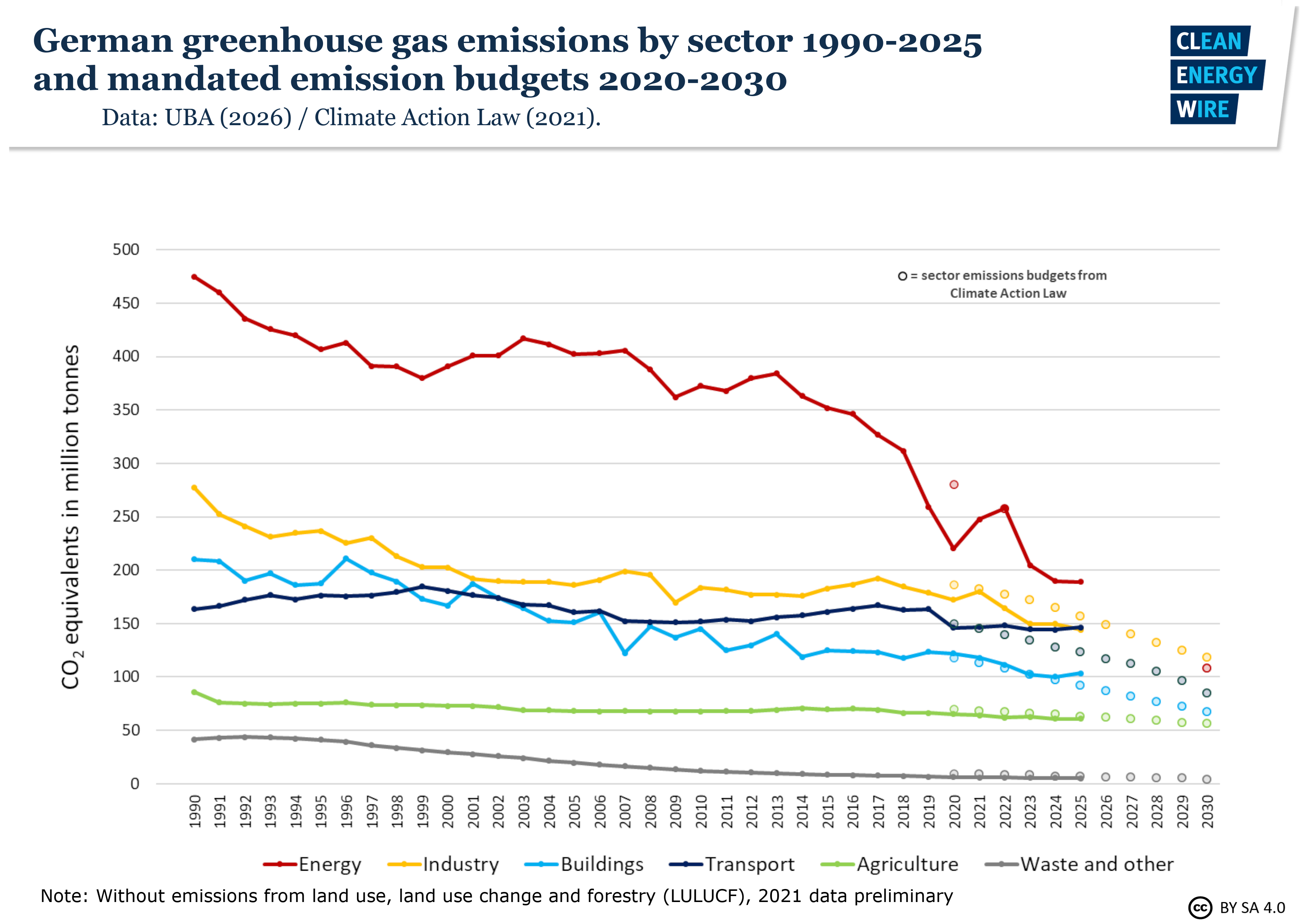
https://www.cleanenergywire.org/sites/default/files/GHG%20em...
Over a 60% reduction in emissions from the electrical sector.
---
Compare that to the US, where environmentalists haven't been allowed anywhere near any influence in the federal government... And you'll very quickly see that they are just a convenient boogieman, and not the actual problem.
https://www.epa.gov/ghgemissions/inventory-us-greenhouse-gas...
That's unrealistic. Climate models aren't good enough to predict the regional-level consequences of large-scale interventions (not to mention that scientists are people, and they might be averse to creating an international flashpoint).
Realistically, it will create/exacerbate international tensions. The monsoon/desertification will be linked to geoengineering with or without scientific consensus and whether or not they were really caused by geoengineering.
As the climate models improve by incorporating active intervention data it will be possible to decrease adverse consequences.
It's a risky approach, but, when the consequences of climate change will become undeniably bad, some countries/individuals might try.
But, yeah, I agree with you in the end.
The very first sentence says:
> The Panama Canal expansion project (Spanish: ampliación del Canal de Panamá), also called the Third Set of Locks Project, doubled the capacity of the Panama Canal by adding a new traffic lane, enabling more ships to transit the waterway, and increasing the width and depth of the lanes and locks, allowing larger ships to pass.
Of course widening and deepening not just the short length locks but especially the long length shipping lanes will take a lot of time.
It's not about who's in charge, its about reading carefully what people state, and the goals ogled. The expansion project you posted was about increasing capacity: wider, deeper lanes enabling larger ships to pass. Now go up the thread, you will see none of us discuss that. We were discussing the absolute waste of fresh water (if assuming BBC reporting to be correct), which yes, can be ugraded without interrupting shipping, in a short time frame.
It's different types of upgrade... pro tip: if you don't understand a word that appears, and it turns out to be physics jargon, perhaps take a step back and consider the person may actually know what they are talking about.
This is such a weaselly statement without your definition of "AI". If you specifically mean LLMs or image generation, you're way out of touch and flat out wrong. If you mean machine learning in general, sure, but progress there was never under any threat or question.
They'd be, like, living in conditions of last decade, deprived of personalised targeted AI-slop? The horror.
Is that immeasurably because it's a change too small to measure, or because it's too vast to comprehend? Maybe you're overstating this just a tad.
As a species, however, we can persist indefinitely so long as our lifestyles are sustainable. If it's not sustainable it's a joke.
Go free solo El Cap or something before telling me you're cool taking those kinds of risks on behalf of all humanity.
I’d really like to hear your reasoning for this.
Were it used to make it practical for people to reduce or stop working while maintaining a comparable standard of living, sure.
It seems far more likely it’s going to wipe out jobs on a massive scale, consolidate wealth, and leave millions or billions struggling to eke out a living.
And it certainly hasn’t made anyone’s life dramatically better. It’s made my job easier, but how much longer will I have it?
> The political criticism in the US (and in Canada where I'm from) against fossil fuel extraction makes no sense.
If you _must_ extract fossil fuel, you can arguably say that it's better to do it somewhere with higher environmental standards (of course, here I'm disregarding people disdain to see wilderness areas they know and have an emotional attachment with transformed into oil fields). But what about _stop_ fossil fuel usage? Sure, it would cost a lot of money. So is AI currently, for doubtful returns. Sure, it would require people changing habits. So has the Internet, and we went through it.
It's like hearing an alcoholic telling you that sure, he still drinks 3 bottles a day but hey, it's Canada-made alcohol, "all in all better than alcohol coming from Russia", right? Yes, I guess it's better for the Canadian economy, but what about just stop drinking?
About your Tesla, deciding to buy without any political consideration is your choice, which you are entitled to. But why would it be impossible to understand someone actually considering the political/social side of things? All your acts and conscious decisions are strictly driven by objective, scientific criteria, never taking into account anything else?
What is Europe's excuse for having such low wages and output despite having more people?
Sure, there might be more transmission constraints or whatever, but those will certainly be solved in time (transmission capacity is more distributed so I'm not surprised it's lagging capacity).
It's not about accuracy, it's about the units people choose when having these discussions
Wermspowke?
Oil and gas production is relatively in elastic taking years to expand.
The extra installed solar and wind generation - as a reaction to increased fossil fuel costs and supply disruption - permanently displaces fossil fuel consumption. No matter what fossil fuel prices do subsequently. Like the massive growth in nuclear generation immediately after the 1970s oil crisis.
Championing the continuing extraction of fossil fuels to be sold for combustion given what we know they do to the planet is not balanced in terms of morality by you driving an EV sorry. We have to abandon fossil fuels for energy asap and we practically can - the tech is available and affordable. The current reliance on fossil fuels - outside of some niches - is a political choice backed by inertia and established and powerful financial interests.
That will be far too late. I mean, nearly the entire EU has reached record temps this year... if not now, then when? Wait until AMOC stops? Does anyone have any idea the havoc that this will create? We will be a dry arctic climate. Ireland and UK first, the rest of us next.
We need multiple Manhattan Project-level projects in the EU, for insulation + renewables + batteries. When we let Northvolt die, I almost cried. Fuck the German bankers who are somehow beholden to Moscow, and we cannot pray for Norwegian money. We need to take care of this shit.
We are more exposed to climate change and economically to China-focused manufacturing than any large group on the planet.
However, we are larger than the USA, we can do this. We have to do this.
Meanwhile, we have to get the entire planet on-board, especially by getting Moscow out of the 19th Century, and their insane imperialist ambitions.
No big deal. At the rate of Reform/AfD/KO/Rassemblement National election projections, we in Europe are entirely fucked.
What the fuck? Forget "EU regulations," is anyone actually paying attention to what actually matters?
And how do you propose we do that if we’re not the ones selling the fossils?
Fossil fuel usage is for the most part, a transaction between willing participants at a fair market price. Will you ban that? How will you enforce it? I hate to be presumptuous, but I assume you’re not a fan of colonialism or wars in the Middle East.
While oil is as valuable as it is for heating, industry, transport, war, and gestures widely at our modern lifestyle. There are two realistic ways to stop it: replace it with something cheaper and better, or genocide.
Neither of these are likely to happen at the scale and timeline required to solve our predicament. But regardless, pretending we can just stop people far poorer than us from striving to meet our standing of living by… asking nicely? It doesn’t help, if your goal is indeed to solve the problem.
We are not all going to "just stop" using fossil fuels. That is not a realistic goal. If it was possible then I'd entertain it. Being religious about this doesn't help make progress because it alienates people. I am all for pragmatic measures that reduce fossil fuel usage globally. Tanking Canada's economy to make zero or negative global impact is how I evaluate some of the proposed aggressive policies. What is happening is that we are funding Russia's war on Ukraine indirectly due to our lack of ability to replace that supply in Europe. That to me feels like obviously bad policy.
I made changes in my life to reduce fossil fuel usage and am considering more. I also try and influence others where I can to make similar changes. I am not optimizing for $'s here, I can afford to spend more and use less fossil fuels. This isn't really to boast or anything, just to say that this approach works for me and can work for others.
My wife boycotts Nestle for political considerations. I sort of get it but also not get it. That's not to say I would never consider something like that but I also am not a believer in the efficiency of that driving change and I don't have time to research everything in enough depth to come to a conclusion about everything I buy. Not buying Tesla for politics X is a very one dimensional decision. I don't understand how to make that decision and so I don't bother.
Sorry that sounds like, if you get murdered than better here because the knives are cleaner.
The point isn't that they're wonderful, it's that they're treated as this thing that only a few have benefited from, when it's exactly the opposite.
It's literally just a couple of decades of effort what separates the scenarios between mild climate change and the accelerated extinction of most of humanity and biomes. All so that Saudi Aramco and Chevron could get a bit more profit.