According to https://futurism.com/science-energy/diarrhea-lettuce-taylor-...
Taylor Farms is "heavily involved in modern-day forced labor."
They contract labor out from AZ Dept of Corrections for $4.75 / hr (but inmates are capped at $1.50 / hr in AZ)
Some of the incarcerated workers were here as non-citizens, detained by ICE, and only then eligible for work / slavery.
If an individual farm has an outbreak they can (usually) source it, eliminate it from the supply chain, and switch to an alternative without any interruption to service. That also means you want as large of a geographic distribution of your farm network as possible. (I'm looking at you, Yuma Valley - a semi-regular source of e.coli outbreaks).
As a bonus, the supply chain is much more efficient at this scale. Small farms can have their salads packed in nitrogen filled bags for longer shelf life and less waste.
Fresh leafy greens are naturally just one of the toughest and most vulnerable supply chains. The disappointing answer (like in a lot of these situations) is that being bigger and more massive company is what makes the product better.
My armchair assessment is the best way to push back is for farmers to join together into co-ops and find a middle ground between the efficiency of scale and the concerns of food safety and ethical working conditions.
Food packaged and distributed by these mega-suppliers probably has less human handling through the supply chain than any other food, and they have lot numbers and sources logged for all of it, which allowed them to quickly pinpoint the farm that was the source of the Cyclospora outbreak.
There are downsides to the consolidation of food suppliers, to be sure, but food safety is probably better for it.
“The only social responsibility of the government is to increase campaign sponsor’s profits”
Completely anecdotal, I see lots or recalls from smaller producers I’ve never heard of, I can imagine they have less scrutiny and oversight.
2) Taylor farms is paying 4.75, the government is the one paying 1/3 of the cost price to the worker.
The high efficiency gains and safety disregard the environmental impact caused by pesticides and agrochemicals in general. These are much less of a concern in small farms when they have much less pressure to increase food yield per area.
Except now it's our food supply that's wiped out by the consolidation. I haven't bought bagged lettuce in months in response to this outbreak.
Smaller organizations means redundancies and options. Redundancy is the same thing as saying inefficiency. Redundancy is good.
With the elevated standards of megascale agriculture you have the issue now where diseases from a lettuce farm in Mexico could affect somebody's health in NYC a month later in a way that simply wouldn't be possible in a previous era.
There's no complete solution but in this particular case it's important to remember that salads are actually pretty serious foodborne—illness vectors and they need to be heavily rinsed and ideally cleaned with a bleach or vinegar solution. It's one of the reasons that salads are traditionally on the no-eat list for pregnant women.
Today, if it was a mandate you could slap a label on every vegetable and track it back to the field it was grown.
I think most Americans would be shocked as to where their food comes from.
I suspect that a lot of Whole Foods shoppers would be a bit miffed to find out that the lettuce in their salad kit also ends up on a macdonalds burger.
Everyone is invested in maintaining the illusion. And that collision is rampant across all of food: Pepsi price fixing with Walmart, the price of beef at retail being long decoupled from wholesale / Agri Stats...
With appropriate regulation and enforcement I agree with you, but in the current regime, I’m not surprised that foodborne illness in America has 10x in 2026.
[0] https://www.nytimes.com/1970/09/13/archives/a-friedman-doctr...
The jist is that a lot of this is from consolidation at all levels. There are fewer grocery stores and distributors which has ultimately made hard to know where food ultimately comes from.
Couple that with deregulation and the dismantling of the government regulatory agencies under DOGE and we get what we have.
> but if you think the people selling lettuce at farmers markets or farm stands have any verified food safety or food handling expertise, they don't.
FUD. While we know the mega farms don't because they kill every year through corner cutting. But keep spraying your salads late in the season with human waste water, keep bleaching your chicken and keep telling yourselves that they follow best practices.
The United States has allowed many industries to consolidate, but the fines they face when they mess up are infinitely small compared to their size.
In the former example, there's far more pressure on the smaller companies, which is why in such a regime people expect more consistent quality from the big guys, and the smaller guys are often boutique in some way (=offering something unique in their service/product in order to be able to compete). Small guys have a hard time standing up to big guys.
On the other hand, in a regime where no one becomes that huge, like the latter example, there's still pressure, but the competition is fair, just like if all the companies were similarly big (except that you can't have that many big companies in a single industry, by proportion definitions).
Realizing this drove home why inconsistent antitrust enforcement appears to produce bad results. Because it leaves us in the state of the former example. It's also unfortunately the intermediate state of getting serious with antitrust enforcement.
Direct-from-farm delivery boxes are a better bet, at least the mainstay ones, but they’re certainly more expensive and the variety is more obviously seasonal (as you would expect).
Neither of these is a solution to nutrition at scale. It’s difficult to balance the economies of scale that consolidated distribution brings against the corruption that comes along with increased supplier leverage. Monopsony is just as pernicious as Monopoly (and they tend to feed each other, with large grocery and restaurant chains preferring large distributors).
I don’t think they have the oversight corporate farmers do. But I also don’t think they put immigrants into the field for 12 hour days with no breaks and no bathroom.
There’s something to be said for a farmer who doesn’t pass explosive diarrhea onto the crops he sells me as food….
Like.. before? When we didn't have nationwide food recalls that had seeped into nationwide fast food chains and bagged products distributed into every commercial food selling outlet, under a myriad of different names?
Not only is the blast radius smaller, but small businesses are less incentivized to cut corners since serious violations pose a greater risk to their business than large businesses. Corruption is essentially legalized in America via lobbying, but only big companies can really afford to lobby and make huge campaign contributions to sway the government in their favor.
Government is meant to be a check on businesses, but that completely falls down once business is big enough to buy the government. It wouldn't surprise me if quality control at large companies is worse for the simple fact that they know who to pay off if they get caught, as Taylor Farms has here.
> "In each of these cases, the corporate executive would be spending someone else's money for a general social interest. Insofar as his actions in accord with his 'social responsibility' reduce returns to stockholders, he is spending their money. Insofar as his actions raise the price to customers, he is spending customers' money. Insofar as his actions lower the wages of some employees, he is spending their money.
> The stockholders or the customers or the employees could separately spend their own money on the particular action if they wished to do so. The executive is exercising a distinct 'social responsibility,' rather than serving as an agent of the stockholders or the customers or the employees, only if he spends the money in a different way than they would have spent it.
> But if he does this, he is in effect imposing taxes, on the one hand, and deciding how the tax proceeds shall be spent, on the other."
His point wasn't that businesses can't act ethically or with responsibility, it's that they shouldn't act to become welfare centers and corporate philanthropies (which was a trend at the time). And I think even the most anti-capitalist person would agree that corporation acting "charitably" should be treated with a huge eye of skepticism.
Not to diminish this for anyone affected, but the safety of driving cars is far worse than that and most of us do that daily.
I never stopped buying or eating lettuce.
Redundancy may be inefficient, but you can also build redundant systems that looking at from a micro perspective seem inefficient but what you see is only a local inefficiency; if you distribute their effects far enough in space and time you find that they are actually at a macro scale more efficient than not having them because they prevent breakdowns that destroy all the smaller systems held within the bigger one.
I say this as someone who gets most of my veg from a local CSA. It's not because I think it's safer. It probably isn't.
https://press.princeton.edu/books/paperback/9780691004129/no...
which is a book that I enjoy less now than the first time I read it. He was worried that shipping and aviation were both going to get more dangerous whereas that perception of a safety crisis in shipping in the 1970s went away and aviation got much much safer.
It's definitely an extremely exploitative situation and overall icky, but the people who jump in to compare it to slave labor are kind of embarrassing themselves in unnecessary hyperbole.
1) Why? The source was quickly identified, and it's trivial to avoid the tainted supplier.
2) Why only now? Bagged leafy greens are notorious for outbreaks. The extra processing steps means greater opportunity for introducing contamination (more people handling the produce), and greater opportunity for cross-contamination.
This food safety expert/activist/litigator has explained both of those points many times: https://www.marlerblog.com/ Though, being middle-aged and perhaps with better-than-average recollection, I connected the dots to bagged leafy greens years ago, across many news cycles, and to the risk of food poisoning from vegetables generally, through hard, personal experience.
These are two unrelated events though.
Other consolidated suppliers have had events in the past, and they did not 'wipe out' our food supply because they identified the root cause and the impacted supplies, initiated a recall, and the rest of their redundant, distributed systems remained intact.
The issue going on with Taylor Farms isn't their consolidation, it's their lack of taking responsibility.
If we had 20 'local' distributors who were all bought by Taylor farms and one of those locations had a significant health issue, there wouldn't be a large issue if Taylor identified which one had the failing and then distributed their other 19 location's product to the area facing the shortage due to it's location's product being recalled.
Have you ever ate prison food? I literally would not feed most of it to my dog.
Bubba flipping burgers getting his dirty hands on your meal might make you sick, but Bobba inspecting the meatslop production line with constant pressure from upper management to be as efficient as possible according to whatever recent regulations were stripped back might accidentally spray the horse-meat product decontaminizer on the pig-meat product, generating a national pandemic.
This is because many states are full of people who are both weirdly "Free market" brain, to the point that they believe it's a good idea to tell the warden "Any dollar from this budget that you do not spend feeding inmates, you get to personally keep" is a good idea because they have no knowledge of systems design or perverse incentives, and more importantly, because they genuinely want prisoners to suffer. No, this is not a joke. In some states, the budget for feeding inmates is explicitly a compensation package for the warden.
When people joke about "I should go to jail, at least I will get three square meals a day", that's just false. Most prisons are only required to serve two meals a day. The quality of those meals varies from "Okay for a middle school lunch if you put a gun to my head" to "Fyre festival had better food, and this is not a joke"
That still is massively undercutting regular wages, it's government price dumping. The ethics of prison labor aside, whoever buys prison labor should be forced to pay fair market wages to the prison.
I would fully support such a mandate, for meat products too.
It would be interesting, giving consumers more information is nearly always better, it opens the door for open source analysis, the 2nd and 3rd order effects would probably be mostly harmless and highly entertaining.
>I suspect that a lot of Whole Foods shoppers would be a bit miffed to find out that the lettuce in their salad kit also ends up on a McDonalds burger.
They're be too busy being angry that "BNSF Alliance Intermodal Facility, Haslet Texas" is in fact not an avocado farm.
It's good that that plant is so well-run. But America doesn't lack for less well-run large meatpacking plants. Remember Boar's Head? - https://news.ycombinator.com/item?id=41403919
Except AWS doesn't fall over, regions do. The problem isn't using one provider, it's that everyone uses one region of that provider. When that region goes down, so many people report outages that it seems like AWS as a whole went down, but it didn't.
Same basic deal with Taylor Farms. It was only lettuce sourced from Central Mexico, and it was distributed to the east coast and some central states. Page 18 of this PDF (https://www.taylorfarms.com/wp-content/uploads/2025/09/Taylo...) shows all the growing regions. Of all 22, only 1 sent out bad lettuce. But popular opinion is that the all of it was bad.
So the risk wasn't their scale. If anything, the risk was their customers (the walmarts, costcos, krogers, etc) not labeling where it came from or more stringently tracking these things or planning for an "incident". None of this is new, everybody knows leafy greens are the most likely source of food poisoning.
Just like AWS isn't to blame when customer sites we depend on go down from one bad service in one region, we shouldn't be blaming Taylor Farms. We should be blaming the customer-companies we all use who didn't plan for a very predictable failure.
So facility risk seems similar or higher for the local shop, depending on specific people running it, but animal-bourne risk seems higher at the packing plant, which seems to be the more likely vector to me anyways.
No data on that. But qualitative experience shows the local farmer/butcher has much nicer/fresher looking/smelling meat than the Walmart.
We're working against the desire to get the basic needs of life (in this case, food) met for the lowest possible price.
No; you can't have redundancy without inefficiency, but you can have inefficiency without redundancy.
The new dealers can be counted on one hand (they're the ones 70+) while the neoliberals have been at the helm for 40 years.
(That's what makes this recent outbreak so atypical - either there was a massive screw up or someone is hiding something).
People also are not aware that the US has (or at least had) one of the most meticulous food inspection regimes in the world. Agency inspectors actually drop in and inspect facilities regularly. The EU might have more stringent food regulations, but as a reminder people were able to slip horse meat into the beef supply for decades before being caught - something like that would be inconceivable in the US.
Right, and the issue with the King of England wasn't the consolidation of all power in his hands, but rather him not taking responsibility for everyone's welfare.
It really, really is not. They are massive and are a supplier for a huge number of restaurants.
Good time means you get to exit the prison for things like visiting family.
The prisoners are coerced to work for sub-human wages because, if they don’t, they stay in prison longer and can’t see their loved ones.
**A Farm Action report
August 2026
**Research and analysis by Sarah Carden, Colleen Fulton, Angela Huffman, and Caroline Nodus
Written by Jessica Cusworth
The 2026 Cyclospora outbreak has sickened thousands of people across the United States and killed at least two. In July, the U.S. Food and Drug Administration (FDA) linked the outbreak to shredded iceberg lettuce served at Taco Bell and supplied by Taylor Farms, a company most Americans had never heard of despite its enormous reach.
Taylor Farms’ products are in grocery stores, restaurants, schools, hospitals, and prepared foods, often under other names. That extensive and often hidden reach raises questions that go far beyond this outbreak. When so much of the food supply runs through a single company, a problem can quickly affect people across the country.
This report examines how Taylor Farms became one of the country’s largest produce suppliers, how far its reach extends, and what that power means for food safety, farmers, workers, and competition. It also looks at the company’s political influence, raises questions about government oversight, and recommends policy changes to strengthen food safety, competition, transparency, and public accountability.
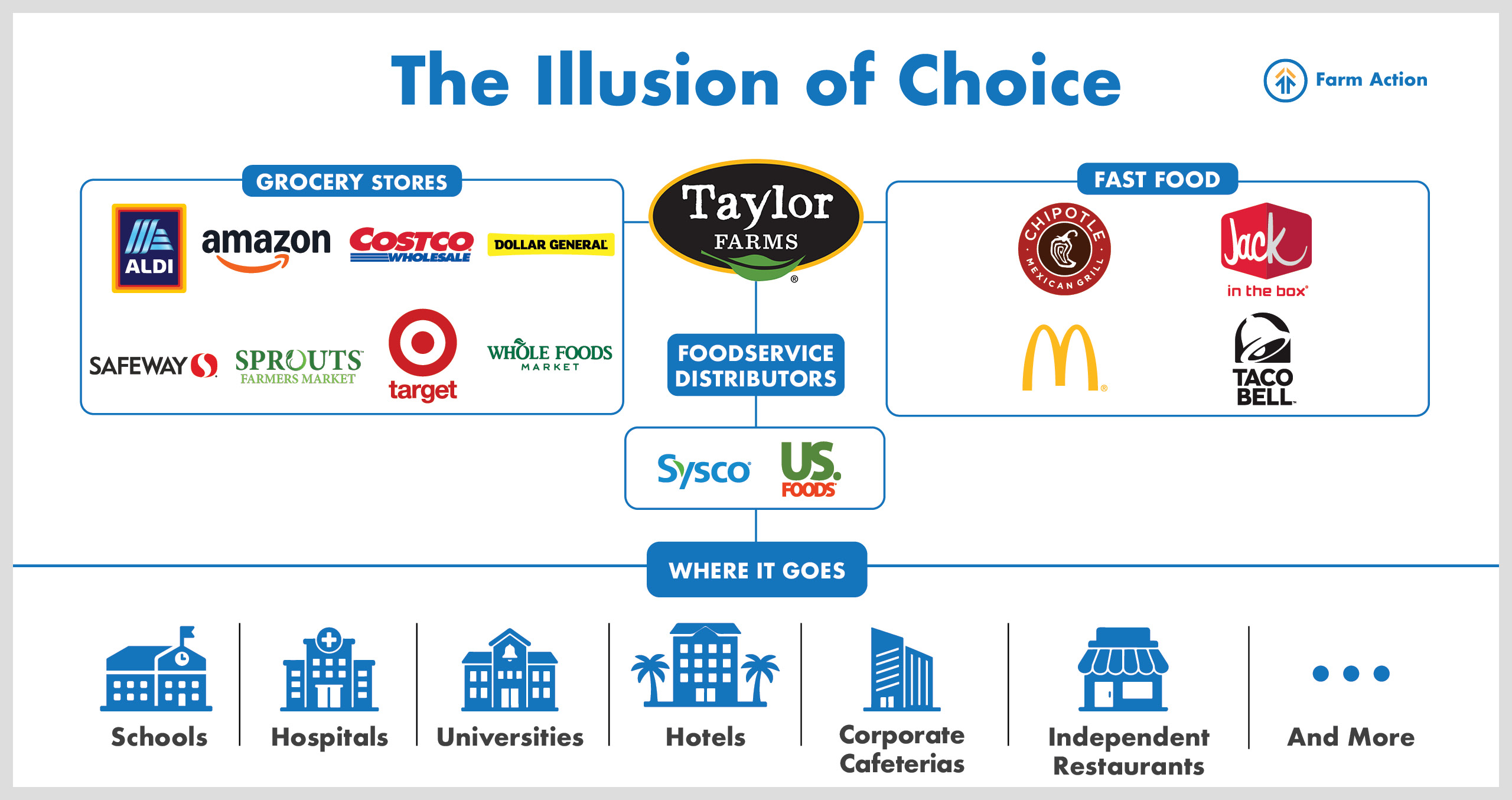
Taylor Farms products are nearly everywhere, often under other brands, making one supplier look like many.
Founded in 1995, Taylor Farms has grown into a $7 billion company with more than 25,000 employees and 30 processing facilities across the U.S., Canada, Mexico, and Europe. It produces more than 265 million servings of fresh food each week, making it one of the largest companies in the U.S. produce system.
Its products extend far beyond its own brand, including salad kits, fresh-cut vegetables, prepared meals, organic products, and more. Taylor Farms produces 40% of the salad kits sold in the country and grows about one-quarter of its own vegetables, sourcing the rest through partner farms. That makes it a major link between farms and some of the nation’s largest food buyers.
Taylor Farms products appear in grocery stores, restaurants, prepared meals, and institutional kitchens, often without the Taylor Farms name attached. Consumers may see many different brands, while much of that food comes from the same supplier.
As a privately held company, Taylor Farms does not publish a full customer list. Public records and recalls have linked its facilities to products sold through retailers like Kroger, Trader Joe’s, H-E-B, Meijer, Albertsons, and Walmart, as well as foodservice distributors like Sysco and US Foods that supply schools, hospitals, hotels, and more.
This means its reach is often hidden from consumers and difficult to track. That invisibility shields its market power from public scrutiny and sows confusion during an outbreak.
Taylor Farms’ rise was shaped by decades of consolidation across agriculture and the food industry, enabled in part by public policies that allowed companies to grow larger and markets to become more concentrated. Grocery chains, restaurant companies, foodservice distributors, processors, and other large buyers have consolidated, leaving fewer and much larger companies buying produce.
Those buyers increasingly wanted fewer, larger suppliers that could provide high volumes of produce year-round, deliver it across the country, meet consistent quality standards, produce private-label products, and handle the work of getting food from farms to stores and restaurants. That favored large grower-shipper-packers (GSPs) that could meet those demands. Today, an estimated 80-90% of fresh produce is marketed through these companies.
Taylor Farms is one of those GSPs. As it grew, the company bought other businesses, built processing facilities, and developed a sourcing network spanning multiple regions and countries. Like other large GSPs, Taylor Farms sources produce through regional and international networks rather than relying primarily on nearby farms. That helps explain why investigators traced lettuce implicated in the 2026 Cyclospora outbreak to Mexico, even in the middle of summer when much of the U.S. is capable of growing lettuce.
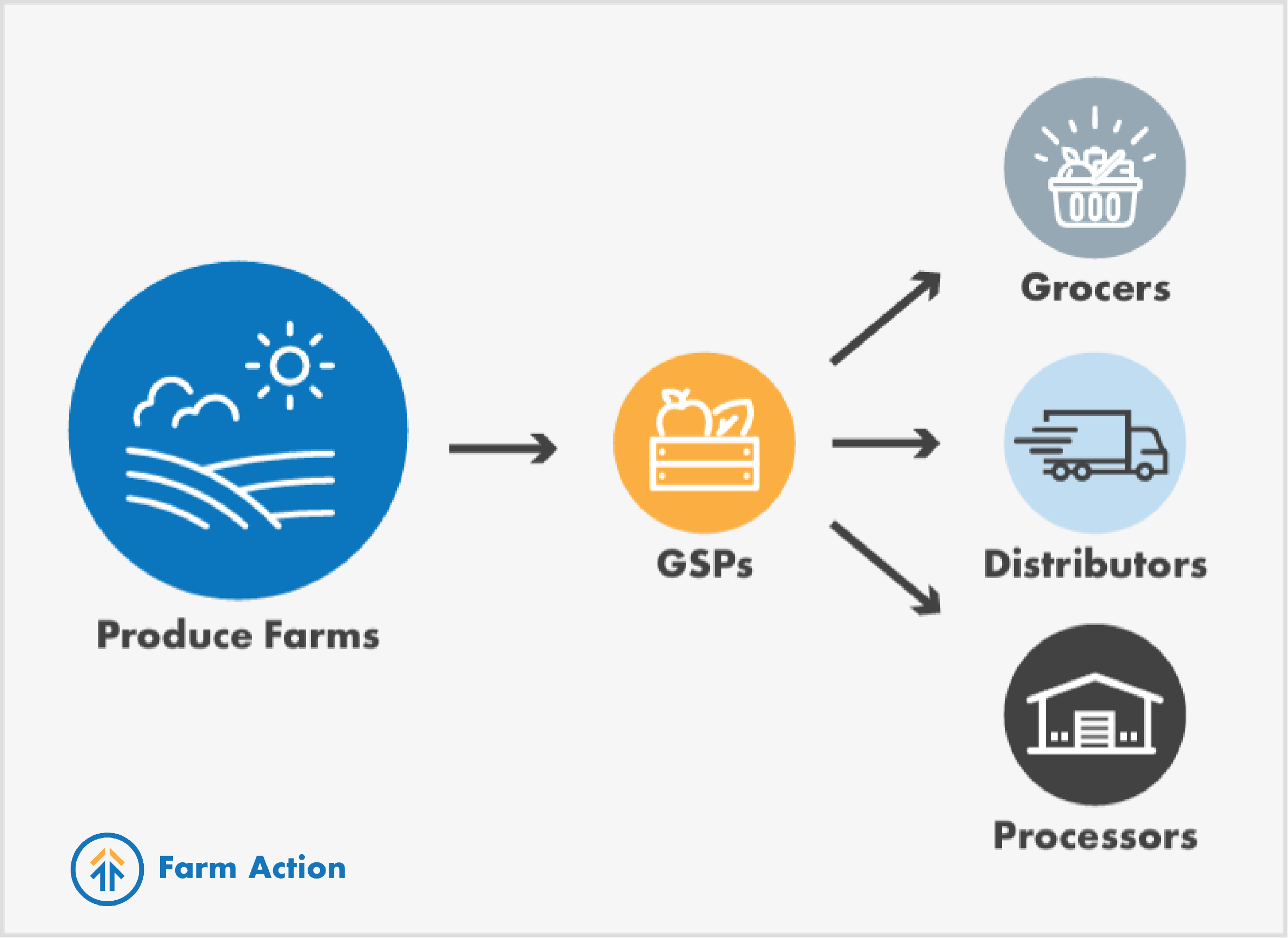
Grower-shipper-packers (GSPs) like Taylor Farms have become key gateways between farms and the companies that sell food across the country.
As Taylor Farms expanded, it became a major link between farms and national grocery stores, restaurants, and foodservice companies. As buyers consolidated and markets became organized around large national contracts, companies that could operate at this scale gained an advantage, giving the largest suppliers more control over how produce moves from farms to consumers.
That concentration of power comes at a cost. The larger a company’s reach, the greater the consequences when something goes wrong.
Those risks are compounded when a company’s reach is largely hidden from public view. Consumers often have no way of knowing when they are eating Taylor Farms products, leaving regulators, researchers, and journalists to piece together the company’s footprint during a food safety investigation.
Taylor Farms has been connected to several major food safety events, including the 2026 Salmonella outbreak linked to jalapeño products, previous Cyclospora outbreaks, the 2024 E. coli outbreak linked to McDonald’s onions, the 2021 E. coli cluster involving romaine lettuce, and numerous recalls for allergens, labeling errors, contamination risks, and processing defects.
These incidents do not by themselves prove a pattern of systemic problems. But Taylor Farms’ repeated connection to major outbreaks and recalls warrants a closer look at whether these are unrelated incidents or signs of recurring weaknesses.
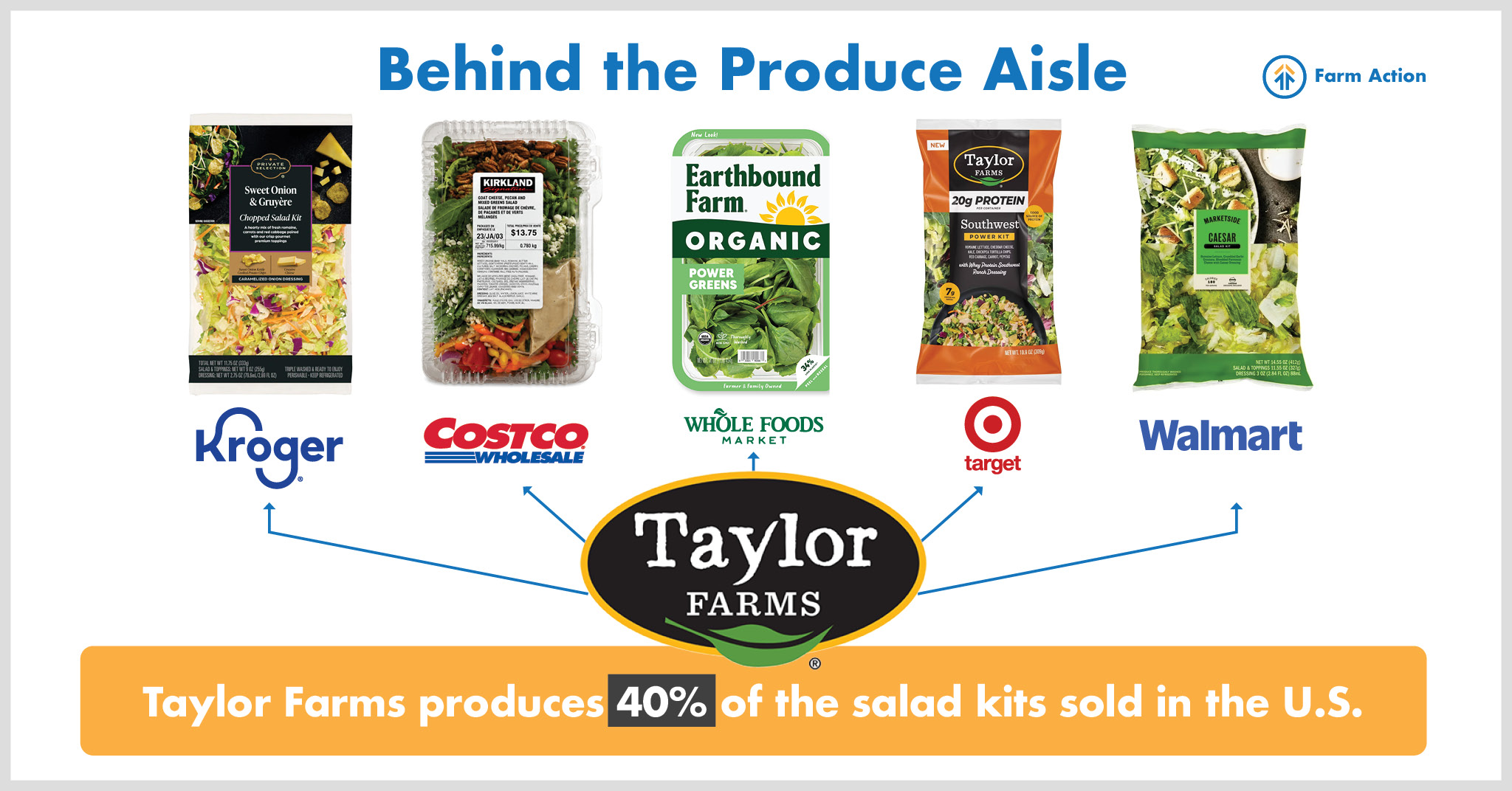
Taylor Farms’ growth has made it a major supplier behind the products lining grocery store shelves.
The same forces that fueled Taylor Farms’ rise reshaped produce markets to the detriment of farmers and smaller competitors.
As the food system consolidated in recent decades, farmers lost many of the independent buyers and markets they once relied on to sell their produce. Instead of selling to many competing buyers, farmers increasingly rely on a smaller number of large GSPs and other buyers to reach the market. This creates higher barriers for independent farmers, regional suppliers, and new competitors trying to access the market.
With fewer buyers to choose from, farmers have less leverage in negotiations over prices and services. Many have little choice but to accept the terms they’re offered. Over time, that shift has contributed to a shrinking number of small and mid-sized produce farms and greater concentration among the largest farms and suppliers.
Taylor Farms’ rise shows how a system built around scale can create powerful gatekeepers between farmers and consumers.
Taylor Farms’ massive operations depend on thousands of workers who process, package, and move its produce. Its workplace safety record includes serious violations and worker complaints.
Taylor Farms has paid more than $1 million in penalties for violations cited by the Occupational Safety and Health Administration, including machine hazards, chemical exposure, electrical hazards, sanitation failures, amputations, and a fatal workplace incident.
Workers and labor organizations have also raised concerns about retaliation, low wages, temporary-worker practices, hazardous conditions, and inhumane treatment. In 2013 and 2014, workers at Taylor Farms’ Tracy, California, facility reported pressure not to use the bathroom during shifts, being denied meal breaks, and being fired after injuries. They also accused the company of retaliating against workers who organized for better pay and working conditions.
These conditions do not establish that Taylor Farms’ labor practices caused the Cyclospora outbreak. However, they do raise broader questions about how a company operating at this scale protects its workers and is held accountable for workplace safety.
Taylor Farms’ power extends beyond the produce market. Its size gives the company financial resources and access that smaller farms and businesses do not have, creating more opportunities to influence the policies and regulations that govern its industry.
Taylor Farms and its CEO, Bruce Taylor, have donated millions to Republican and Trump Administration-associated political action committees (PACs) since 2025. This includes a $1 million contribution to both MAGA Inc. and a super PAC dedicated to electing House Republicans. Taylor Farms has also spent $810,000 on lobbying since 2025.
Taylor Farms also hired a former White House official. And on July 16, the same day the FDA and the Centers for Disease Control and Prevention announced their investigation into the multistate Cyclospora outbreak, Taylor Farms executives met with White House and FDA officials. Administration officials said Taylor Farms sought to distance itself from the outbreak and questioned the government’s conclusions. This meeting shows the level of access Taylor Farms had to federal decision-makers while its interests were directly at stake.
Taylor Farms has another avenue for influence through industry trade associations. Bruce Taylor has held notable positions in the International Fresh Produce Association, the Produce Marketing Association, and Western Growers. Large companies like Taylor Farms have more resources to help shape trade association positions, which can then be presented to regulators and policymakers as the voice of the broader industry.
The FDA’s Food Traceability Rule provides an example. Trade groups connected to Taylor Farms pushed back on aspects of the rule and its implementation before the agency ultimately delayed its compliance deadline.
Political contributions and lobbying do not prove that government decisions were influenced by Taylor Farms. However, when a company holds a major position in the food supply, its financial resources and political access can give it a stronger voice in shaping the rules that govern its industry.
That imbalance raises a broader concern that the companies with the most market power also have the greatest ability to influence the policies meant to hold them accountable.
The problems documented in this report stem in part from policies that have allowed a small number of companies to gain enormous power over how our food is produced, sold, and distributed. Our policy recommendations would restore competition, give farmers more ways to reach the market, strengthen food safety and traceability, and hold powerful companies and government decision-makers accountable.
View the full policy recommendations (PDF).
Farmers have fewer buyers to choose from, while large produce companies have gained more control over how food moves from farms to consumers.
Heavy reliance on large national suppliers can make communities more vulnerable when one supplier has a problem.
Federal policies currently reinforce the growth of the largest farms and suppliers instead of helping maintain a diverse farm economy.
Powerful companies have greater access to the government officials and institutions responsible for overseeing their industries. Greater transparency and stronger safeguards are needed to ensure that public decisions serve the public interest.
Strengthen conflict-of-interest and revolving-door rules for senior food safety officials to prevent companies from gaining an unfair advantage through government connections.
Restore routine disclosure of White House visitor logs so the public can see who has access to federal decision-makers.
Require FDA to review major multistate outbreaks after they end and publicly identify supply chain weaknesses and steps to prevent similar problems.
Consolidation has created sprawling supply chains that can make it harder to trace contaminated food back to its source, especially when products move through multiple companies and brands.
Building a more competitive and resilient produce market will require policy change, but consumers and communities can also support alternatives to the dominant national supply chains.
Buy directly from local farms whenever possible through farmers markets, community-supported agriculture programs, farm stands, and direct online sales.
Ask grocery stores, restaurants, schools, and institutions where their produce comes from and encourage them to source from local and regional farms.
Advocate for public policies that strengthen competition, transparency, and market access for independent farmers.
STOP THE FOOD OUTBREAKS. HOLD POWERFUL CORPORATIONS ACCOUNTABLE.
Taylor Farms didn’t become one of the nation’s largest produce suppliers just because consumers preferred its brand. It grew as grocery chains, restaurant companies, distributors, and other buyers consolidated and increasingly demanded suppliers that could provide large volumes year-round, serve customers across the country, and produce food under other brands.
The Cyclospora outbreak put the spotlight on Taylor Farms, but the questions raised by this report go beyond one company or one outbreak. Taylor Farms’ reach shows what can happen when a small number of companies gain enormous power over how food is sourced, processed, and sold, while much of that power remains hidden from the public.
A more resilient produce system requires more than better practices from the largest companies. It requires more competition, more ways for farmers to reach the market, stronger oversight, greater transparency, and policies that stop rewarding consolidation.
The other side of it is that many forms of contamination sporulate, so short of using a powerful surfactant to wipe it all away, the spores will survive basically forever until they hit growing conditions.
The mixed messaging certainly didn’t help.
One day it’s Taylor Farms and the next the FDA was apologizing.
And even once it was found to be Taylor Farms, you can’t control every Taco Bell or anything else.
Mostly it just killed any consumer confidence in greens
That whole "he is in effect imposing taxes" thing is ridiculous. Taxes are forcibly collected by the government, not voluntarily spent by a business. Businesses are not the military, executives are not obligated to follow orders. If the stockholders don't like what an executive does, they can fire the executive and hire someone else. An executive who wants to keep their job therefore might be wise to stick to what the stockholders will like. But they aren't doing anything wrong if they don't, any more than an employee is doing something wrong if they disobey their manager.
It also misses the idea that a lot of misbehavior by companies is stuff that's bad for the company, but they do it anyway because of stupidity, shortsightedness, coordination problems, or the incentives of decisionmakers not lining up with the consequences for the company they work for. Or rather, it doesn't miss the idea but explicitly dismisses it; anything that is actually good for the company is defined by Friedman as not being "social responsibility."
We also stopped buying lettuce.
i guarantee you that first number is wildly non-illustrative of the reach of this outbreak.
this "whattabout"ism is brought up during every safety discussion. can we please accept that 1/ everyone knows about the car issue, and 2/ the car issue being a problem does not mean we should stop talking about other issues that exist.
This is not a data exercise, this is real life and 1 person getting sick from this stuff is too much.
But, again, that's not a Taylor Farms issue, that's a government issue.
Personally, I think it's a very good thing to let prisoners work as long as the working conditions are the same standards as free people, including any wage laws.
Prison is not voluntary.
Tomatoes prove your point better, but I still would never eat any of the tomatoes in an NYC supermarket in the winter, as they don't taste much better than soggy cardboard.
Isn't that not the actual choice though?
Like for a prison with monetary advantages to the inmates working don't they actually send you to solitary for refusing work detail?
This is an incredible claim, so I'm trying to find out where you got that from. Seems like maybe that was just in Alabama and they changed the law already?
https://www.latimes.com/nation/la-na-alabama-prison-meals-la...
https://law.justia.com/codes/alabama/2024/title-14/chapter-6...
follows with wall of vibes
LOL
Number of times the lettuce I grew at home this year made me shit a tsunami: 0
Number of times lettuce I bought at the store this year made me shit a tsunami: 1
Also, if you worked 8 hours you'd be able to buy a lot more than a single pack of ramen.
> While ramen costs about 35 cents at Target, prison commissaries charge between 24 cents to $1.06 nationwide.
https://theappeal.org/locked-in-priced-out-how-much-prison-c...
These are all right within the USDA's general population daily calorie guidance of 2-3 thousand per day for males.
There's your problem. Ground products are completely dispensable.
You've got some weird looking hands :)
They give farmers a 500 page document describing in detail how the produce must be grown, but then they provide little to no actual oversite, while producing enormous pricing pressure on the farmer. Any farmer who actually follows the 500 page document will not be able to make any money, so every farmer is compelled to violate the rules.
Then when product is contaminated Driscoll can say "that farmer wasn't following our policy we've cancelled our contract with them" while making no effort to actually clean up all the other farms, who are definitely violating the contract because it's impossible to follow it and make money selling to Driscolls.
What volume brings is increased odds of one of them introducing/reinforcing a contaminant, especially if they're from a CAFO, which are horrifically unsanitary. Again, there's a reason industrial operations have apparently higher standards. When Mad Cow disease was spreading, it wasn't because a local butcher was lax wiping things down, it was because cow brains were being recycled into cow feed and sold across North America on an industrial scale.
You are almost certainly not reflected in those numbers.
People are very prone to overweight the risk of things that are prominent in the media.
You may not wish to hear this, but real life is very much a data exercise:
We do hold food safety to a high standard. We have some of the highest standards on the planet.
In any case, it's a good barometer for judging personal risk. I don't stress about the danger when I get into my car, so I probably shouldn't stress about the danger from something substantially less likely to take me out. It contextualizes a number by comparing it to something most of us do every day.
But I can't source what I said.
What I can source is that prisoners largely report going hungry. That's a completely different problem though.
I cannot remove or edit my comment. Thank you for the push back.
Supposing cows yield a better ratio of cut to ground meat (we've been breeding them for meat production and process them on an industrial scale), you'd still have to raise and kill a whole lot more cows to satisfy the world's current beef demand. I think good food safety practices and accepting a low, controlled risk of food-borne illness are justified by not having to kill as many animals.
[0] Not looking to start a discussion about the ethics of hunting. Not being in meat processing, this is an example I have first-hand knowledge of.
I’ve argued in systems reliability that once you are already high reliability you are better off lowering incident size vs total unavailability.
The reality is that the documentation is like software T&Cs. You get to run your farm however you want and Driscolls has some CYA for later.
The reality cuts both ways. You can still sell produce directly to local grocery distributors that pay higher, but the requirements are going to be even more stringent with less guarantees.
But doesn't toxoplasmosis come from owning cats?
Nope. The correlation between cat ownership and toxoplasmosis is basically zero. Because toxoplasmosis comes from stray cats who poop in your garden and you catch them through the gardening. Something like 40% of toxoplasmosis cases come from gardening with people unaware that stray cats poop there. (The majority comes from eating undercooked food, like pork, because the pork grazed in fields where there was stray cat poop.)
So essentially doing your own gardening creates a risk vector that is significantly less present in industrial-level gardening of vegetables.
By logic, a Driscoll or Taylor Farms set of rules needs to sit beyond the regulatory minimum (their lawyers would hate them putting a violation of the regulation in writing).
So, even if a farmer violates the contract, the existing regulation is either insufficient or was also violated.
[0] https://www.newsweek.com/donald-trump-cdc-food-net-monitorin...
1) you're taking my comment too seriously.
2) assuming I had enough space to subsistence farm for my household (I don't), I wouldn't try growing lettuce year-round. Lettuce in the cooler months, peppers and tomatoes in the warmer months.
3) the majority of the lettuce I've prepared in my home this year did come from my patio
This is more a culinary and ethical argument than efficiency or safety. One should use the whole animal, in all its varieties, because they're delicious. Grinding otherwise edible parts of an animal killed on one's behalf because one disfavors (or is repulsed by) them seems to me much worse than the killing. Eat - and enjoy! - all of it or don't kill it.
Why? For years, Tyson Chicken gave written instructions to its undocumented employees on how to stay under the radar for employment, insurance, immigration, tax and healthcare.
One of the big issues with a company like Taylor Farms is that when something like cyclospora hits, we all discovered that the grocery store and restaurants really only had an illusion of choice. Nearly all the lettuce products were actually just Taylor farms. That means the only option for consumers to pressure the company is to stop eating lettuce all together. Healthy competition means these distributors will care a lot more about an outbreak like this because it'll drive people to their competitors rather than just being a blip in this quarter's budget. Markets only work when there's an actual market and not just a single player.
But further, yeah I do think the FDA needs a more active role in doing compliance checks. Ideally this isn't the job of the FDA and instead gets rolled into the USDA or a separate agency dedicated to food products. Having one big agency in charge of both food and drugs isn't great as drugs has ended up with all the actual investment.
Big companies are good at reducing cost, but one way they do that is by making liabilities someone else's problem. The bigger they get, the more they do that. It's a key reason why companies like Walmart are constantly being found to employ slave labor through their contractors. Walmart can rehire the very same contractors (but rebranded) after the controversy blows over and rinse/repeat.
The same dynamic exists with these mega-distributors.
Also, the GP doesn't read to me the way you're interpreting it. To me the GP has grown produce and purchased produce this year. The purchase hit him while the grown at home did not.
https://www.fda.gov/food/people-risk-foodborne-illness/toxop...
But it does cripple our ability to ask if this was a one-off, or if we're seeing long term trends that should be worrisome.
A few lucky people live in the densest urban areas where car non-ownership is totally fine, nice even. For the rest, it's horrible and no one would choose it. A trip to the grocery store in the suburbs could take 30-45 minutes each way in 90º heat (and in half the country, with humidity too) is terrible - and think how many times you'll have to go to the store if you're buying only what you can carry 3 miles. Also many school districts provide no buses, so now you're walking kids to and from school in all weather. Bikes are a thing, but the roads aren't always safe and it still sucks in weather.
Who are you to say that it's wrong for me to enjoy some parts of the animal ground up, versus in their original shape? Either way the entire animal is being eaten and enjoyed, so there's no reasonable moral basis on which to say it's wrong. Your position would make sense if people were throwing away the cheek, tongue, etc but we aren't.
It’s definitely better to freeze the left over bits and grind it yourself, but half the animal gets ground up regardless.
> If you're growing food to sustain yourself for a whole year, I'm assuming you're willing to sacrifice some indoor space to accommodate.
It would be unheard of for it to contain enough space to produce the family's annual supply of food. And pointless. If you're growing that much food, there's no reason to build walls around it.
Like, it's not like we're scrubbing every crevice of every leaf with soap. We're spraying some water on a whole pile of it, and then like shaking it off or spinning it. It feels like theatre more than it does food safety.
And I'll confess, I don't even buy or consume fresh produce normally, besides apples and bananas.
For all animals on earth, you can't really get by without food. This is jus a fact.
Having looked into it, it's not clear at all how to do better at home than hosing it down with some plain water and spinning it dry-ish.
Soap ruins leafy vegetables. Dilute bleach seems strongly frowned upon. Vinegar doesn't necessarily kill enough things well-enough.
And water is just water. The efficaciousness of it reminds me of the handwashing scene from Pulp Fiction. https://www.youtube.com/watch?v=o4fDsq0k2rI
I grow leafy greens in containers, and while not totally self sufficient, it provides a decent amount. I have multiple pots that I rotate through offsetting planting so new seedlings are going in as older plants are harvesting. If you're wanting head lettuce types then it's different, but if you just want leafy greens, you can totally do more than I think you're thinking you can.